Recombinant Human Mitofusin-2 (MFN2) Protein

Recombinant Human Mitofusin-2 (MFN2) Protein — Mitochondrial outer membrane GTPase that mediates mitochondrial clustering and fusion. Purity >85%.

SKU: BCRECP-00068TM Category:

Product Specifications

Uniprot No.O95140
Gene NamesMFN2
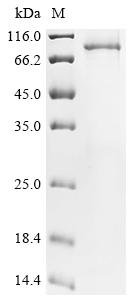
PurityGreater than 85% as determined by SDS-PAGE.
Expression Systemin vitro E.coli expression system
Expression Region1-757aa
SpeciesHomo sapiens (Human)
Tag InfoN-terminal 10xHis-tagged
Molecular weight87.9kDa
ActivityNot Test
BufferIf the delivery form is liquid, the default storage buffer is Tris/PBS-based buffer, 5%-50% glycerol.If the delivery form is lyophilized powder, the buffer before lyophilization is Tris/PBS-based buffer, 6% Trehalose.
StorageStore at -20°C/-80°C upon receipt, aliquoting is necessary for mutiple use. Avoid repeated freeze-thaw cycles.

Function

Mitochondrial outer membrane GTPase that mediates mitochondrial clustering and fusion. Mitochondria are highly dynamic organelles, and their morphology is determined by the equilibrium between mitochondrial fusion and fission events. Overexpression induces the formation of mitochondrial networks.

Biological Context

Subcellular Location: Mitochondrion outer membrane (Multi-pass membrane protein)
Tissue Specificity: Ubiquitous; expressed at low level. Highly expressed in heart and kidney
Disease Association: Charcot-Marie-Tooth disease, axonal, type 2A2B (CMT2A2B) : An axonal form of Charcot-Marie-Tooth disease, a disorder of the peripheral nervous system, characterized by progressive weakness and atrophy, initially of the peroneal muscles and later of the distal muscles of the arms. Charcot-Marie-Tooth disease is classified in two main groups on the basis of electrophysiologic properties and histopathology: primary peripheral demyelinating neuropathies (designated CMT1 when they are dominantly inherited) and primary peripheral axonal neuropathies (CMT2). Neuropathies of the CMT2 group are characterized by signs of axonal degeneration in the absence of obvious myelin alterations, normal or slightly reduced nerve conduction velocities, and progressive distal muscle weakness and atrophy. CMT2A2B is a severe form with autosomal recessive inheritance. [The disease is caused by variants affecting the gene represented in this entry] | Charcot-Marie-Tooth disease, axonal, type 2A2A (CMT2A2A) : An autosomal dominant, axonal form of Charcot-Marie-Tooth disease, a disorder of the peripheral nervous system, characterized by progressive weakness and atrophy, initially of the peroneal muscles and later of the distal muscles of the arms. Charcot-Marie-Tooth disease is classified in two main groups on the basis of electrophysiologic properties and histopathology: primary peripheral demyelinating neuropathies (designated CMT1 when they are dominantly inherited) and primary peripheral axonal neuropathies (CMT2). Neuropathies of the CMT2 group are characterized by signs of axonal degeneration in the absence of obvious myelin alterations, normal or slightly reduced nerve conduction velocities, and progressive distal muscle weakness and atrophy. [The disease is caused by variants affecting the gene represented in this entry] | Neuropathy, hereditary motor and sensory, 6A, with optic atrophy (HMSN6A) : An autosomal dominant neurologic disorder characterized by optic atrophy and peripheral sensorimotor neuropathy manifesting as axonal Charcot-Marie-Tooth disease. Charcot-Marie-Tooth disease is a disorder of the peripheral nervous system, characterized by progressive weakness and atrophy, initially of the peroneal muscles and later of the distal muscles of the arms. It is classified in two main groups on the basis of electrophysiologic properties and histopathology: primary peripheral demyelinating neuropathies and primary peripheral axonal neuropathies. Peripheral axonal neuropathies are characterized by signs of axonal regeneration in the absence of obvious myelin alterations, and normal or slightly reduced nerve conduction velocities. [The disease is caused by variants affecting the gene represented in this entry] | Lipomatosis, multiple symmetric, with or without peripheral neuropathy (MSL) : An autosomal recessive disorder characterized by the growth of unencapsulated, lipomatous masses affecting the upper body, especially the cervical and thoracic regions. Lipomatosis can be disfiguring, and lipoma growth around the neck may cause difficulty swallowing or breathing. The age at onset ranges from childhood to young adulthood. Some patients develop distal muscle weakness and atrophy due to axonal peripheral neuropathy. [The disease is caused by variants affecting the gene represented in this entry]

Product Specifications

Recombinant Human Mitofusin-2 (MFN2) Protein is a recombinant protein from Homo sapiens (Human), expressed in in vitro E.coli expression system, covering amino acids 1-757aa, with N-terminal 10xHis-tagged tag, molecular weight 87.9kDa, purity Greater than 85% as determined by SDS-PAGE.. Suitable for ELISA and Western Blot applications.
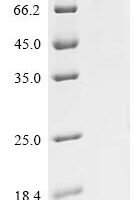
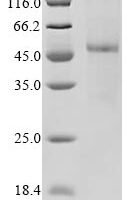
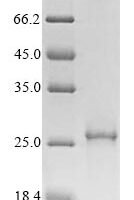
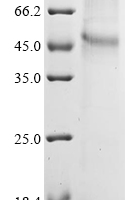
SDS-PAGE: Single band at expected molecular weight confirming purity.

ELISA: Suitable as coating antigen or detection standard.

Western Blot: Compatible with standard Western Blot protocols.

Protein Interaction: Validated for SPR (Surface Plasmon Resonance) and BLI (Bio-Layer Interferometry) studies.

Shipping: Shipped at ambient temperature. Lyophilized protein is stable during transit.

Storage: Store lyophilized protein at -20°C to -80°C. Reconstituted protein should be aliquoted and stored at -80°C. Avoid repeated freeze-thaw cycles.

Shelf Life: 12 months from date of receipt when stored as recommended.

Shipping Time: Orders placed before 2 PM EST ship same day. International orders typically deliver within 5-10 business days.

Protein Biology

Function

Mitochondrial outer membrane GTPase that mediates mitochondrial clustering and fusion (PubMed:11181170, PubMed:11950885, PubMed:19889647, PubMed:26214738, PubMed:28114303). Mitochondria are highly dynamic organelles, and their morphology is determined by the equilibrium between mitochondrial fusion and fission events (PubMed:28114303). Overexpression induces the formation of mitochondrial networks (PubMed:28114303). Membrane clustering requires GTPase activity and may involve a major rearrangement of the coiled coil domains (Probable). Plays a central role in mitochondrial metabolism and may be associated with obesity and/or apoptosis processes (By similarity). Plays an important role in the regulation of vascular smooth muscle cell proliferation (By similarity). Involved in the clearance of damaged mitochondria via selective autophagy (mitophagy) (PubMed:23620051). Is required for PRKN recruitment to dysfunctional mitochondria (PubMed:23620051). Involved in the control of unfolded protein response (UPR) upon ER stress including activation of apoptosis and autophagy during ER stress (By similarity). Acts as an upstream regulator of EIF2AK3 and suppresses EIF2AK3 activation under basal conditions (By similarity)

Subcellular Location

Mitochondrion outer membrane (Multi-pass membrane protein)

Disease Association

Charcot-Marie-Tooth disease, axonal, type 2A2B (CMT2A2B) : An axonal form of Charcot-Marie-Tooth disease, a disorder of the peripheral nervous system, characterized by progressive weakness and atrophy, initially of the peroneal muscles and later of the distal muscles of the arms. Charcot-Marie-Tooth disease is classified in two main groups on the basis of electrophysiologic properties and histopathology: primary peripheral demyelinating neuropathies (designated CMT1 when they are dominantly inherited) and primary peripheral axonal neuropathies (CMT2). Neuropathies of the CMT2 group are characterized by signs of axonal degeneration in the absence of obvious myelin alterations, normal or slightly reduced nerve conduction velocities, and progressive distal muscle weakness and atrophy. CMT2A2B is a severe form with autosomal recessive inheritance. [The disease is caused by variants affecting the gene represented in this entry] | Charcot-Marie-Tooth disease, axonal, type 2A2A (CMT2A2A) : An autosomal dominant, axonal form of Charcot-Marie-Tooth disease, a disorder of the peripheral nervous system, characterized by progressive weakness and atrophy, initially of the peroneal muscles and later of the distal muscles of the arms. Charcot-Marie-Tooth disease is classified in two main groups on the basis of electrophysiologic properties and histopathology: primary peripheral demyelinating neuropathies (designated CMT1 when they are dominantly inherited) and primary peripheral axonal neuropathies (CMT2). Neuropathies of the CMT2 group are characterized by signs of axonal degeneration in the absence of obvious myelin alterations, normal or slightly reduced nerve conduction velocities, and progressive distal muscle weakness and atrophy. [The disease is caused by variants affecting the gene represented in this entry] | Neuropathy, hereditary motor and sensory, 6A, with optic atrophy (HMSN6A) : An autosomal dominant neurologic disorder characterized by optic atrophy and peripheral sensorimotor neuropathy manifesting as axonal Charcot-Marie-Tooth disease. Charcot-Marie-Tooth disease is a disorder of the peripheral nervous system, characterized by progressive weakness and atrophy, initially of the peroneal muscles and later of the distal muscles of the arms. It is classified in two main groups on the basis of electrophysiologic properties and histopathology: primary peripheral demyelinating neuropathies and primary peripheral axonal neuropathies. Peripheral axonal neuropathies are characterized by signs of axonal regeneration in the absence of obvious myelin alterations, and normal or slightly reduced nerve conduction velocities. [The disease is caused by variants affecting the gene represented in this entry] | Lipomatosis, multiple symmetric, with or without peripheral neuropathy (MSL) : An autosomal recessive disorder characterized by the growth of unencapsulated, lipomatous masses affecting the upper body, especially the cervical and thoracic regions. Lipomatosis can be disfiguring, and lipoma growth around the neck may cause difficulty swallowing or breathing. The age at onset ranges from childhood to young adulthood. Some patients develop distal muscle weakness and atrophy due to axonal peripheral neuropathy. [The disease is caused by variants affecting the gene represented in this entry]

Tissue Specificity

Ubiquitous; expressed at low level. Highly expressed in heart and kidney

Subunit

Forms homomultimers and heteromultimers with MFN1 (PubMed:26085578, PubMed:38843396). Oligomerization is essential for mitochondrion fusion (Probable). Interacts with VAT1 (By similarity). Interacts with STOML2; may form heterooligomers (PubMed:17121834). Interacts (phosphorylated) with PRKN (PubMed:23620051). Interacts with EIF2AK3 (By similarity). Interacts with THG1L; THG1L probably functions as a guanyl-nucleotide exchange factor/GEF, activating MFN2. Interacts with TRABD (PubMed:38843396)

Gene: MFN2  |  Organism: Homo sapiens  |  Synonyms: Transmembrane GTPase MFN2
Key Publications

Frequently Asked Questions

How do I order or inquire about this product?

Fill out the Online Inquiry form with your required quantity and specifications. You can also email sales@biocrestsci.com. Our team typically responds within 4 business hours with a quote and availability confirmation.

What is the shipping and delivery time?

Orders placed before 2 PM EST ship the same day. Domestic (US) delivery typically takes 2-3 business days. International orders deliver within 5-10 business days. All products are shipped at ambient temperature with appropriate packaging to ensure stability.

How should I store this recombinant protein?

Lyophilized proteins should be stored at -20°C to -80°C upon receipt. After reconstitution, aliquot and store at -80°C. Avoid repeated freeze-thaw cycles. Shelf life is 12 months from date of receipt when stored as recommended.

What quality controls are performed on your products?

Each product undergoes SDS-PAGE purity analysis (typically >85-95%), endotoxin testing, and bioactivity validation. Products are validated for ELISA, Western Blot, and SPR/BLI applications as specified on this product page. A Certificate of Analysis (CoA) is available upon request.

Shopping Cart
Scroll to Top