Recombinant Human Myelin-associated glycoprotein (MAG), partial

Recombinant Human Myelin-associated glycoprotein (MAG), partial — Adhesion molecule that mediates interactions between myelinating cells and neurons by binding to neuronal sialic acid-containing gangliosides and to the glycoproteins RTN4R and RTN4RL2. Purity >90%.

SKU: BCRECP-001109 Category:

Product Specifications

Product SkuBCRECP-001109
Product DescriptionRecombinant Human Myelin-associated glycoprotein (MAG) Protein is expressed from E.coli with N-terminal 6xHis-tagged. It contains 20-516aa. [Accession | P20916].
Uniprot No.P20916
Gene NamesMAG
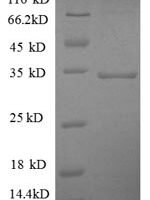
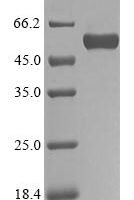
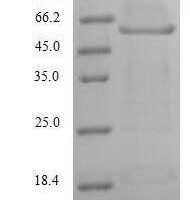
PurityGreater than 90% as determined by SDS-PAGE.
Expression SystemE.coli
Expression Region20-516aa
SpeciesHomo sapiens (Human)
Tag InfoN-terminal 6xHis-tagged
Molecular weight58.8kDa
ActivityPlease contact us to obtain bioactivity data.
BufferIf the delivery form is liquid, the default storage buffer is Tris/PBS-based buffer, 5%-50% glycerol. If the delivery form is lyophilized powder, the buffer before lyophilization is Tris/PBS-based buffer, 6% Trehalose.
StorageStore at -20°C/-80°C upon receipt, aliquoting is necessary for mutiple use. Avoid repeated freeze-thaw cycles.
Research AreasCell Adhesion

Function

Adhesion molecule that mediates interactions between myelinating cells and neurons by binding to neuronal sialic acid-containing gangliosides and to the glycoproteins RTN4R and RTN4RL2. Not required for initial myelination, but seems to play a role in the maintenance of normal axon myelination. Protects motoneurons against apoptosis, also after injury; protection against apoptosis is probably mediated via interaction with neuronal RTN4R and RTN4RL2.

Biological Context

Subcellular Location: Cell membrane (Single-pass type I membrane protein); Membrane raft
Tissue Specificity: Both isoform 1 and isoform 2 are detected in myelinated structures in the central and peripheral nervous system, in periaxonal myelin and at Schmidt-Lanterman incisures. Detected in optic nerve, in oligodendroglia and in periaxonal myelin sheaths. Detected in compact myelin (at protein level). Both isoform 1 and isoform 2 are detected in the central and peripheral nervous system
Disease Association: Spastic paraplegia 75, autosomal recessive (SPG75) : A form of spastic paraplegia, a neurodegenerative disorder characterized by a slow, gradual, progressive weakness and spasticity of the lower limbs. Rate of progression and the severity of symptoms are quite variable. Initial symptoms may include difficulty with balance, weakness and stiffness in the legs, muscle spasms, and dragging the toes when walking. In some forms of the disorder, bladder symptoms (such as incontinence) may appear, or the weakness and stiffness may spread to other parts of the body. SPG75 is characterized by onset in early childhood and is associated with mild to moderate cognitive impairment. [The disease is caused by variants affecting the gene represented in this entry]

Product Specifications

Recombinant Human Myelin-associated glycoprotein (MAG), partial is a recombinant protein from Homo sapiens (Human), expressed in E.coli, covering amino acids 20-516aa, with N-terminal 6xHis-tagged tag, molecular weight 58.8kDa, purity Greater than 90% as determined by SDS-PAGE.. Suitable for ELISA and Western Blot applications.

Recommended applications depend on the target, product format, and product-specific validation data. Refer to the product datasheet or Certificate of Analysis (CoA), or contact BioCrest Sci for application guidance.

Biological Activity: Please contact us to obtain bioactivity data.

Storage: Store at -20°C/-80°C upon receipt, aliquoting is necessary for mutiple use. Avoid repeated freeze-thaw cycles.

Shipping & Lead Time: Availability, shipping conditions, and estimated lead time are confirmed in the formal quotation or order confirmation based on the product format, destination, and order requirements.

Protein Biology

Function

Adhesion molecule that mediates interactions between myelinating cells and neurons by binding to neuronal sialic acid-containing gangliosides and to the glycoproteins RTN4R and RTN4RL2 (By similarity). Not required for initial myelination, but seems to play a role in the maintenance of normal axon myelination. Protects motoneurons against apoptosis, also after injury; protection against apoptosis is probably mediated via interaction with neuronal RTN4R and RTN4RL2. Required to prevent degeneration of myelinated axons in adults; this probably depends on binding to gangliosides on the axon cell membrane (By similarity). Negative regulator of neurite outgrowth; in dorsal root ganglion neurons the inhibition is mediated primarily via binding to neuronal RTN4R or RTN4RL2 and to a lesser degree via binding to neuronal gangliosides. In cerebellar granule cells the inhibition is mediated primarily via binding to neuronal gangliosides. In sensory neurons, inhibition of neurite extension depends only partially on RTN4R, RTN4RL2 and gangliosides. Inhibits axon longitudinal growth (By similarity). Inhibits axon outgrowth by binding to RTN4R (By similarity). Preferentially binds to alpha-2,3-linked sialic acid. Binds ganglioside Gt1b (By similarity)

Subcellular Location

Cell membrane (Single-pass type I membrane protein); Membrane raft

Disease Association

Spastic paraplegia 75, autosomal recessive (SPG75) : A form of spastic paraplegia, a neurodegenerative disorder characterized by a slow, gradual, progressive weakness and spasticity of the lower limbs. Rate of progression and the severity of symptoms are quite variable. Initial symptoms may include difficulty with balance, weakness and stiffness in the legs, muscle spasms, and dragging the toes when walking. In some forms of the disorder, bladder symptoms (such as incontinence) may appear, or the weakness and stiffness may spread to other parts of the body. SPG75 is characterized by onset in early childhood and is associated with mild to moderate cognitive impairment. [The disease is caused by variants affecting the gene represented in this entry]

Tissue Specificity

Both isoform 1 and isoform 2 are detected in myelinated structures in the central and peripheral nervous system, in periaxonal myelin and at Schmidt-Lanterman incisures (PubMed:6200494, PubMed:9495552). Detected in optic nerve, in oligodendroglia and in periaxonal myelin sheaths (PubMed:6200494). Detected in compact myelin (at protein level) (PubMed:6200494). Both isoform 1 and isoform 2 are detected in the central and peripheral nervous system (PubMed:9495552)

Subunit

Monomer and homodimer (By similarity). Interacts (via the first three N-terminal Ig-like domains) with RTN4R and RTN4RL2 (By similarity). Interacts with RTN4R (PubMed:19052207). Interacts with isoform 2 of BSG (By similarity). Interacts with the palmitolyated form of CADM4 (By similarity)

Gene: MAG  |  Organism: Homo sapiens  |  Synonyms: Siglec-4a
Key Publications

Frequently Asked Questions

How do I order or inquire about this product?

Submit the Online Inquiry form with your required quantity and specifications, or email sales@biocrestsci.com. Available sizes, pricing, stock status, documentation, and estimated lead time are confirmed in the formal quotation.

What is the shipping and delivery time?

Availability, dispatch timing, shipping conditions, and delivery estimates depend on the product format, destination, and order requirements. These details are confirmed in the formal quotation or order confirmation.

How should this product be stored?

Follow the storage and handling instructions in the product-specific datasheet and Certificate of Analysis (CoA). Requirements may vary by product form and formulation; contact BioCrest Sci if product-specific guidance is needed.

What quality controls are performed on your products?

Quality-control data such as identity, purity, endotoxin level, or biological activity are provided only when specified on this product page, the datasheet, or Certificate of Analysis (CoA). Biological activity is not implied unless explicitly stated.

Shopping Cart
Scroll to Top