,

Recombinant Human Natural killer cell receptor 2B4 (CD244), partial

Recombinant Human Natural killer cell receptor 2B4 (CD244), partial — Heterophilic receptor of the signaling lymphocytic activation molecule (SLAM) family; its ligand is CD48. Purity >90%.

SKU: BCRECP-000272 Categories: ,

Product Specifications

Product SkuBCRECP-000272
Product DescriptionRecombinant Human Natural killer cell receptor 2B4 (CD244) Protein is expressed from Mammalian cell with C-terminal hFc1-Myc-tagged. It contains 22-221aa. [Accession | Q9BZW8].
Uniprot No.Q9BZW8
Gene NamesCD244
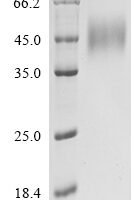
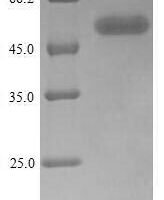
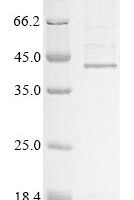
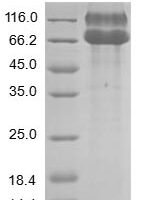
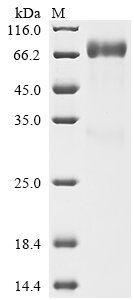
PurityGreater than 90% as determined by SDS-PAGE.
Expression SystemMammalian cell
Expression Region22-221aa
SpeciesHomo sapiens (Human)
Tag InfoC-terminal hFc1-Myc-tagged
Molecular weight51.0kDa
ActivityPlease contact us to obtain bioactivity data.
BufferIf the delivery form is liquid, the default storage buffer is Tris/PBS-based buffer, 5%-50% glycerol. If the delivery form is lyophilized powder, the buffer before lyophilization is Tris/PBS-based buffer, 6% Trehalose.
StorageStore at -20°C/-80°C upon receipt, aliquoting is necessary for mutiple use. Avoid repeated freeze-thaw cycles.
Research AreasImmunology

Function

Heterophilic receptor of the signaling lymphocytic activation molecule (SLAM) family; its ligand is CD48. SLAM receptors triggered by homo- or heterotypic cell-cell interactions are modulating the activation and differentiation of a wide variety of immune cells and thus are involved in the regulation and interconnection of both innate and adaptive immune response. Activities are controlled by presence or absence of small cytoplasmic adapter proteins, SH2D1A/SAP and/or SH2D1B/EAT-2.

Biological Context

Subcellular Location: Membrane (Single-pass type I membrane protein); Cell membrane; Membrane raft
Tissue Specificity: Expressed in spleen, PBL, followed by lung, liver, testis and small intestine. Expressed in all natural killer (NK) cells, monocytes and basophils, TCR-gamma/delta+ T-cells, monocytes, basophils, and on a subset of CD8(+) T-cells

Product Specifications

Recombinant Human Natural killer cell receptor 2B4 (CD244), partial is a recombinant protein from Homo sapiens (Human), expressed in Mammalian cell, covering amino acids 22-221aa, with C-terminal hFc1-Myc-tagged tag, molecular weight 51.0kDa, purity Greater than 90% as determined by SDS-PAGE.. Suitable for ELISA and Western Blot applications.

SDS-PAGE: Single band at expected molecular weight confirming purity.

ELISA: Suitable as coating antigen or detection standard.

Western Blot: Compatible with standard Western Blot protocols.

Protein Interaction: Validated for SPR (Surface Plasmon Resonance) and BLI (Bio-Layer Interferometry) studies.

Shipping: Shipped at ambient temperature. Lyophilized protein is stable during transit.

Storage: Store lyophilized protein at -20°C to -80°C. Reconstituted protein should be aliquoted and stored at -80°C. Avoid repeated freeze-thaw cycles.

Shelf Life: 12 months from date of receipt when stored as recommended.

Shipping Time: Orders placed before 2 PM EST ship same day. International orders typically deliver within 5-10 business days.

Protein Biology

Function

Heterophilic receptor of the signaling lymphocytic activation molecule (SLAM) family; its ligand is CD48. SLAM receptors triggered by homo- or heterotypic cell-cell interactions are modulating the activation and differentiation of a wide variety of immune cells and thus are involved in the regulation and interconnection of both innate and adaptive immune response. Activities are controlled by presence or absence of small cytoplasmic adapter proteins, SH2D1A/SAP and/or SH2D1B/EAT-2. Acts as activating natural killer (NK) cell receptor (PubMed:10359122, PubMed:11714776, PubMed:8376943). Activating function implicates association with SH2D1A and FYN (PubMed:15713798). Downstreaming signaling involves predominantly VAV1, and, to a lesser degree, INPP5D/SHIP1 and CBL. Signal attenuation in the absence of SH2D1A is proposed to be dependent on INPP5D and to a lesser extent PTPN6/SHP-1 and PTPN11/SHP-2 (PubMed:10934222, PubMed:15713798). Stimulates NK cell cytotoxicity, production of IFN-gamma and granule exocytosis (PubMed:11714776, PubMed:8376943). Optimal expansion and activation of NK cells seems to be dependent on the engagement of CD244 with CD48 expressed on neighboring NK cells (By similarity). Acts as costimulator in NK activation by enhancing signals by other NK receptors such as NCR3 and NCR1 (PubMed:10741393). At early stages of NK cell differentiation may function as an inhibitory receptor possibly ensuring the self-tolerance of developing NK cells (PubMed:11917118). Involved in the regulation of CD8(+) T-cell proliferation; expression on activated T-cells and binding to CD48 provides costimulatory-like function for neighboring T-cells (By similarity). Inhibits inflammatory responses in dendritic cells (DCs) (By similarity)

Subcellular Location

Membrane (Single-pass type I membrane protein); Cell membrane; Membrane raft

Tissue Specificity

Expressed in spleen, PBL, followed by lung, liver, testis and small intestine. Expressed in all natural killer (NK) cells, monocytes and basophils, TCR-gamma/delta+ T-cells, monocytes, basophils, and on a subset of CD8(+) T-cells

Subunit

Interacts with CD48 (PubMed:27249817, PubMed:9841922). Interacts (via phosphorylated ITSM 1-4) with SH2D1A (via SH2 domain); SH2D1A probably mediates association with FYN. Interacts (via phosphorylated ITSM 3) with PTPN11/SHP-2, INPP5D/SHIP1, PTPN6/SHP-1 and CSK; binding of SH2D1A/SAP prevents association with PTPN11, PTPN6 and CSK; conflictingly a similar association has been described for phosphorylated ITSM 1 also including GRB2 and PLCG1. Interacts weakly (via phosphorylated ITSM 2) with PTPN11/SHP-2 and CSK (PubMed:10358138, PubMed:10934222, PubMed:12458214, PubMed:15713798, PubMed:24642916, PubMed:26221972). Interacts with SH2D1B (PubMed:12458214, PubMed:24642916). Interacts with PIK3R1; PI3K recruits SH2D1A (PubMed:11815622). Interacts with MHC class I proteins; the interaction is proposed to prevent self-killing of NK cells

Gene: CD244  |  Organism: Homo sapiens  |  Synonyms: NK cell activation-inducing ligand; NK cell type I receptor protein 2B4; SLAM family member 4; Signaling lymphocytic activation molecule 4
Key Publications

Frequently Asked Questions

How do I order or inquire about this product?

Fill out the Online Inquiry form with your required quantity and specifications. You can also email sales@biocrestsci.com. Our team typically responds within 4 business hours with a quote and availability confirmation.

What is the shipping and delivery time?

Orders placed before 2 PM EST ship the same day. Domestic (US) delivery typically takes 2-3 business days. International orders deliver within 5-10 business days. All products are shipped at ambient temperature with appropriate packaging to ensure stability.

How should I store this recombinant protein?

Lyophilized proteins should be stored at -20°C to -80°C upon receipt. After reconstitution, aliquot and store at -80°C. Avoid repeated freeze-thaw cycles. Shelf life is 12 months from date of receipt when stored as recommended.

What quality controls are performed on your products?

Each product undergoes SDS-PAGE purity analysis (typically >85-95%), endotoxin testing, and bioactivity validation. Products are validated for ELISA, Western Blot, and SPR/BLI applications as specified on this product page. A Certificate of Analysis (CoA) is available upon request.

Shopping Cart
Scroll to Top