Recombinant Human Neuroendocrine secretory protein 55 (GNAS)

Recombinant Human Neuroendocrine secretory protein 55 (GNAS) — recombinant protein from Homo sapiens (Human), expressed in E.coli. Purity >85%.

SKU: BCRECP-000765 Category:

Product Specifications

Product SkuBCRECP-000765
Product DescriptionRecombinant Human Neuroendocrine secretory protein 55 (GNAS) Protein is expressed from E.coli with N-terminal 6xHis-tagged. It contains 47-245aa. [Accession | O95467].
Uniprot No.O95467
Gene NamesGNAS
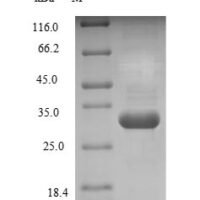
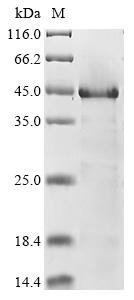
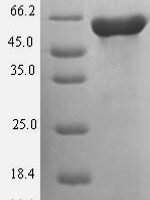
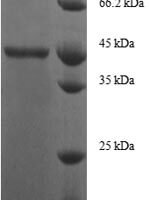
PurityGreater than 85% as determined by SDS-PAGE.
Expression SystemE.coli
Expression Region47-245aa
SpeciesHomo sapiens (Human)
Tag InfoN-terminal 6xHis-tagged
Molecular weight28.7kDa
ActivityPlease contact us to obtain bioactivity data.
BufferIf the delivery form is liquid, the default storage buffer is Tris/PBS-based buffer, 5%-50% glycerol. If the delivery form is lyophilized powder, the buffer before lyophilization is Tris/PBS-based buffer, 6% Trehalose.
StorageStore at -20°C/-80°C upon receipt, aliquoting is necessary for mutiple use. Avoid repeated freeze-thaw cycles.
Research AreasCancer

Biological Context

Subcellular Location: Cytoplasmic vesicle, secretory vesicle; Secreted
Disease Association: ACTH-independent macronodular adrenal hyperplasia 1 (AIMAH1) : A rare adrenal defect characterized by multiple, bilateral, non-pigmented, benign, adrenocortical nodules. It results in excessive production of cortisol leading to ACTH-independent Cushing syndrome. Clinical manifestations of Cushing syndrome include facial and truncal obesity, abdominal striae, muscular weakness, osteoporosis, arterial hypertension, diabetes. [The disease is caused by variants affecting the gene represented in this entry] | Pseudohypoparathyroidism 1B (PHP1B) : A disorder characterized by end-organ resistance to parathyroid hormone, hypocalcemia and hyperphosphatemia. Patients affected with PHP1B lack developmental defects characteristic of Albright hereditary osteodystrophy, and typically show no other endocrine abnormalities besides resistance to PTH. [The disease is caused by variants affecting the gene represented in this entry. Most affected individuals have defects in methylation of the gene. In some cases microdeletions involving the STX16 appear to cause loss of methylation at exon A/B of GNAS, resulting in PHP1B. Paternal uniparental isodisomy have also been observed] | [Genetic variation affecting the GNAS locus is associated with GNAS hyperfunction, a condition characterized by increased trauma-related bleeding tendency, prolonged bleeding time, brachydactyly and intellectual disability. Both the XLas isoforms and the ALEX protein are mutated which strongly reduces the interaction between them and this may allow unimpeded activation of the XLas isoforms]

Product Specifications

Recombinant Human Neuroendocrine secretory protein 55 (GNAS) is a recombinant protein from Homo sapiens (Human), expressed in E.coli, covering amino acids 47-245aa, with N-terminal 6xHis-tagged tag, molecular weight 28.7kDa, purity Greater than 85% as determined by SDS-PAGE.. Suitable for ELISA and Western Blot applications.
Recommended applications depend on the target, product format, and product-specific validation data. Refer to the product datasheet or Certificate of Analysis (CoA), or contact BioCrest Sci for application guidance.

Biological Activity: Please contact us to obtain bioactivity data.

Storage: Store at -20°C/-80°C upon receipt, aliquoting is necessary for mutiple use. Avoid repeated freeze-thaw cycles.

Shipping & Lead Time: Availability, shipping conditions, and estimated lead time are confirmed in the formal quotation or order confirmation based on the product format, destination, and order requirements.

Protein Biology

Subcellular Location

Cytoplasmic vesicle, secretory vesicle; Secreted

Disease Association

ACTH-independent macronodular adrenal hyperplasia 1 (AIMAH1) : A rare adrenal defect characterized by multiple, bilateral, non-pigmented, benign, adrenocortical nodules. It results in excessive production of cortisol leading to ACTH-independent Cushing syndrome. Clinical manifestations of Cushing syndrome include facial and truncal obesity, abdominal striae, muscular weakness, osteoporosis, arterial hypertension, diabetes. [The disease is caused by variants affecting the gene represented in this entry] | Pseudohypoparathyroidism 1B (PHP1B) : A disorder characterized by end-organ resistance to parathyroid hormone, hypocalcemia and hyperphosphatemia. Patients affected with PHP1B lack developmental defects characteristic of Albright hereditary osteodystrophy, and typically show no other endocrine abnormalities besides resistance to PTH. [The disease is caused by variants affecting the gene represented in this entry. Most affected individuals have defects in methylation of the gene. In some cases microdeletions involving the STX16 appear to cause loss of methylation at exon A/B of GNAS, resulting in PHP1B. Paternal uniparental isodisomy have also been observed] | [Genetic variation affecting the GNAS locus is associated with GNAS hyperfunction, a condition characterized by increased trauma-related bleeding tendency, prolonged bleeding time, brachydactyly and intellectual disability. Both the XLas isoforms and the ALEX protein are mutated which strongly reduces the interaction between them and this may allow unimpeded activation of the XLas isoforms]

Gene: GNAS  |  Organism: Homo sapiens
Key Publications

Frequently Asked Questions

How do I order or inquire about this product?

Submit the Online Inquiry form with your required quantity and specifications, or email sales@biocrestsci.com. Available sizes, pricing, stock status, documentation, and estimated lead time are confirmed in the formal quotation.

What is the shipping and delivery time?

Availability, dispatch timing, shipping conditions, and delivery estimates depend on the product format, destination, and order requirements. These details are confirmed in the formal quotation or order confirmation.

How should this product be stored?

Follow the storage and handling instructions in the product-specific datasheet and Certificate of Analysis (CoA). Requirements may vary by product form and formulation; contact BioCrest Sci if product-specific guidance is needed.

What quality controls are performed on your products?

Quality-control data such as identity, purity, endotoxin level, or biological activity are provided only when specified on this product page, the datasheet, or Certificate of Analysis (CoA). Biological activity is not implied unless explicitly stated.

Shopping Cart
Scroll to Top