Recombinant Human Otoferlin (OTOF), partial

Recombinant Human Otoferlin (OTOF), partial — Key calcium ion sensor involved in the Ca(2+)-triggered synaptic vesicle-plasma membrane fusion and in the control of neurotransmitter release at these output synapses. Purity >85%.

SKU: BCRECP-001314 Category:

Product Specifications

Product SkuBCRECP-001314
Product DescriptionRecombinant Human Otoferlin (OTOF) Protein is expressed from E.coli with N-terminal 6xHis-tagged. It contains 1461-1868aa. [Accession | Q9HC10].
Uniprot No.Q9HC10
Gene NamesOTOF
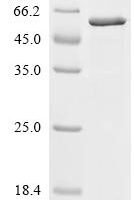
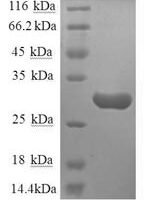
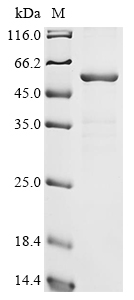
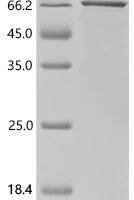
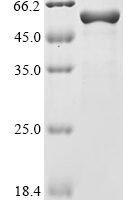
PurityGreater than 85% as determined by SDS-PAGE.
Expression SystemE.coli
Expression Region1461-1868aa
SpeciesHomo sapiens (Human)
Tag InfoN-terminal 6xHis-tagged
Molecular weight52.6kDa
ActivityPlease contact us to obtain bioactivity data.
BufferIf the delivery form is liquid, the default storage buffer is Tris/PBS-based buffer, 5%-50% glycerol. If the delivery form is lyophilized powder, the buffer before lyophilization is Tris/PBS-based buffer, 6% Trehalose.
StorageStore at -20°C/-80°C upon receipt, aliquoting is necessary for mutiple use. Avoid repeated freeze-thaw cycles.
Research AreasNeuroscience

Function

Key calcium ion sensor involved in the Ca(2+)-triggered synaptic vesicle-plasma membrane fusion and in the control of neurotransmitter release at these output synapses. Interacts in a calcium-dependent manner to the presynaptic SNARE proteins at ribbon synapses of cochlear inner hair cells (IHCs) to trigger exocytosis of neurotransmitter.

Product Specifications

Recombinant Human Otoferlin (OTOF), partial — Key calcium ion sensor involved in the Ca(2+)-triggered synaptic vesicle-plasma membrane fusion and in the control of neurotransmitter release at these output synapses. Purity >85%. Suitable for ELISA and Western Blot applications.
Recommended applications depend on the target, product format, and product-specific validation data. Refer to the product datasheet or Certificate of Analysis (CoA), or contact BioCrest Sci for application guidance.

Biological Activity: Please contact us to obtain bioactivity data.

Storage: Store at -20°C/-80°C upon receipt, aliquoting is necessary for mutiple use. Avoid repeated freeze-thaw cycles.

Shipping & Lead Time: Availability, shipping conditions, and estimated lead time are confirmed in the formal quotation or order confirmation based on the product format, destination, and order requirements.

Protein Biology

Function

Key calcium ion sensor involved in the Ca(2+)-triggered synaptic vesicle-plasma membrane fusion and in the control of neurotransmitter release at these output synapses. Interacts in a calcium-dependent manner to the presynaptic SNARE proteins at ribbon synapses of cochlear inner hair cells (IHCs) to trigger exocytosis of neurotransmitter. Also essential to synaptic exocytosis in immature outer hair cells (OHCs). May also play a role within the recycling of endosomes (By similarity)

Subcellular Location

Cytoplasmic vesicle, secretory vesicle, synaptic vesicle membrane (Single-pass type IV membrane protein); Basolateral cell membrane (Single-pass type IV membrane protein); Endoplasmic reticulum membrane (Single-pass type IV membrane protein); Golgi apparatus membrane (Single-pass type IV membrane protein); Presynaptic cell membrane (Single-pass type IV membrane protein); Cell membrane (Single-pass type IV membrane protein); Golgi apparatus, trans-Golgi network

Disease Association

Deafness, autosomal recessive, 9 (DFNB9) : A form of non-syndromic sensorineural hearing loss. Sensorineural deafness results from damage to the neural receptors of the inner ear, the nerve pathways to the brain, or the area of the brain that receives sound information. [The disease is caused by variants affecting the gene represented in this entry] | Auditory neuropathy, autosomal recessive, 1 (AUNB1) : A form of sensorineural hearing loss with absent or severely abnormal auditory brainstem response, in the presence of normal cochlear outer hair cell function and normal otoacoustic emissions. Auditory neuropathies result from a lesion in the area including the inner hair cells, connections between the inner hair cells and the cochlear branch of the auditory nerve, the auditory nerve itself and auditory pathways of the brainstem. In some cases AUNB1 phenotype can be temperature sensitive. [The disease is caused by variants affecting the gene represented in this entry]

Tissue Specificity

Isoform 1 and isoform 3 are found in adult brain. Isoform 2 is expressed in the fetus and in adult brain, heart, placenta, skeletal muscle and kidney

Subunit

Interacts with SNAP2; the interaction is direct. Interacts with STX1; the interaction is direct. Interacts with RAB8B (By similarity)

Gene: OTOF  |  Organism: Homo sapiens  |  Synonyms: Fer-1-like protein 2
Key Publications

Frequently Asked Questions

How do I order or inquire about this product?

Submit the Online Inquiry form with your required quantity and specifications, or email sales@biocrestsci.com. Available sizes, pricing, stock status, documentation, and estimated lead time are confirmed in the formal quotation.

What is the shipping and delivery time?

Availability, dispatch timing, shipping conditions, and delivery estimates depend on the product format, destination, and order requirements. These details are confirmed in the formal quotation or order confirmation.

How should this product be stored?

Follow the storage and handling instructions in the product-specific datasheet and Certificate of Analysis (CoA). Requirements may vary by product form and formulation; contact BioCrest Sci if product-specific guidance is needed.

What quality controls are performed on your products?

Quality-control data such as identity, purity, endotoxin level, or biological activity are provided only when specified on this product page, the datasheet, or Certificate of Analysis (CoA). Biological activity is not implied unless explicitly stated.

Shopping Cart
Scroll to Top