Recombinant Human Protein max (MAX)

Recombinant Human Protein max (MAX) — Transcription regulator. Purity >85%.

SKU: BCRECP-001137 Category:

Product Specifications

Product SkuBCRECP-001137
Product DescriptionRecombinant Human Protein max (MAX) Protein is expressed from E.coli with N-terminal 10xHis-tagged and C-terminal Myc-tagged. It contains 2-160aa. [Accession | P61244].
Uniprot No.P61244
Gene NamesMAX
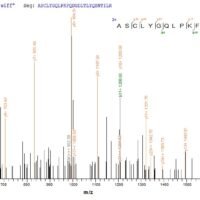
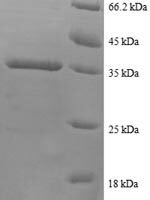
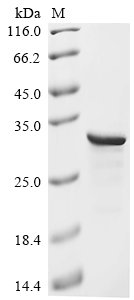
PurityGreater than 85% as determined by SDS-PAGE.
Expression SystemE.coli
Expression Region2-160aa
SpeciesHomo sapiens (Human)
Tag InfoN-terminal 10xHis-tagged and C-terminal Myc-tagged
Molecular weight25.6kDa
ActivityPlease contact us to obtain bioactivity data.
BufferIf the delivery form is liquid, the default storage buffer is Tris/PBS-based buffer, 5%-50% glycerol. If the delivery form is lyophilized powder, the buffer before lyophilization is Tris/PBS-based buffer, 6% Trehalose.
StorageStore at -20°C/-80°C upon receipt, aliquoting is necessary for mutiple use. Avoid repeated freeze-thaw cycles.
Research AreasEpigenetics and Nuclear Signaling

Function

Transcription regulator. Forms a sequence-specific DNA-binding protein complex with MYC or MAD which recognizes the core sequence 5'-CAC[GA]TG-3'. The MYC:MAX complex is a transcriptional activator, whereas the MAD:MAX complex is a repressor.

Biological Context

Subcellular Location: Nucleus; Cell projection, dendrite
Tissue Specificity: High levels found in the brain, heart and lung while lower levels are seen in the liver, kidney and skeletal muscle
Disease Association: Pheochromocytoma (PCC) : A catecholamine-producing tumor of chromaffin tissue of the adrenal medulla or sympathetic paraganglia. The cardinal symptom, reflecting the increased secretion of epinephrine and norepinephrine, is hypertension, which may be persistent or intermittent. [Disease susceptibility is associated with variants affecting the gene represented in this entry] | Polydactyly-macrocephaly syndrome (PDMCS) : An autosomal dominant syndrome characterized by progressive macrocephaly and post-axial polydactyly, a condition defined by the occurrence of supernumerary digits affecting the fifth finger and/or toe. Additional variable features include ocular anomalies, global developmental delay and autistic traits. [The disease is caused by variants affecting the gene represented in this entry]

Product Specifications

Recombinant Human Protein max (MAX) is a recombinant protein from Homo sapiens (Human), expressed in E.coli, covering amino acids 2-160aa, with N-terminal 10xHis-tagged and C-terminal Myc-tagged tag, molecular weight 25.6kDa, purity Greater than 85% as determined by SDS-PAGE.. Suitable for ELISA and Western Blot applications.
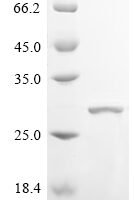
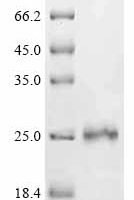
SDS-PAGE: Single band at expected molecular weight confirming purity.

ELISA: Suitable as coating antigen or detection standard.

Western Blot: Compatible with standard Western Blot protocols.

Protein Interaction: Validated for SPR (Surface Plasmon Resonance) and BLI (Bio-Layer Interferometry) studies.

Shipping: Shipped at ambient temperature. Lyophilized protein is stable during transit.

Storage: Store lyophilized protein at -20°C to -80°C. Reconstituted protein should be aliquoted and stored at -80°C. Avoid repeated freeze-thaw cycles.

Shelf Life: 12 months from date of receipt when stored as recommended.

Shipping Time: Orders placed before 2 PM EST ship same day. International orders typically deliver within 5-10 business days.

Protein Biology

Function

Transcription regulator. Forms a sequence-specific DNA-binding protein complex with MYC or MAD which recognizes the core sequence 5'-CAC[GA]TG-3'. The MYC:MAX complex is a transcriptional activator, whereas the MAD:MAX complex is a repressor. May repress transcription via the recruitment of a chromatin remodeling complex containing H3 'Lys-9' histone methyltransferase activity. Represses MYC transcriptional activity from E-box elements

Subcellular Location

Nucleus; Cell projection, dendrite

Disease Association

Pheochromocytoma (PCC) : A catecholamine-producing tumor of chromaffin tissue of the adrenal medulla or sympathetic paraganglia. The cardinal symptom, reflecting the increased secretion of epinephrine and norepinephrine, is hypertension, which may be persistent or intermittent. [Disease susceptibility is associated with variants affecting the gene represented in this entry] | Polydactyly-macrocephaly syndrome (PDMCS) : An autosomal dominant syndrome characterized by progressive macrocephaly and post-axial polydactyly, a condition defined by the occurrence of supernumerary digits affecting the fifth finger and/or toe. Additional variable features include ocular anomalies, global developmental delay and autistic traits. [The disease is caused by variants affecting the gene represented in this entry]

Tissue Specificity

High levels found in the brain, heart and lung while lower levels are seen in the liver, kidney and skeletal muscle

Subunit

Efficient DNA binding requires dimerization with another bHLH protein. Binds DNA as a heterodimer with MYC or MAD. Part of the E2F6.com-1 complex in G0 phase composed of E2F6, MGA, MAX, TFDP1, CBX3, BAT8, EUHMTASE1, RING1, RNF2, MBLR, L3MBTL2 and YAF2. Component of some MLL1/MLL complex, at least composed of the core components KMT2A/MLL1, ASH2L, HCFC1/HCF1, WDR5 and RBBP5, as well as the facultative components BACC1, CHD8, E2F6, HSP70, INO80C, KANSL1, LAS1L, MAX, MCRS1, MGA, MYST1/MOF, PELP1, PHF20, PRP31, RING2, RUVB1/TIP49A, RUVB2/TIP49B, SENP3, TAF1, TAF4, TAF6, TAF7, TAF9 and TEX10. Interacts with SPAG9. The heterodimer MYC:MAX interacts with ABI1; the interaction may enhance MYC:MAX transcriptional activity

Gene: MAX  |  Organism: Homo sapiens  |  Synonyms: Class D basic helix-loop-helix protein 4; Myc-associated factor X
Key Publications

Frequently Asked Questions

How do I order or inquire about this product?

Fill out the Online Inquiry form with your required quantity and specifications. You can also email sales@biocrestsci.com. Our team typically responds within 4 business hours with a quote and availability confirmation.

What is the shipping and delivery time?

Orders placed before 2 PM EST ship the same day. Domestic (US) delivery typically takes 2-3 business days. International orders deliver within 5-10 business days. All products are shipped at ambient temperature with appropriate packaging to ensure stability.

How should I store this recombinant protein?

Lyophilized proteins should be stored at -20°C to -80°C upon receipt. After reconstitution, aliquot and store at -80°C. Avoid repeated freeze-thaw cycles. Shelf life is 12 months from date of receipt when stored as recommended.

What quality controls are performed on your products?

Each product undergoes SDS-PAGE purity analysis (typically >85-95%), endotoxin testing, and bioactivity validation. Products are validated for ELISA, Western Blot, and SPR/BLI applications as specified on this product page. A Certificate of Analysis (CoA) is available upon request.

Shopping Cart
Scroll to Top