Function
GTPase-activating protein (GAP) that stimulates the intrinsic GTPase activity of Ras proteins, such as NRAS, facilitating their transition from the active GTP-bound state to the inactive GDP-bound state, thereby terminating Ras signaling.
Biological Context
Subcellular Location: Cytoplasm
Tissue Specificity: In placental villi, detected only in the trophoblast layer (cytotrophoblast and syncytiotrophoblast). Not detected in stromal, endothelial or Hofbauer cells (at protein level)
Disease Association: [Mutations in the SH2 domain of RASA seem to be oncogenic and cause basal cell carcinomas] | Capillary malformation-arteriovenous malformation 1 (CMAVM1) : A disorder characterized by atypical capillary malformations that are multiple, small, round to oval in shape and pinkish red in color. These capillary malformations are associated with either arteriovenous malformation, arteriovenous fistula, or Parkes Weber syndrome. CMAVM1 inheritance is autosomal dominant. [The disease is caused by variants affecting the gene represented in this entry]
Product Specifications
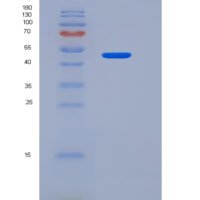
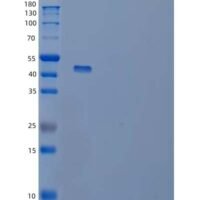
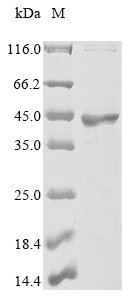
Recombinant Human Ras GTPase-activating protein 1 (RASA1), partial is a recombinant protein from Homo sapiens (Human), expressed in E.coli, covering amino acids 714-1047aa, with N-terminal 10xHis-tagged and C-terminal Myc-tagged tag, molecular weight 45.6kDa, purity Greater than 85% as determined by SDS-PAGE.. Suitable for ELISA and Western Blot applications.