Recombinant Human Retinol-binding protein 4 (RBP4) (Active)

Recombinant Human Retinol-binding protein 4 (RBP4) (Active) — Retinol-binding protein that mediates retinol transport in blood plasma. Purity >90%.

SKU: BCRECP-001523 Category:

Product Specifications

Product SkuBCRECP-001523
Product DescriptionRecombinant Human Retinol-binding protein 4 (RBP4) (Active) Protein is expressed from Mammalian cell with C-terminal hFc1-tagged. It contains 19-201aa. [Accession | P02753].
Uniprot No.P02753
Gene NamesRBP4
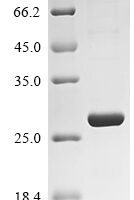
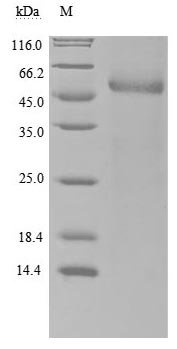
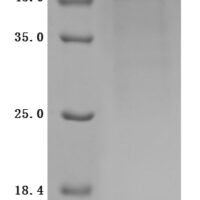
PurityGreater than 90% as determined by SDS-PAGE.
Expression SystemMammalian cell
Expression Region19-201aa
SpeciesHomo sapiens (Human)
Tag InfoC-terminal hFc1-tagged
Molecular weight50.0kDa
ActivityPlease contact us to obtain bioactivity data.
BufferIf the delivery form is liquid, the default storage buffer is Tris/PBS-based buffer, 5%-50% glycerol. If the delivery form is lyophilized powder, the buffer before lyophilization is Tris/PBS-based buffer, 6% Trehalose.
StorageStore at -20°C/-80°C upon receipt, aliquoting is necessary for mutiple use. Avoid repeated freeze-thaw cycles.
Research AreasCancer

Function

Retinol-binding protein that mediates retinol transport in blood plasma. Delivers retinol from the liver stores to the peripheral tissues (Probable). Transfers the bound all-trans retinol to STRA6, that then facilitates retinol transport across the cell membrane.

Biological Context

Subcellular Location: Secreted
Tissue Specificity: Detected in blood plasma and in urine (at protein level)
Disease Association: Retinal dystrophy, iris coloboma, and comedogenic acne syndrome (RDCCAS) : A disease characterized by retinal degeneration, ocular colobomas involving both the anterior and posterior segment, impaired night vision and loss of visual acuity. Additional characteristic features include developmental abnormalities and severe acne. [The disease is caused by variants affecting the gene represented in this entry. Loss of functional RBP4 protein results in serum retinol deficiency. Lack of normal levels of retinol impairs the visual cycle leading to night blindness at early stages; prolonged deficiency may lead to retinal degeneration. Additionally, retinol deficiency may result in dry skin, increased susceptibility to infection and acne ] | Microphthalmia/Coloboma 10 (MCOPCB10) : A disorder of eye formation, ranging from small size of a single eye to complete bilateral absence of ocular tissues. Ocular abnormalities like opacities of the cornea and lens, scaring of the retina and choroid, and other abnormalities may also be present. Ocular colobomas are a set of malformations resulting from abnormal morphogenesis of the optic cup and stalk, and the fusion of the fetal fissure (optic fissure). [The disease is caused by variants affecting the gene represented in this entry]

Product Specifications

Recombinant Human Retinol-binding protein 4 (RBP4) (Active) is a recombinant protein from Homo sapiens (Human), expressed in Mammalian cell, covering amino acids 19-201aa, with C-terminal hFc1-tagged tag, molecular weight 50.0kDa, purity Greater than 90% as determined by SDS-PAGE.. Suitable for ELISA and Western Blot applications.
Recommended applications depend on the target, product format, and product-specific validation data. Refer to the product datasheet or Certificate of Analysis (CoA), or contact BioCrest Sci for application guidance.

Biological Activity: Please contact us to obtain bioactivity data.

Storage: Store at -20°C/-80°C upon receipt, aliquoting is necessary for mutiple use. Avoid repeated freeze-thaw cycles.

Shipping & Lead Time: Availability, shipping conditions, and estimated lead time are confirmed in the formal quotation or order confirmation based on the product format, destination, and order requirements.

Protein Biology

Function

Retinol-binding protein that mediates retinol transport in blood plasma (PubMed:5541771). Delivers retinol from the liver stores to the peripheral tissues (Probable). Transfers the bound all-trans retinol to STRA6, that then facilitates retinol transport across the cell membrane (PubMed:22665496)

Subcellular Location

Secreted

Disease Association

Retinal dystrophy, iris coloboma, and comedogenic acne syndrome (RDCCAS) : A disease characterized by retinal degeneration, ocular colobomas involving both the anterior and posterior segment, impaired night vision and loss of visual acuity. Additional characteristic features include developmental abnormalities and severe acne. [The disease is caused by variants affecting the gene represented in this entry. Loss of functional RBP4 protein results in serum retinol deficiency. Lack of normal levels of retinol impairs the visual cycle leading to night blindness at early stages; prolonged deficiency may lead to retinal degeneration. Additionally, retinol deficiency may result in dry skin, increased susceptibility to infection and acne (PubMed:23189188)] | Microphthalmia/Coloboma 10 (MCOPCB10) : A disorder of eye formation, ranging from small size of a single eye to complete bilateral absence of ocular tissues. Ocular abnormalities like opacities of the cornea and lens, scaring of the retina and choroid, and other abnormalities may also be present. Ocular colobomas are a set of malformations resulting from abnormal morphogenesis of the optic cup and stalk, and the fusion of the fetal fissure (optic fissure). [The disease is caused by variants affecting the gene represented in this entry]

Tissue Specificity

Detected in blood plasma and in urine (at protein level)

Subunit

Interacts with TTR (PubMed:10052934, PubMed:19021760, PubMed:5541771, PubMed:7754382). Interaction with TTR prevents its loss by filtration through the kidney glomeruli (Probable). Interacts with STRA6 (PubMed:22665496, PubMed:25910211)

Gene: RBP4  |  Organism: Homo sapiens  |  Synonyms: Plasma retinol-binding protein
Key Publications

Frequently Asked Questions

How do I order or inquire about this product?

Submit the Online Inquiry form with your required quantity and specifications, or email sales@biocrestsci.com. Available sizes, pricing, stock status, documentation, and estimated lead time are confirmed in the formal quotation.

What is the shipping and delivery time?

Availability, dispatch timing, shipping conditions, and delivery estimates depend on the product format, destination, and order requirements. These details are confirmed in the formal quotation or order confirmation.

How should this product be stored?

Follow the storage and handling instructions in the product-specific datasheet and Certificate of Analysis (CoA). Requirements may vary by product form and formulation; contact BioCrest Sci if product-specific guidance is needed.

What quality controls are performed on your products?

Quality-control data such as identity, purity, endotoxin level, or biological activity are provided only when specified on this product page, the datasheet, or Certificate of Analysis (CoA). Biological activity is not implied unless explicitly stated.

Shopping Cart
Scroll to Top