,

Recombinant Human Sclerostin (SOST), Biotinylated

Recombinant Human Sclerostin (SOST), Biotinylated — recombinant protein from Homo sapiens (Human), expressed in Mammalian cell. Purity >95%.

SKU: BCRECP-001680 Categories: ,

Product Specifications

Product SkuBCRECP-001680
Product DescriptionRecombinant Human Sclerostin (SOST) Protein is expressed from Mammalian cell with N-terminal 10xHis-tagged and C-terminal Avi-tagged. It contains 24-213aa. [Accession | Q9BQB4].
Uniprot No.Q9BQB4
Gene NamesSOST
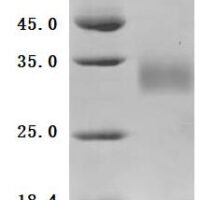
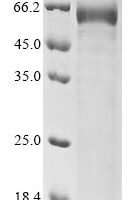
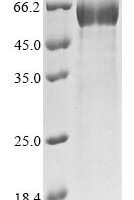
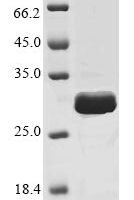
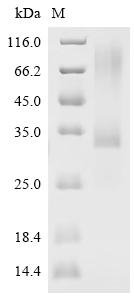
PurityGreater than 95% as determined by SDS-PAGE.
Expression SystemMammalian cell
Expression Region24-213aa
SpeciesHomo sapiens (Human)
Tag InfoN-terminal 10xHis-tagged and C-terminal Avi-tagged
Molecular weight25.0kDa
ActivityPlease contact us to obtain bioactivity data.
BufferIf the delivery form is liquid, the default storage buffer is Tris/PBS-based buffer, 5%-50% glycerol. If the delivery form is lyophilized powder, the buffer before lyophilization is Tris/PBS-based buffer, 6% Trehalose.
StorageStore at -20°C/-80°C upon receipt, aliquoting is necessary for mutiple use. Avoid repeated freeze-thaw cycles.
Research AreasSignal Transduction

Function

Negative regulator of bone growth that acts through inhibition of Wnt signaling and bone formation.

Biological Context

Subcellular Location: Secreted, extracellular space, extracellular matrix
Tissue Specificity: Widely expressed at low levels with highest levels in bone, cartilage, kidney, liver, bone marrow and primary osteoblasts differentiated for 21 days. Detected in the subendothelial layer of the aortic intima (at protein level)
Disease Association: Sclerosteosis 1 (SOST1) : An autosomal recessive sclerosing bone dysplasia characterized by a generalized hyperostosis and sclerosis leading to a markedly thickened skull, with mandible, ribs, clavicles and all long bones also being affected. Due to narrowing of the foramina of the cranial nerves, facial nerve palsy, hearing loss and atrophy of the optic nerves can occur. Sclerosteosis is clinically and radiologically very similar to van Buchem disease, mainly differentiated by hand malformations and a large stature in sclerosteosis patients. [The disease is caused by variants affecting the gene represented in this entry] | Van Buchem disease (VBCH) : VBCH is an autosomal recessive sclerosing bone dysplasia characterized by endosteal hyperostosis of the mandible, skull, ribs, clavicles, and diaphyses of the long bones. Affected patients present a symmetrically increased thickness of bones, most frequently found as an enlarged jawbone, but also an enlargement of the skull, ribs, diaphysis of long bones, as well as tubular bones of hands and feet. The clinical consequence of increased thickness of the skull include facial nerve palsy causing hearing loss, visual problems, neurological pain, and, very rarely, blindness as a consequence of optic atrophy. Serum alkaline phosphatase levels are elevated. [The disease is caused by variants affecting the gene represented in this entry. A 52 kb deletion downstream of SOST results in SOST transcription suppression causing van Buchem disease] | Craniodiaphyseal dysplasia autosomal dominant (CDD) : A severe bone dysplasia characterized by massive generalized hyperostosis and sclerosis, especially involving the skull and facial bones. The sclerosis is so severe that the resulting facial distortion is referred to as 'leontiasis ossea' (leonine faces) and the bone deposition results in progressive stenosis of craniofacial foramina. Respiratory obstruction due to choanal stenosis compromises the clinical outcomes of affected patients. [The disease is caused by variants affecting the gene represented in this entry. Heterozygous mutations located in the secretion signal of the SOST gene prevent sclerostin secretion and can be responsible for craniodiaphyseal dysplasia]

Product Specifications

Recombinant Human Sclerostin (SOST), Biotinylated is a recombinant protein from Homo sapiens (Human), expressed in Mammalian cell, covering amino acids 24-213aa, with N-terminal 10xHis-tagged and C-terminal Avi-tagged tag, molecular weight 25.0kDa, purity Greater than 95% as determined by SDS-PAGE.. Suitable for ELISA and Western Blot applications.

SDS-PAGE: Single band at expected molecular weight confirming purity.

ELISA: Suitable as coating antigen or detection standard.

Western Blot: Compatible with standard Western Blot protocols.

Protein Interaction: Validated for SPR (Surface Plasmon Resonance) and BLI (Bio-Layer Interferometry) studies.

Shipping: Shipped at ambient temperature. Lyophilized protein is stable during transit.

Storage: Store lyophilized protein at -20°C to -80°C. Reconstituted protein should be aliquoted and stored at -80°C. Avoid repeated freeze-thaw cycles.

Shelf Life: 12 months from date of receipt when stored as recommended.

Shipping Time: Orders placed before 2 PM EST ship same day. International orders typically deliver within 5-10 business days.

Protein Biology

Function

Negative regulator of bone growth that acts through inhibition of Wnt signaling and bone formation

Subcellular Location

Secreted, extracellular space, extracellular matrix

Disease Association

Sclerosteosis 1 (SOST1) : An autosomal recessive sclerosing bone dysplasia characterized by a generalized hyperostosis and sclerosis leading to a markedly thickened skull, with mandible, ribs, clavicles and all long bones also being affected. Due to narrowing of the foramina of the cranial nerves, facial nerve palsy, hearing loss and atrophy of the optic nerves can occur. Sclerosteosis is clinically and radiologically very similar to van Buchem disease, mainly differentiated by hand malformations and a large stature in sclerosteosis patients. [The disease is caused by variants affecting the gene represented in this entry] | Van Buchem disease (VBCH) : VBCH is an autosomal recessive sclerosing bone dysplasia characterized by endosteal hyperostosis of the mandible, skull, ribs, clavicles, and diaphyses of the long bones. Affected patients present a symmetrically increased thickness of bones, most frequently found as an enlarged jawbone, but also an enlargement of the skull, ribs, diaphysis of long bones, as well as tubular bones of hands and feet. The clinical consequence of increased thickness of the skull include facial nerve palsy causing hearing loss, visual problems, neurological pain, and, very rarely, blindness as a consequence of optic atrophy. Serum alkaline phosphatase levels are elevated. [The disease is caused by variants affecting the gene represented in this entry. A 52 kb deletion downstream of SOST results in SOST transcription suppression causing van Buchem disease] | Craniodiaphyseal dysplasia autosomal dominant (CDD) : A severe bone dysplasia characterized by massive generalized hyperostosis and sclerosis, especially involving the skull and facial bones. The sclerosis is so severe that the resulting facial distortion is referred to as 'leontiasis ossea' (leonine faces) and the bone deposition results in progressive stenosis of craniofacial foramina. Respiratory obstruction due to choanal stenosis compromises the clinical outcomes of affected patients. [The disease is caused by variants affecting the gene represented in this entry. Heterozygous mutations located in the secretion signal of the SOST gene prevent sclerostin secretion and can be responsible for craniodiaphyseal dysplasia]

Tissue Specificity

Widely expressed at low levels with highest levels in bone, cartilage, kidney, liver, bone marrow and primary osteoblasts differentiated for 21 days. Detected in the subendothelial layer of the aortic intima (at protein level)

Subunit

Interacts with LRP4 (via the extracellular domain); the interaction facilitates the inhibition of Wnt signaling. Interacts with LRP5 (via the first two YWTD-EGF repeat domains); the interaction inhibits Wnt-mediated signaling. Interacts with LRP6

Gene: SOST  |  Organism: Homo sapiens
Key Publications

Frequently Asked Questions

How do I order or inquire about this product?

Fill out the Online Inquiry form with your required quantity and specifications. You can also email sales@biocrestsci.com. Our team typically responds within 4 business hours with a quote and availability confirmation.

What is the shipping and delivery time?

Orders placed before 2 PM EST ship the same day. Domestic (US) delivery typically takes 2-3 business days. International orders deliver within 5-10 business days. All products are shipped at ambient temperature with appropriate packaging to ensure stability.

How should I store this recombinant protein?

Lyophilized proteins should be stored at -20°C to -80°C upon receipt. After reconstitution, aliquot and store at -80°C. Avoid repeated freeze-thaw cycles. Shelf life is 12 months from date of receipt when stored as recommended.

What quality controls are performed on your products?

Each product undergoes SDS-PAGE purity analysis (typically >85-95%), endotoxin testing, and bioactivity validation. Products are validated for ELISA, Western Blot, and SPR/BLI applications as specified on this product page. A Certificate of Analysis (CoA) is available upon request.

Shopping Cart
Scroll to Top