, ,

Recombinant Human Serine protease 56 (PRSS56)

Recombinant Human Serine protease 56 (PRSS56) — recombinant protein from Homo sapiens (Human), expressed in E.coli. Purity >85%.

SKU: BCRECP-001457 Categories: , ,

Product Specifications

Product SkuBCRECP-001457
Product DescriptionRecombinant Human Serine protease 56 (PRSS56) Protein is expressed from E.coli with N-terminal 10xHis-tagged and C-terminal Myc-tagged. It contains 20-603aa. [Accession | P0CW18].
Uniprot No.P0CW18
Gene NamesPRSS56
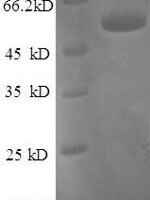
PurityGreater than 85% as determined by SDS-PAGE.
Expression SystemE.coli
Expression Region20-603aa
SpeciesHomo sapiens (Human)
Tag InfoN-terminal 10xHis-tagged and C-terminal Myc-tagged
Molecular weight70.0kDa
ActivityPlease contact us to obtain bioactivity data.
BufferIf the delivery form is liquid, the default storage buffer is Tris/PBS-based buffer, 5%-50% glycerol. If the delivery form is lyophilized powder, the buffer before lyophilization is Tris/PBS-based buffer, 6% Trehalose.
StorageStore at -20°C/-80°C upon receipt, aliquoting is necessary for mutiple use. Avoid repeated freeze-thaw cycles.
Research AreasOthers

Function

Serine protease required during eye development.

Biological Context

Tissue Specificity: Expressed neural retina, cornea, sclera and optic nerve
Disease Association: Microphthalmia, isolated, 6 (MCOP6) : A developmental ocular disorder characterized by small malformed eyes. Clinical features are extreme hyperopia due to short axial length with essentially normal anterior segment, steep corneal curvatures, shallow anterior chamber, thick lenses, and thickened scleral wall. Palpebral fissures appear narrow because of relatively deep-set eyes, visual acuity is mildly to moderately reduced, and anisometropic or strabismic amblyopia is common. The fundus of the eye shows crowded optical disks, tortuous vessels, and an abnormal foveal avascular zone. [The disease is caused by variants affecting the gene represented in this entry]

Product Specifications

Recombinant Human Serine protease 56 (PRSS56) is a recombinant protein from Homo sapiens (Human), expressed in E.coli, covering amino acids 20-603aa, with N-terminal 10xHis-tagged and C-terminal Myc-tagged tag, molecular weight 70.0kDa, purity Greater than 85% as determined by SDS-PAGE.. Suitable for ELISA and Western Blot applications.

Recommended applications depend on the target, product format, and product-specific validation data. Refer to the product datasheet or Certificate of Analysis (CoA), or contact BioCrest Sci for application guidance.

Biological Activity: Please contact us to obtain bioactivity data.

Storage: Store at -20°C/-80°C upon receipt, aliquoting is necessary for mutiple use. Avoid repeated freeze-thaw cycles.

Shipping & Lead Time: Availability, shipping conditions, and estimated lead time are confirmed in the formal quotation or order confirmation based on the product format, destination, and order requirements.

Protein Biology

Function

Serine protease required during eye development

Disease Association

Microphthalmia, isolated, 6 (MCOP6) : A developmental ocular disorder characterized by small malformed eyes. Clinical features are extreme hyperopia due to short axial length with essentially normal anterior segment, steep corneal curvatures, shallow anterior chamber, thick lenses, and thickened scleral wall. Palpebral fissures appear narrow because of relatively deep-set eyes, visual acuity is mildly to moderately reduced, and anisometropic or strabismic amblyopia is common. The fundus of the eye shows crowded optical disks, tortuous vessels, and an abnormal foveal avascular zone. [The disease is caused by variants affecting the gene represented in this entry]

Tissue Specificity

Expressed neural retina, cornea, sclera and optic nerve

Gene: PRSS56  |  Organism: Homo sapiens

Frequently Asked Questions

How do I order or inquire about this product?

Submit the Online Inquiry form with your required quantity and specifications, or email sales@biocrestsci.com. Available sizes, pricing, stock status, documentation, and estimated lead time are confirmed in the formal quotation.

What is the shipping and delivery time?

Availability, dispatch timing, shipping conditions, and delivery estimates depend on the product format, destination, and order requirements. These details are confirmed in the formal quotation or order confirmation.

How should this product be stored?

Follow the storage and handling instructions in the product-specific datasheet and Certificate of Analysis (CoA). Requirements may vary by product form and formulation; contact BioCrest Sci if product-specific guidance is needed.

What quality controls are performed on your products?

Quality-control data such as identity, purity, endotoxin level, or biological activity are provided only when specified on this product page, the datasheet, or Certificate of Analysis (CoA). Biological activity is not implied unless explicitly stated.

Shopping Cart
Scroll to Top