, ,

Recombinant Human Serine/threonine-protein kinase STK11 (STK11)

Recombinant Human Serine/threonine-protein kinase STK11 (STK11) — recombinant protein from Homo sapiens (Human), expressed in E.coli. Purity >90%.

SKU: BCRECP-001711 Categories: , ,

Product Specifications

Product SkuBCRECP-001711
Product DescriptionRecombinant Human Serine/threonine-protein kinase STK11 (STK11) Protein is expressed from E.coli with N-terminal 6xHis-SUMO-tagged. It contains 1-430aa. [Accession | Q15831].
Uniprot No.Q15831
Gene NamesSTK11
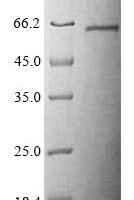
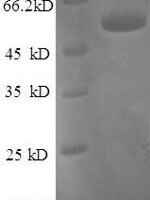
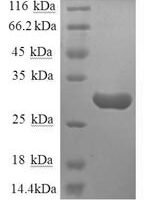
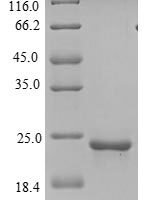
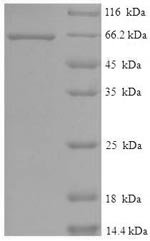
PurityGreater than 90% as determined by SDS-PAGE.
Expression SystemE.coli
Expression Region1-430aa
SpeciesHomo sapiens (Human)
Tag InfoN-terminal 6xHis-SUMO-tagged
Molecular weight64.3kDa
ActivityPlease contact us to obtain bioactivity data.
BufferIf the delivery form is liquid, the default storage buffer is Tris/PBS-based buffer, 5%-50% glycerol. If the delivery form is lyophilized powder, the buffer before lyophilization is Tris/PBS-based buffer, 6% Trehalose.
StorageStore at -20°C/-80°C upon receipt, aliquoting is necessary for mutiple use. Avoid repeated freeze-thaw cycles.
Research AreasApoptosis

Function

Has a role in spermiogenesis.

Biological Context

Subcellular Location: Nucleus; Cytoplasm
Tissue Specificity: Ubiquitously expressed. Strongest expression in testis and fetal liver
Disease Association: Peutz-Jeghers syndrome (PJS) : An autosomal dominant disorder characterized by melanocytic macules of the lips, multiple gastrointestinal hamartomatous polyps and an increased risk for various neoplasms, including gastrointestinal cancer. [The disease is caused by variants affecting the gene represented in this entry] | Testicular germ cell tumor (TGCT) : A common malignancy in males representing 95% of all testicular neoplasms. TGCTs have various pathologic subtypes including: unclassified intratubular germ cell neoplasia, seminoma (including cases with syncytiotrophoblastic cells), spermatocytic seminoma, embryonal carcinoma, yolk sac tumor, choriocarcinoma, and teratoma. [The gene represented in this entry may be involved in disease pathogenesis] | [Defects in STK11 are associated with some sporadic cancers, especially lung cancers. Frequently mutated and inactivated in non-small cell lung cancer (NSCLC). Defects promote lung cancerigenesis process, especially lung cancer progression and metastasis. Confers lung adenocarcinoma the ability to trans-differentiate into squamous cell carcinoma. Also able to promote lung cancer metastasis, via both cancer-cell autonomous and non-cancer-cell autonomous mechanisms]

Product Specifications

Recombinant Human Serine/threonine-protein kinase STK11 (STK11) is a recombinant protein from Homo sapiens (Human), expressed in E.coli, covering amino acids 1-430aa, with N-terminal 6xHis-SUMO-tagged tag, molecular weight 64.3kDa, purity Greater than 90% as determined by SDS-PAGE.. Suitable for ELISA and Western Blot applications.

Recommended applications depend on the target, product format, and product-specific validation data. Refer to the product datasheet or Certificate of Analysis (CoA), or contact BioCrest Sci for application guidance.

Biological Activity: Please contact us to obtain bioactivity data.

Storage: Store at -20°C/-80°C upon receipt, aliquoting is necessary for mutiple use. Avoid repeated freeze-thaw cycles.

Shipping & Lead Time: Availability, shipping conditions, and estimated lead time are confirmed in the formal quotation or order confirmation based on the product format, destination, and order requirements.

Protein Biology

Function

Has a role in spermiogenesis

Subcellular Location

Nucleus; Cytoplasm

Disease Association

Peutz-Jeghers syndrome (PJS) : An autosomal dominant disorder characterized by melanocytic macules of the lips, multiple gastrointestinal hamartomatous polyps and an increased risk for various neoplasms, including gastrointestinal cancer. [The disease is caused by variants affecting the gene represented in this entry] | Testicular germ cell tumor (TGCT) : A common malignancy in males representing 95% of all testicular neoplasms. TGCTs have various pathologic subtypes including: unclassified intratubular germ cell neoplasia, seminoma (including cases with syncytiotrophoblastic cells), spermatocytic seminoma, embryonal carcinoma, yolk sac tumor, choriocarcinoma, and teratoma. [The gene represented in this entry may be involved in disease pathogenesis] | [Defects in STK11 are associated with some sporadic cancers, especially lung cancers. Frequently mutated and inactivated in non-small cell lung cancer (NSCLC). Defects promote lung cancerigenesis process, especially lung cancer progression and metastasis. Confers lung adenocarcinoma the ability to trans-differentiate into squamous cell carcinoma. Also able to promote lung cancer metastasis, via both cancer-cell autonomous and non-cancer-cell autonomous mechanisms]

Tissue Specificity

Ubiquitously expressed. Strongest expression in testis and fetal liver

Subunit

Catalytic component of a trimeric complex composed of STK11/LKB1, STRAD (STRADA or STRADB) and CAB39/MO25 (CAB39/MO25alpha or CAB39L/MO25beta): the complex tethers STK11/LKB1 in the cytoplasm and stimulates its catalytic activity. Found in a ternary complex composed of SMAD4, STK11/LKB1 and STK11IP. Interacts with p53/TP53, SMAD4, STK11IP and WDR6. Interacts with NR4A1. Interacts with NISCH; this interaction may increase STK11 activity. Interacts with PTEN; leading to PTEN phosphorylation. Interacts with SIRT1; the interaction deacetylates STK11. Interacts with CDKN1A

Gene: STK11  |  Organism: Homo sapiens  |  Synonyms: Liver kinase B1; Renal carcinoma antigen NY-REN-19
Key Publications

Frequently Asked Questions

How do I order or inquire about this product?

Submit the Online Inquiry form with your required quantity and specifications, or email sales@biocrestsci.com. Available sizes, pricing, stock status, documentation, and estimated lead time are confirmed in the formal quotation.

What is the shipping and delivery time?

Availability, dispatch timing, shipping conditions, and delivery estimates depend on the product format, destination, and order requirements. These details are confirmed in the formal quotation or order confirmation.

How should this product be stored?

Follow the storage and handling instructions in the product-specific datasheet and Certificate of Analysis (CoA). Requirements may vary by product form and formulation; contact BioCrest Sci if product-specific guidance is needed.

What quality controls are performed on your products?

Quality-control data such as identity, purity, endotoxin level, or biological activity are provided only when specified on this product page, the datasheet, or Certificate of Analysis (CoA). Biological activity is not implied unless explicitly stated.

Shopping Cart
Scroll to Top