Recombinant Human Splicing factor 3B subunit 1 (SF3B1) (S488F), partial

Recombinant Human Splicing factor 3B subunit 1 (SF3B1) (S488F), partial — Component of the 17S U2 SnRNP complex of the spliceosome, a large ribonucleoprotein complex that removes introns from transcribed pre-mRNAs. Purity >90%.

SKU: BCRECP-001622 Category:

Product Specifications

Product SkuBCRECP-001622
Product DescriptionRecombinant Human Splicing factor 3B subunit 1 (SF3B1) (S488F) Protein is expressed from E.coli with N-terminal 10xHis-tagged. It contains 326-571aa(S488F). [Accession | O75533].
Uniprot No.O75533
Gene NamesSF3B1
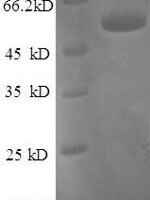
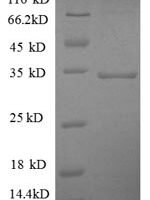
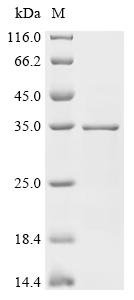
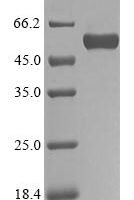
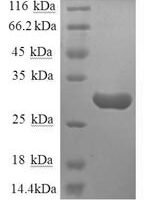
PurityGreater than 90% as determined by SDS-PAGE.
Expression SystemE.coli
Expression Region326-571aa(S488F)
SpeciesHomo sapiens (Human)
Tag InfoN-terminal 10xHis-tagged
Molecular weight33.8kDa
ActivityPlease contact us to obtain bioactivity data.
BufferIf the delivery form is liquid, the default storage buffer is Tris/PBS-based buffer, 5%-50% glycerol. If the delivery form is lyophilized powder, the buffer before lyophilization is Tris/PBS-based buffer, 6% Trehalose.
StorageStore at -20°C/-80°C upon receipt, aliquoting is necessary for mutiple use. Avoid repeated freeze-thaw cycles.
Research AreasEpigenetics and Nuclear Signaling

Function

Component of the 17S U2 SnRNP complex of the spliceosome, a large ribonucleoprotein complex that removes introns from transcribed pre-mRNAs. The 17S U2 SnRNP complex (1) directly participates in early spliceosome assembly and (2) mediates recognition of the intron branch site during pre-mRNA splicing by promoting the selection of the pre-mRNA branch-site adenosine, the nucleophile for the first step of splicing. Within the 17S U2 SnRNP complex, SF3B1 is part of the SF3B subcomplex, which is required for 'A' complex assembly formed by the stable binding of U2 snRNP to the branchpoint sequence in pre-mRNA.

Biological Context

Subcellular Location: Nucleus; Nucleus speckle

Product Specifications

Recombinant Human Splicing factor 3B subunit 1 (SF3B1) (S488F), partial is a recombinant protein from Homo sapiens (Human), expressed in E.coli, covering amino acids 326-571aa(S488F), with N-terminal 10xHis-tagged tag, molecular weight 33.8kDa, purity Greater than 90% as determined by SDS-PAGE.. Suitable for ELISA and Western Blot applications.
Recommended applications depend on the target, product format, and product-specific validation data. Refer to the product datasheet or Certificate of Analysis (CoA), or contact BioCrest Sci for application guidance.

Biological Activity: Please contact us to obtain bioactivity data.

Storage: Store at -20°C/-80°C upon receipt, aliquoting is necessary for mutiple use. Avoid repeated freeze-thaw cycles.

Shipping & Lead Time: Availability, shipping conditions, and estimated lead time are confirmed in the formal quotation or order confirmation based on the product format, destination, and order requirements.

Protein Biology

Function

Component of the 17S U2 SnRNP complex of the spliceosome, a large ribonucleoprotein complex that removes introns from transcribed pre-mRNAs (PubMed:12234937, PubMed:27720643, PubMed:32494006, PubMed:34822310, PubMed:36104565). The 17S U2 SnRNP complex (1) directly participates in early spliceosome assembly and (2) mediates recognition of the intron branch site during pre-mRNA splicing by promoting the selection of the pre-mRNA branch-site adenosine, the nucleophile for the first step of splicing (PubMed:32494006, PubMed:34822310, PubMed:36104565). Within the 17S U2 SnRNP complex, SF3B1 is part of the SF3B subcomplex, which is required for 'A' complex assembly formed by the stable binding of U2 snRNP to the branchpoint sequence in pre-mRNA (PubMed:12234937, PubMed:36104565). Sequence independent binding of SF3A and SF3B subcomplexes upstream of the branch site is essential, it may anchor U2 snRNP to the pre-mRNA (PubMed:12234937). May also be involved in the assembly of the 'E' complex (PubMed:10882114). Also acts as a component of the minor spliceosome, which is involved in the splicing of U12-type introns in pre-mRNAs (PubMed:15146077, PubMed:33509932). Together with other U2 snRNP complex components may also play a role in the selective processing of microRNAs (miRNAs) from the long primary miRNA transcript, pri-miR-17-92 (By similarity)

Subcellular Location

Nucleus; Nucleus speckle

Subunit

Component of the 17S U2 SnRNP complex, a ribonucleoprotein complex that contains small nuclear RNA (snRNA) U2 and a number of specific proteins (PubMed:30567737, PubMed:32494006, PubMed:34822310, PubMed:36797247). Part of the SF3B subcomplex of the 17S U2 SnRNP complex (PubMed:12234937, PubMed:12738865, PubMed:27720643, PubMed:28541300). SF3B associates with the splicing subcomplex SF3A and a 12S RNA unit to form the U2 small nuclear ribonucleoproteins complex (U2 snRNP) (PubMed:12234937). Within the SF3B complex, interacts directly (via HEAT domain) with SF3B3, SF3B5, SF3B6 and (via HEAT domain) with PHF5A (PubMed:16432215, PubMed:21062891, PubMed:27720643, Ref.41). The SF3B subcomplex interacts with U2AF2 (PubMed:27720643). Identified in the spliceosome C complex (PubMed:11991638). Component of the minor (U12-type spliceosome) spliceosome (PubMed:15146077, PubMed:33509932). Within the minor spliceosome complex, interacts with SCNM1 and CRIPT (PubMed:33509932). Component of the B-WICH complex, at least composed of SMARCA5/SNF2H, BAZ1B/WSTF, SF3B1, DEK, MYO1C, ERCC6, MYBBP1A and DDX21 (PubMed:16603771). Phosphorylated form interacts with PPP1R8 (PubMed:12105215). Interacts with PQBP1 (PubMed:23512658). Interacts with RBM17 (PubMed:17589525). Interacts with RBM39 (PubMed:24795046). Interacts with SETX (PubMed:21700224). Interacts with RBM15 (PubMed:26575292). Interacts with USH1G (PubMed:34023904). Interacts with SDE2 (PubMed:34365507). Interacts with U2AF1 (PubMed:34365507). Interacts with CACTIN (PubMed:34365507). Interacts with ZRSR1 (By similarity). Interacts with CYREN (PubMed:37813856)

Gene: SF3B1  |  Organism: Homo sapiens  |  Synonyms: Pre-mRNA-splicing factor SF3b 155 kDa subunit; Spliceosome-associated protein 155
Key Publications

Frequently Asked Questions

How do I order or inquire about this product?

Submit the Online Inquiry form with your required quantity and specifications, or email sales@biocrestsci.com. Available sizes, pricing, stock status, documentation, and estimated lead time are confirmed in the formal quotation.

What is the shipping and delivery time?

Availability, dispatch timing, shipping conditions, and delivery estimates depend on the product format, destination, and order requirements. These details are confirmed in the formal quotation or order confirmation.

How should this product be stored?

Follow the storage and handling instructions in the product-specific datasheet and Certificate of Analysis (CoA). Requirements may vary by product form and formulation; contact BioCrest Sci if product-specific guidance is needed.

What quality controls are performed on your products?

Quality-control data such as identity, purity, endotoxin level, or biological activity are provided only when specified on this product page, the datasheet, or Certificate of Analysis (CoA). Biological activity is not implied unless explicitly stated.

Shopping Cart
Scroll to Top