Function
Bifunctional enzyme with both sucrase and isomaltase activities involved in breakdown of dietary starch oligosaccharides in small intestine. The isomaltase domain hydrolazes alpha-1,6-glycosidic linkages in isomaltose. The sucrase domain cleaves the alpha-1,2-glycosidic linkages in sucrose to form glucose and fructose, and contributes to the cleavage of the alpha-1,4-glycosidic linkage in maltose to form two glucose monosaccharides.
Biological Context
Subcellular Location: Apical cell membrane (Single-pass type II membrane protein)
Tissue Specificity: Expressed in the poorly differentiated crypt cells of the small intestine as well as in the mature villous cells. Expressed at very low levels in the colon
Disease Association: Congenital sucrase-isomaltase deficiency (CSID) : Autosomal recessive intestinal disorder that is clinically characterized by fermentative diarrhea, abdominal pain, and cramps upon ingestion of sugar. The symptoms are the consequence of absent or drastically reduced enzymatic activities of sucrase and isomaltase. The prevalence of CSID is 0.02 % in individuals of European descent and appears to be much higher in Greenland, Alaskan, and Canadian native people. CSID arises due to post-translational perturbations in the intracellular transport, polarized sorting, aberrant processing, and defective function of SI. [The disease is caused by variants affecting the gene represented in this entry]
Pathway: Carbohydrate degradation
Product Specifications
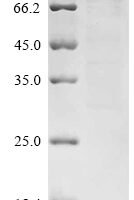
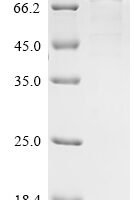
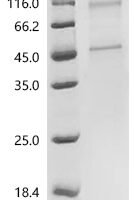
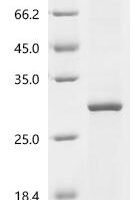
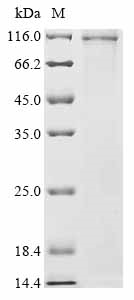
Recombinant Human Sucrase-isomaltase, intestinal (SI), partial Protein is a recombinant protein from Homo sapiens (Human), expressed in in vitro E.coli expression system, covering amino acids 1-1007aa, with C-terminal 6xHis-tagged tag, molecular weight 115.2kDa, purity Greater than 90% as determined by SDS-PAGE.. Suitable for ELISA and Western Blot applications.