Recombinant Human Sucrase-isomaltase, intestinal (SI), partial

Recombinant Human Sucrase-isomaltase, intestinal (SI), partial — Bifunctional enzyme with both sucrase and isomaltase activities involved in breakdown of dietary starch oligosaccharides in small intestine. Purity >85%.

SKU: BCRECP-001630 Category:

Product Specifications

Product SkuBCRECP-001630
Product DescriptionRecombinant Human Sucrase-isomaltase, intestinal (SI) Protein is expressed from Baculovirus with C-terminal 6xHis-tagged. It contains 1008-1827aa. [Accession | P14410].
Uniprot No.P14410
Gene NamesSI
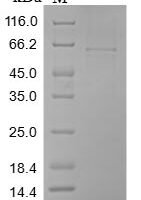
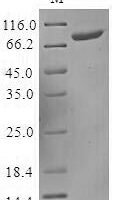
PurityGreater than 85% as determined by SDS-PAGE.
Expression SystemBaculovirus
Expression Region1008-1827aa
SpeciesHomo sapiens (Human)
Tag InfoC-terminal 6xHis-tagged
Molecular weight100.8kDa
ActivityPlease contact us to obtain bioactivity data.
BufferIf the delivery form is liquid, the default storage buffer is Tris/PBS-based buffer, 5%-50% glycerol. If the delivery form is lyophilized powder, the buffer before lyophilization is Tris/PBS-based buffer, 6% Trehalose.
StorageStore at -20°C/-80°C upon receipt, aliquoting is necessary for mutiple use. Avoid repeated freeze-thaw cycles.
Research AreasCancer

Function

Bifunctional enzyme with both sucrase and isomaltase activities involved in breakdown of dietary starch oligosaccharides in small intestine. The isomaltase domain hydrolazes alpha-1,6-glycosidic linkages in isomaltose. The sucrase domain cleaves the alpha-1,2-glycosidic linkages in sucrose to form glucose and fructose, and contributes to the cleavage of the alpha-1,4-glycosidic linkage in maltose to form two glucose monosaccharides.

Biological Context

Subcellular Location: Apical cell membrane (Single-pass type II membrane protein)
Tissue Specificity: Expressed in the poorly differentiated crypt cells of the small intestine as well as in the mature villous cells. Expressed at very low levels in the colon
Disease Association: Congenital sucrase-isomaltase deficiency (CSID) : Autosomal recessive intestinal disorder that is clinically characterized by fermentative diarrhea, abdominal pain, and cramps upon ingestion of sugar. The symptoms are the consequence of absent or drastically reduced enzymatic activities of sucrase and isomaltase. The prevalence of CSID is 0.02 % in individuals of European descent and appears to be much higher in Greenland, Alaskan, and Canadian native people. CSID arises due to post-translational perturbations in the intracellular transport, polarized sorting, aberrant processing, and defective function of SI. [The disease is caused by variants affecting the gene represented in this entry]
Pathway: Carbohydrate degradation

Product Specifications

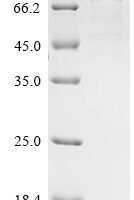
Recombinant Human Sucrase-isomaltase, intestinal (SI), partial is a recombinant protein from Homo sapiens (Human), expressed in Baculovirus, covering amino acids 1008-1827aa, with C-terminal 6xHis-tagged tag, molecular weight 100.8kDa, purity Greater than 85% as determined by SDS-PAGE.. Suitable for ELISA and Western Blot applications.
Recommended applications depend on the target, product format, and product-specific validation data. Refer to the product datasheet or Certificate of Analysis (CoA), or contact BioCrest Sci for application guidance.

Biological Activity: Please contact us to obtain bioactivity data.

Storage: Store at -20°C/-80°C upon receipt, aliquoting is necessary for mutiple use. Avoid repeated freeze-thaw cycles.

Shipping & Lead Time: Availability, shipping conditions, and estimated lead time are confirmed in the formal quotation or order confirmation based on the product format, destination, and order requirements.

Protein Biology

Function

Bifunctional enzyme with both sucrase and isomaltase activities involved in breakdown of dietary starch oligosaccharides in small intestine. The isomaltase domain hydrolazes alpha-1,6-glycosidic linkages in isomaltose. The sucrase domain cleaves the alpha-1,2-glycosidic linkages in sucrose to form glucose and fructose, and contributes to the cleavage of the alpha-1,4-glycosidic linkage in maltose to form two glucose monosaccharides

Subcellular Location

Apical cell membrane (Single-pass type II membrane protein)

Disease Association

Congenital sucrase-isomaltase deficiency (CSID) : Autosomal recessive intestinal disorder that is clinically characterized by fermentative diarrhea, abdominal pain, and cramps upon ingestion of sugar. The symptoms are the consequence of absent or drastically reduced enzymatic activities of sucrase and isomaltase. The prevalence of CSID is 0.02 % in individuals of European descent and appears to be much higher in Greenland, Alaskan, and Canadian native people. CSID arises due to post-translational perturbations in the intracellular transport, polarized sorting, aberrant processing, and defective function of SI. [The disease is caused by variants affecting the gene represented in this entry]

Tissue Specificity

Expressed in the poorly differentiated crypt cells of the small intestine as well as in the mature villous cells. Expressed at very low levels in the colon

Subunit

Homodimers (PubMed:20356844). The two subunits produced by proteolytic cleavage, the sucrase and isomaltase subunits remain associated as a complex through non-covalent interactions (PubMed:20356844)

Pathway

Carbohydrate degradation

Gene: SI  |  Organism: Homo sapiens
Key Publications

Frequently Asked Questions

How do I order or inquire about this product?

Submit the Online Inquiry form with your required quantity and specifications, or email sales@biocrestsci.com. Available sizes, pricing, stock status, documentation, and estimated lead time are confirmed in the formal quotation.

What is the shipping and delivery time?

Availability, dispatch timing, shipping conditions, and delivery estimates depend on the product format, destination, and order requirements. These details are confirmed in the formal quotation or order confirmation.

How should this product be stored?

Follow the storage and handling instructions in the product-specific datasheet and Certificate of Analysis (CoA). Requirements may vary by product form and formulation; contact BioCrest Sci if product-specific guidance is needed.

What quality controls are performed on your products?

Quality-control data such as identity, purity, endotoxin level, or biological activity are provided only when specified on this product page, the datasheet, or Certificate of Analysis (CoA). Biological activity is not implied unless explicitly stated.

Shopping Cart
Scroll to Top