Recombinant Human Transcription factor 7-like 2 (TCF7L2), partial

Recombinant Human Transcription factor 7-like 2 (TCF7L2), partial — Participates in the Wnt signaling pathway and modulates MYC expression by binding to its promoter in a sequence-specific manner. Purity >90%.

SKU: BCRECP-001743 Category:

Product Specifications

Product SkuBCRECP-001743
Product DescriptionRecombinant Human Transcription factor 7-like 2 (TCF7L2) Protein is expressed from E.coli with N-terminal 6xHis-tagged. It contains 1-456aa. [Accession | Q9NQB0].
Uniprot No.Q9NQB0
Gene NamesTCF7L2
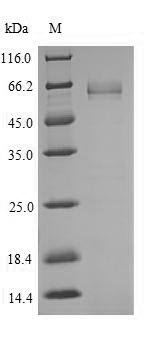
PurityGreater than 90% as determined by SDS-PAGE.
Expression SystemE.coli
Expression Region1-456aa
SpeciesHomo sapiens (Human)
Tag InfoN-terminal 6xHis-tagged
Molecular weight54.9kDa
ActivityPlease contact us to obtain bioactivity data.
BufferIf the delivery form is liquid, the default storage buffer is Tris/PBS-based buffer, 5%-50% glycerol. If the delivery form is lyophilized powder, the buffer before lyophilization is Tris/PBS-based buffer, 6% Trehalose.
StorageStore at -20°C/-80°C upon receipt, aliquoting is necessary for mutiple use. Avoid repeated freeze-thaw cycles.
Research AreasEpigenetics and Nuclear Signaling

Function

Participates in the Wnt signaling pathway and modulates MYC expression by binding to its promoter in a sequence-specific manner. Acts as a repressor in the absence of CTNNB1, and as activator in its presence. Activates transcription from promoters with several copies of the Tcf motif 5'-CCTTTGATC-3' in the presence of CTNNB1.

Biological Context

Subcellular Location: Nucleus, PML body; Nucleus
Tissue Specificity: Detected in epithelium from small intestine, with the highest expression at the top of the crypts and a gradient of expression from crypt to villus. Detected in colon epithelium and colon cancer, and in epithelium from mammary gland and carcinomas derived therefrom
Disease Association: [Constitutive activation and subsequent transactivation of target genes may lead to the maintenance of stem-cell characteristics (cycling and longevity) in cells that should normally undergo terminal differentiation and constitute the primary transforming event in colorectal cancer (CRC)] | Type 2 diabetes mellitus (T2D) : A multifactorial disorder of glucose homeostasis caused by a lack of sensitivity to insulin. Affected individuals usually have an obese body habitus and manifestations of a metabolic syndrome characterized by diabetes, insulin resistance, hypertension and hypertriglyceridemia. The disease results in long-term complications that affect the eyes, kidneys, nerves, and blood vessels. [Disease susceptibility is associated with variants affecting the gene represented in this entry]

Product Specifications

Recombinant Human Transcription factor 7-like 2 (TCF7L2), partial is a recombinant protein from Homo sapiens (Human), expressed in E.coli, covering amino acids 1-456aa, with N-terminal 6xHis-tagged tag, molecular weight 54.9kDa, purity Greater than 90% as determined by SDS-PAGE.. Suitable for ELISA and Western Blot applications.
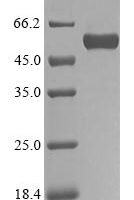
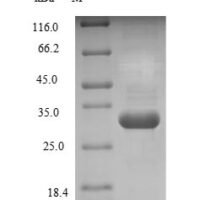
SDS-PAGE: Single band at expected molecular weight confirming purity.

ELISA: Suitable as coating antigen or detection standard.

Western Blot: Compatible with standard Western Blot protocols.

Protein Interaction: Validated for SPR (Surface Plasmon Resonance) and BLI (Bio-Layer Interferometry) studies.

Shipping: Shipped at ambient temperature. Lyophilized protein is stable during transit.

Storage: Store lyophilized protein at -20°C to -80°C. Reconstituted protein should be aliquoted and stored at -80°C. Avoid repeated freeze-thaw cycles.

Shelf Life: 12 months from date of receipt when stored as recommended.

Shipping Time: Orders placed before 2 PM EST ship same day. International orders typically deliver within 5-10 business days.

Protein Biology

Function

Participates in the Wnt signaling pathway and modulates MYC expression by binding to its promoter in a sequence-specific manner. Acts as a repressor in the absence of CTNNB1, and as activator in its presence. Activates transcription from promoters with several copies of the Tcf motif 5'-CCTTTGATC-3' in the presence of CTNNB1. TLE1, TLE2, TLE3 and TLE4 repress transactivation mediated by TCF7L2/TCF4 and CTNNB1. Expression of dominant-negative mutants results in cell-cycle arrest in G1. Necessary for the maintenance of the epithelial stem-cell compartment of the small intestine

Subcellular Location

Nucleus, PML body; Nucleus

Disease Association

[Constitutive activation and subsequent transactivation of target genes may lead to the maintenance of stem-cell characteristics (cycling and longevity) in cells that should normally undergo terminal differentiation and constitute the primary transforming event in colorectal cancer (CRC)] | Type 2 diabetes mellitus (T2D) : A multifactorial disorder of glucose homeostasis caused by a lack of sensitivity to insulin. Affected individuals usually have an obese body habitus and manifestations of a metabolic syndrome characterized by diabetes, insulin resistance, hypertension and hypertriglyceridemia. The disease results in long-term complications that affect the eyes, kidneys, nerves, and blood vessels. [Disease susceptibility is associated with variants affecting the gene represented in this entry]

Tissue Specificity

Detected in epithelium from small intestine, with the highest expression at the top of the crypts and a gradient of expression from crypt to villus. Detected in colon epithelium and colon cancer, and in epithelium from mammary gland and carcinomas derived therefrom

Subunit

Interacts with TGFB1I1 (By similarity). Interacts with CTNNB1 (via the armadillo repeat); forms stable transcription complex (PubMed:10080941, PubMed:17052462, PubMed:19816403, PubMed:28829046, PubMed:29739711, PubMed:9065401, PubMed:9916915). Interacts with EP300. Interacts with NLK. Interacts with CCDC85B (probably through the HMG box); prevents interaction with CTNNB1. Interacts with TNIK. Interacts with MAD2L2; prevents TCF7L2/TCF4 binding to promZIPK/DAPK3oters, negatively modulating its transcriptional activity. Interacts with ZIPK/DAPK3. Interacts with XIAP/BIRC4 and TLE3. Interacts with DDIT3/CHOP. The CTNNB1 and TCF7L2/TCF4 complex interacts with PML (isoform PML-4). Identified in a complex with CTNNB1 and FERMT2. Interacts with SPIN1 (PubMed:22258766, PubMed:24589551, PubMed:29061846). Interacts with C11orf84/SPINDOC in a SPIN1-dependent manner (PubMed:29061846). Interacts with DAZAP2; the interaction results in localization of DAZAP2 to the nucleus (PubMed:19304756)

Gene: TCF7L2  |  Organism: Homo sapiens  |  Synonyms: HMG box transcription factor 4; T-cell-specific transcription factor 4
Key Publications

Frequently Asked Questions

How do I order or inquire about this product?

Fill out the Online Inquiry form with your required quantity and specifications. You can also email sales@biocrestsci.com. Our team typically responds within 4 business hours with a quote and availability confirmation.

What is the shipping and delivery time?

Orders placed before 2 PM EST ship the same day. Domestic (US) delivery typically takes 2-3 business days. International orders deliver within 5-10 business days. All products are shipped at ambient temperature with appropriate packaging to ensure stability.

How should I store this recombinant protein?

Lyophilized proteins should be stored at -20°C to -80°C upon receipt. After reconstitution, aliquot and store at -80°C. Avoid repeated freeze-thaw cycles. Shelf life is 12 months from date of receipt when stored as recommended.

What quality controls are performed on your products?

Each product undergoes SDS-PAGE purity analysis (typically >85-95%), endotoxin testing, and bioactivity validation. Products are validated for ELISA, Western Blot, and SPR/BLI applications as specified on this product page. A Certificate of Analysis (CoA) is available upon request.

Shopping Cart
Scroll to Top