,

Recombinant Human Transforming growth factor beta-3 proprotein (TGFB3) (Active)

Recombinant Human Transforming growth factor beta-3 proprotein (TGFB3) (Active) — Transforming growth factor beta-3: Multifunctional protein that regulates embryogenesis and cell differentiation and is required in various processes such as secondary palate development. Purity >95%.

SKU: BCACP-000566 Categories: ,
Product SKUBCACP-000566
Product DescriptionRecombinant Human Transforming growth factor beta-3 proprotein (TGFB3) protein is expressed from Mammalian cell with N-terminal 10xHis-tagged. It contains 24-412aa. [Accession | P10600].
Uniprot No.P10600
Gene NamesTGFB3
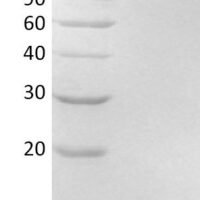
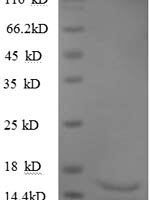
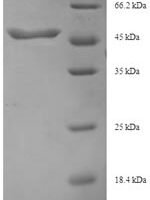
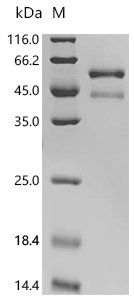
PurityGreater than 95% as determined by SDS-PAGE.
Expression SystemMammalian cell
Expression Region24-412aa
SpeciesHomo sapiens (Human)
Tag InfoN-terminal 10xHis-tagged
Molecular weight46.2 kDa
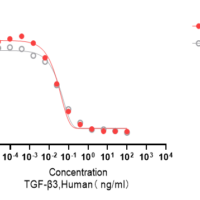
ActivityMeasured by its binding ability in a functional ELISA.Immobilized Mouse Kit at 2 μg/mL can bind Mouse Kitlg. The EC50 is 19.35-24.80 ng/mL.;Recombinant Mouse Kitlg captured on Protein A Chip can bind Recombinant Mouse Kit with an affinity constant of 15.1 nM as detected by MetaSPR Assay (WeSPRTM 200).
BufferLyophilized from a 0.2 μm filtered 20 mM Tris-HCl, 0.5 M NaCl, 6% Trehalose, pH 8.0
StorageStore at -20°C/-80°C upon receipt, aliquoting is necessary for mutiple use. Avoid repeated freeze-thaw cycles.
Alternative NamesTransforming growth factor beta-3 proprotein [Cleaved into: Latency-associated peptide; LAP; Transforming growth factor beta-3; TGF-beta-3]

Function

Transforming growth factor beta-3: Multifunctional protein that regulates embryogenesis and cell differentiation and is required in various processes such as secondary palate development. Activation into mature form follows different steps: following cleavage of the proprotein in the Golgi apparatus, Latency-associated peptide (LAP) and Transforming growth factor beta-3 (TGF-beta-3) chains remain non-covalently linked rendering TGF-beta-3 inactive during storage in extracellular matrix. At the same time, LAP chain interacts with 'milieu molecules', such as LTBP1 and LRRC32/GARP that control activation of TGF-beta-3 and maintain it in a latent state during storage in extracellular milieus.

Biological Context

Subcellular Location: Secreted
Disease Association: Arrhythmogenic right ventricular dysplasia, familial, 1 (ARVD1) : A congenital heart disease characterized by infiltration of adipose and fibrous tissue into the right ventricle and loss of myocardial cells, resulting in ventricular and supraventricular arrhythmias. [The disease is caused by variants affecting the gene represented in this entry] | Loeys-Dietz syndrome 5 (LDS5) : A form of Loeys-Dietz syndrome, a syndrome with widespread systemic involvement characterized by arterial tortuosity and aneurysms, hypertelorism, and bifid uvula or cleft palate. LDS5 additional variable features include mitral valve disease, skeletal overgrowth, cervical spine instability, and clubfoot deformity. LDS5 patients do not manifest remarkable aortic or arterial tortuosity, and there is no strong evidence for early aortic dissection. [The disease is caused by variants affecting the gene represented in this entry]

Product Specifications

Recombinant Human Transforming growth factor beta-3 proprotein (TGFB3) (Active) is a recombinant protein from Homo sapiens (Human), expressed in Mammalian cell, covering amino acids 24-412aa, with N-terminal 10xHis-tagged tag, molecular weight 46.2 kDa, purity Greater than 95% as determined by SDS-PAGE.. Suitable for ELISA and Western Blot applications.

SDS-PAGE: Single band at expected molecular weight confirming purity.

ELISA: Suitable as coating antigen or detection standard.

Western Blot: Compatible with standard Western Blot protocols.

Protein Interaction: Validated for SPR (Surface Plasmon Resonance) and BLI (Bio-Layer Interferometry) studies.

Shipping: Shipped at ambient temperature. Lyophilized protein is stable during transit.

Storage: Store lyophilized protein at -20°C to -80°C. Reconstituted protein should be aliquoted and stored at -80°C. Avoid repeated freeze-thaw cycles.

Shelf Life: 12 months from date of receipt when stored as recommended.

Shipping Time: Orders placed before 2 PM EST ship same day. International orders typically deliver within 5-10 business days.

Protein Biology

Function

Transforming growth factor beta-3: Multifunctional protein that regulates embryogenesis and cell differentiation and is required in various processes such as secondary palate development (By similarity). Activation into mature form follows different steps: following cleavage of the proprotein in the Golgi apparatus, Latency-associated peptide (LAP) and Transforming growth factor beta-3 (TGF-beta-3) chains remain non-covalently linked rendering TGF-beta-3 inactive during storage in extracellular matrix (By similarity). At the same time, LAP chain interacts with 'milieu molecules', such as LTBP1 and LRRC32/GARP that control activation of TGF-beta-3 and maintain it in a latent state during storage in extracellular milieus (By similarity). TGF-beta-3 is released from LAP by integrins: integrin-binding results in distortion of the LAP chain and subsequent release of the active TGF-beta-3 (By similarity). Once activated following release of LAP, TGF-beta-3 acts by binding to TGF-beta receptors (TGFBR1 and TGFBR2), which transduce signal (By similarity)

Subcellular Location

Secreted

Disease Association

Arrhythmogenic right ventricular dysplasia, familial, 1 (ARVD1) : A congenital heart disease characterized by infiltration of adipose and fibrous tissue into the right ventricle and loss of myocardial cells, resulting in ventricular and supraventricular arrhythmias. [The disease is caused by variants affecting the gene represented in this entry] | Loeys-Dietz syndrome 5 (LDS5) : A form of Loeys-Dietz syndrome, a syndrome with widespread systemic involvement characterized by arterial tortuosity and aneurysms, hypertelorism, and bifid uvula or cleft palate. LDS5 additional variable features include mitral valve disease, skeletal overgrowth, cervical spine instability, and clubfoot deformity. LDS5 patients do not manifest remarkable aortic or arterial tortuosity, and there is no strong evidence for early aortic dissection. [The disease is caused by variants affecting the gene represented in this entry]

Subunit

Interacts with ASPN (PubMed:8819159). Latency-associated peptide: Homodimer; disulfide-linked. Latency-associated peptide: Interacts with Transforming growth factor beta-3 (TGF-beta-3) chain; interaction is non-covalent and maintains (TGF-beta-3) in a latent state (By similarity). Latency-associated peptide: Interacts with LRRC32/GARP; leading to regulate activation of TGF-beta-3 and promote epithelial fusion during palate development (By similarity). Latency-associated peptide: Interacts (via cell attachment site) with integrins, leading to release of the active TGF-beta-3 (By similarity). Transforming growth factor beta-3: Homodimer; disulfide-linked (PubMed:8819159). Transforming growth factor beta-3: Interacts with TGF-beta receptors (TGFBR1 and TGFBR2), leading to signal transduction (By similarity)

Gene: TGFB3  |  Organism: Homo sapiens

Frequently Asked Questions

How do I order or inquire about this product?

Fill out the Online Inquiry form with your required quantity and specifications. You can also email sales@biocrestsci.com. Our team typically responds within 4 business hours with a quote and availability confirmation.

What is the shipping and delivery time?

Orders placed before 2 PM EST ship the same day. Domestic (US) delivery typically takes 2-3 business days. International orders deliver within 5-10 business days. All products are shipped at ambient temperature with appropriate packaging to ensure stability.

How should I store this recombinant protein?

Lyophilized proteins should be stored at -20°C to -80°C upon receipt. After reconstitution, aliquot and store at -80°C. Avoid repeated freeze-thaw cycles. Shelf life is 12 months from date of receipt when stored as recommended.

What quality controls are performed on your products?

Each product undergoes SDS-PAGE purity analysis (typically >85-95%), endotoxin testing, and bioactivity validation. Products are validated for ELISA, Western Blot, and SPR/BLI applications as specified on this product page. A Certificate of Analysis (CoA) is available upon request.

Shopping Cart
Scroll to Top