Recombinant human Trichohyalin (TCHH), partial

Recombinant human Trichohyalin (TCHH), partial — Intermediate filament-associated protein that associates in regular arrays with keratin intermediate filaments (KIF) of the inner root sheath cells of the hair follicle and the granular layer of th… Purity >85%.

SKU: BCRECP-001744 Category:

Product Specifications

Product SkuBCRECP-001744
Product DescriptionRecombinant human Trichohyalin (TCHH) Protein is expressed from E.coli with N-terminal 10xHis-tagged and C-terminal Myc-tagged. It contains 1854-1943aa. [Accession | Q07283].
Uniprot No.Q07283
Gene NamesTCHH
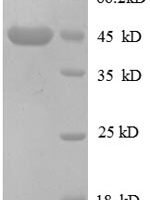
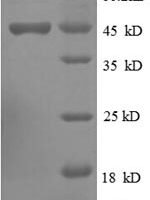
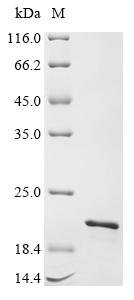
PurityGreater than 85% as determined by SDS-PAGE.
Expression SystemE.coli
Expression Region1854-1943aa
SpeciesHomo sapiens (Human)
Tag InfoN-terminal 10xHis-tagged and C-terminal Myc-tagged
Molecular weight18.6kDa
ActivityPlease contact us to obtain bioactivity data.
BufferIf the delivery form is liquid, the default storage buffer is Tris/PBS-based buffer, 5%-50% glycerol. If the delivery form is lyophilized powder, the buffer before lyophilization is Tris/PBS-based buffer, 6% Trehalose.
StorageStore at -20°C/-80°C upon receipt, aliquoting is necessary for mutiple use. Avoid repeated freeze-thaw cycles.
Research AreasOthers

Function

Intermediate filament-associated protein that associates in regular arrays with keratin intermediate filaments (KIF) of the inner root sheath cells of the hair follicle and the granular layer of the epidermis. It later becomes cross-linked to KIF by isodipeptide bonds. It may serve as scaffold protein, together with involucrin, in the organization of the cell envelope or even anchor the cell envelope to the KIF network.

Biological Context

Tissue Specificity: Found in the hard keratinizing tissues such as the inner root sheath (IRS) of hair follicles and medulla, and in the filiform papillae of dorsal tongue epithelium
Disease Association: Uncombable hair syndrome 3 (UHS3) : A form of uncombable hair syndrome, a condition characterized by scalp hair that is impossible to comb due to the haphazard arrangement of the hair bundles. A characteristic morphologic feature is a triangular to reniform to heart shape on cross-sections, and a groove, canal or flattening along the entire length of the hair. Most individuals are affected early in childhood and the hair takes on a spun-glass appearance with the hair becoming dry, curly, glossy, lighter in color, and progressively uncombable. The hair growth rate can range from slow to normal, and the condition improves with age. [The disease is caused by variants affecting the gene represented in this entry]

Product Specifications

Recombinant human Trichohyalin (TCHH), partial is a recombinant protein from Homo sapiens (Human), expressed in E.coli, covering amino acids 1854-1943aa, with N-terminal 10xHis-tagged and C-terminal Myc-tagged tag, molecular weight 18.6kDa, purity Greater than 85% as determined by SDS-PAGE.. Suitable for ELISA and Western Blot applications.
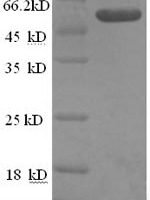
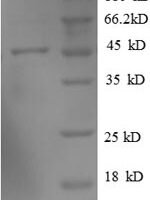
SDS-PAGE: Single band at expected molecular weight confirming purity.

ELISA: Suitable as coating antigen or detection standard.

Western Blot: Compatible with standard Western Blot protocols.

Protein Interaction: Validated for SPR (Surface Plasmon Resonance) and BLI (Bio-Layer Interferometry) studies.

Shipping: Shipped at ambient temperature. Lyophilized protein is stable during transit.

Storage: Store lyophilized protein at -20°C to -80°C. Reconstituted protein should be aliquoted and stored at -80°C. Avoid repeated freeze-thaw cycles.

Shelf Life: 12 months from date of receipt when stored as recommended.

Shipping Time: Orders placed before 2 PM EST ship same day. International orders typically deliver within 5-10 business days.

Protein Biology

Function

Intermediate filament-associated protein that associates in regular arrays with keratin intermediate filaments (KIF) of the inner root sheath cells of the hair follicle and the granular layer of the epidermis. It later becomes cross-linked to KIF by isodipeptide bonds. It may serve as scaffold protein, together with involucrin, in the organization of the cell envelope or even anchor the cell envelope to the KIF network. It may be involved in its own calcium-dependent postsynthetic processing during terminal differentiation

Disease Association

Uncombable hair syndrome 3 (UHS3) : A form of uncombable hair syndrome, a condition characterized by scalp hair that is impossible to comb due to the haphazard arrangement of the hair bundles. A characteristic morphologic feature is a triangular to reniform to heart shape on cross-sections, and a groove, canal or flattening along the entire length of the hair. Most individuals are affected early in childhood and the hair takes on a spun-glass appearance with the hair becoming dry, curly, glossy, lighter in color, and progressively uncombable. The hair growth rate can range from slow to normal, and the condition improves with age. [The disease is caused by variants affecting the gene represented in this entry]

Tissue Specificity

Found in the hard keratinizing tissues such as the inner root sheath (IRS) of hair follicles and medulla, and in the filiform papillae of dorsal tongue epithelium

Subunit

Monomer

Gene: TCHH  |  Organism: Homo sapiens

Frequently Asked Questions

How do I order or inquire about this product?

Fill out the Online Inquiry form with your required quantity and specifications. You can also email sales@biocrestsci.com. Our team typically responds within 4 business hours with a quote and availability confirmation.

What is the shipping and delivery time?

Orders placed before 2 PM EST ship the same day. Domestic (US) delivery typically takes 2-3 business days. International orders deliver within 5-10 business days. All products are shipped at ambient temperature with appropriate packaging to ensure stability.

How should I store this recombinant protein?

Lyophilized proteins should be stored at -20°C to -80°C upon receipt. After reconstitution, aliquot and store at -80°C. Avoid repeated freeze-thaw cycles. Shelf life is 12 months from date of receipt when stored as recommended.

What quality controls are performed on your products?

Each product undergoes SDS-PAGE purity analysis (typically >85-95%), endotoxin testing, and bioactivity validation. Products are validated for ELISA, Western Blot, and SPR/BLI applications as specified on this product page. A Certificate of Analysis (CoA) is available upon request.

Shopping Cart
Scroll to Top