Function
Acts as a decoy receptor for TNFSF11/RANKL and thereby neutralizes its function in osteoclastogenesis. Inhibits the activation of osteoclasts and promotes osteoclast apoptosis in vitro. Bone homeostasis seems to depend on the local ratio between TNFSF11 and TNFRSF11B.
Biological Context
Subcellular Location: Secreted
Tissue Specificity: Highly expressed in adult lung, heart, kidney, liver, spleen, thymus, prostate, ovary, small intestine, thyroid, lymph node, trachea, adrenal gland, testis, and bone marrow. Detected at very low levels in brain, placenta and skeletal muscle. Highly expressed in fetal kidney, liver and lung
Disease Association: Paget disease of bone 5, juvenile-onset (PDB5) : An autosomal recessive, juvenile-onset form of Paget disease, a disorder of bone remodeling characterized by increased bone turnover affecting one or more sites throughout the skeleton, primarily the axial skeleton. Osteoclastic overactivity followed by compensatory osteoblastic activity leads to a structurally disorganized mosaic of bone (woven bone), which is mechanically weaker, larger, less compact, more vascular, and more susceptible to fracture than normal adult lamellar bone. PDB5 clinical manifestations include short stature, progressive long bone deformities, fractures, vertebral collapse, skull enlargement, and hyperostosis with progressive deafness. [The disease is caused by variants affecting the gene represented in this entry]
Product Specifications
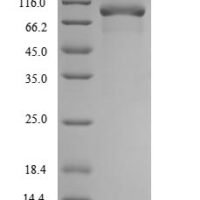
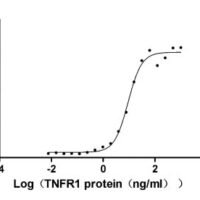
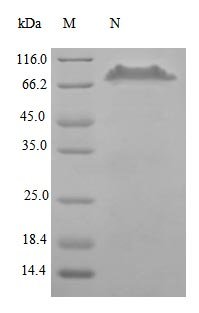
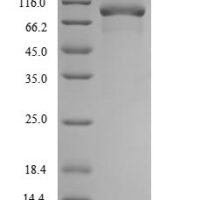
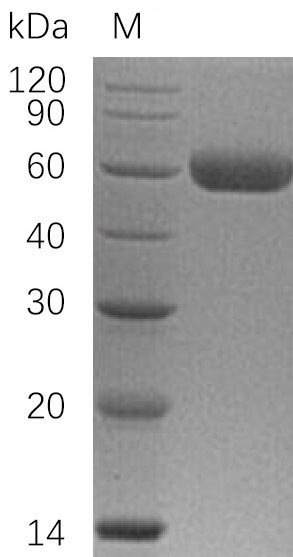
Recombinant Human Tumor necrosis factor receptor superfamily member 11B (TNFRSF11B) (Active) is a recombinant protein from Homo sapiens (Human), expressed in Mammalian cell, covering amino acids 22-401aa, with C-terminal 6xHis-tagged tag, molecular weight 44.65 kDa, purity Greater than 95% as determined by SDS-PAGE.. Suitable for ELISA and Western Blot applications. Explore more TNF Family proteins →