, , ,

Recombinant Macaca fascicularis Low affinity immunoglobulin gamma Fc region receptor III (FCGR3A), partial, Biotinylated (Active)

Recombinant Macaca fascicularis Low affinity immunoglobulin gamma Fc region receptor III (FCGR3A), partial, Biotinylated (Active) — Receptor for the invariable Fc fragment of immunoglobulin gamma (IgG). Purity >95%.

Product Specifications

Product SkuBCRECP-002716
Product DescriptionRecombinant Macaca fascicularis Low affinity immunoglobulin gamma Fc region receptor III (FCGR3A) Protein is expressed from Mammalian cell with C-terminal 10xHis-Avi-tagged. It contains 17-208aa. [Accession | Q8SPW2].
Uniprot No.Q8SPW2
Gene NamesFCGR3A
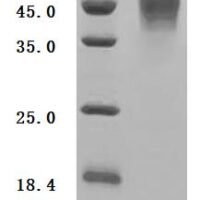
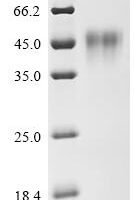
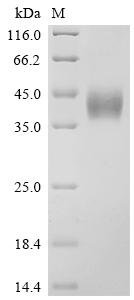
PurityGreater than 95% as determined by SDS-PAGE.
Expression SystemMammalian cell
Expression Region17-208aa
SpeciesMacaca fascicularis (Crab-eating macaque) (Cynomolgus monkey)
Tag InfoC-terminal 10xHis-Avi-tagged
Molecular weight26.9kDa
ActivityPlease contact us to obtain bioactivity data.
BufferIf the delivery form is liquid, the default storage buffer is Tris/PBS-based buffer, 5%-50% glycerol. If the delivery form is lyophilized powder, the buffer before lyophilization is Tris/PBS-based buffer, 6% Trehalose.
StorageStore at -20°C/-80°C upon receipt, aliquoting is necessary for mutiple use. Avoid repeated freeze-thaw cycles.
Research AreasImmunology

Function

Receptor for the invariable Fc fragment of immunoglobulin gamma (IgG). Optimally activated upon binding of clustered antigen-IgG complexes displayed on cell surfaces, triggers lysis of antibody-coated cells, a process known as antibody-dependent cellular cytotoxicity (ADCC). Does not bind free monomeric IgG, thus avoiding inappropriate effector cell activation in the absence of antigenic trigger.

Biological Context

Subcellular Location: Cell membrane (Single-pass type I membrane protein); Secreted
Tissue Specificity: Lymphocytes and monocytes

Product Specifications

Recombinant Macaca fascicularis Low affinity immunoglobulin gamma Fc region receptor III (FCGR3A), partial, Biotinylated (Active) is a recombinant protein from Macaca fascicularis (Crab-eating macaque) (Cynomolgus monkey), expressed in Mammalian cell, covering amino acids 17-208aa, with C-terminal 10xHis-Avi-tagged tag, molecular weight 26.9kDa, purity Greater than 95% as determined by SDS-PAGE.. Suitable for ELISA and Western Blot applications.

Recommended applications depend on the target, product format, and product-specific validation data. Refer to the product datasheet or Certificate of Analysis (CoA), or contact BioCrest Sci for application guidance.

Biological Activity: Please contact us to obtain bioactivity data.

Storage: Store at -20°C/-80°C upon receipt, aliquoting is necessary for mutiple use. Avoid repeated freeze-thaw cycles.

Shipping & Lead Time: Availability, shipping conditions, and estimated lead time are confirmed in the formal quotation or order confirmation based on the product format, destination, and order requirements.

Protein Biology

Function

Receptor for the invariable Fc fragment of immunoglobulin gamma (IgG). Optimally activated upon binding of clustered antigen-IgG complexes displayed on cell surfaces, triggers lysis of antibody-coated cells, a process known as antibody-dependent cellular cytotoxicity (ADCC). Does not bind free monomeric IgG, thus avoiding inappropriate effector cell activation in the absence of antigenic trigger (By similarity). Mediates IgG effector functions on natural killer (NK) cells. Binds antigen-IgG complexes generated upon infection and triggers NK cell-dependent cytokine production and degranulation to limit viral load and propagation. Involved in the generation of memory-like adaptive NK cells capable to produce high amounts of IFNG and to efficiently eliminate virus-infected cells via ADCC. Regulates NK cell survival and proliferation, in particular by preventing NK cell progenitor apoptosis (By similarity). Fc-binding subunit that associates with CD247 and/or FCER1G adapters to form functional signaling complexes. Following the engagement of antigen-IgG complexes, triggers phosphorylation of immunoreceptor tyrosine-based activation motif (ITAM)-containing adapters with subsequent activation of phosphatidylinositol 3-kinase signaling and sustained elevation of intracellular calcium that ultimately drive NK cell activation. The ITAM-dependent signaling coupled to receptor phosphorylation by PKC mediates robust intracellular calcium flux that leads to production of pro-inflammatory cytokines, whereas in the absence of receptor phosphorylation it mainly activates phosphatidylinositol 3-kinase signaling leading to cell degranulation (By similarity). Costimulates NK cells and trigger lysis of target cells independently of IgG binding (By similarity). Mediates the antitumor activities of therapeutic antibodies. Upon ligation on monocytes triggers TNFA-dependent ADCC of IgG-coated tumor cells (By similarity). Mediates enhanced ADCC in response to afucosylated IgGs (By similarity)

Subcellular Location

Cell membrane (Single-pass type I membrane protein); Secreted

Tissue Specificity

Lymphocytes and monocytes

Subunit

Forms a heterooligomeric complex with ITAM-containing signaling subunits, either a homodimer of CD247, a homodimer of FCER1G or a heterodimer of CD247 and FCER1G. Interacts (via transmembrane domain) with signaling subunits; this interaction is a prerequisite for receptor complex expression on the cell surface and intracellular signal transduction. Binds the Fc region of antigen-complexed IgG with a preference for IgG1 and IgG3 isotypes (By similarity). Interacts with CD2; this interaction is involved in NK cell activation and cytotoxicity (By similarity). Interacts with S100A4; this interaction inhibits PKC-dependent phosphorylation of FCGR3A (By similarity)

Gene: FCGR3A  |  Organism: Macaca fascicularis  |  Synonyms: Fc-gamma RIII-alpha

Frequently Asked Questions

How do I order or inquire about this product?

Submit the Online Inquiry form with your required quantity and specifications, or email sales@biocrestsci.com. Available sizes, pricing, stock status, documentation, and estimated lead time are confirmed in the formal quotation.

What is the shipping and delivery time?

Availability, dispatch timing, shipping conditions, and delivery estimates depend on the product format, destination, and order requirements. These details are confirmed in the formal quotation or order confirmation.

How should this product be stored?

Follow the storage and handling instructions in the product-specific datasheet and Certificate of Analysis (CoA). Requirements may vary by product form and formulation; contact BioCrest Sci if product-specific guidance is needed.

What quality controls are performed on your products?

Quality-control data such as identity, purity, endotoxin level, or biological activity are provided only when specified on this product page, the datasheet, or Certificate of Analysis (CoA). Biological activity is not implied unless explicitly stated.

Shopping Cart
Scroll to Top