Recombinant Mouse Cytotoxic and regulatory T-cell molecule (Crtam), partial (Active)

Recombinant Mouse Cytotoxic and regulatory T-cell molecule (Crtam), partial (Active) — Mediates heterophilic cell-cell adhesion which regulates the activation, differentiation and tissue retention of various T-cell subsets. Purity >90%.

SKU: BCRECP-002436 Category:

Product Specifications

Product SkuBCRECP-002436
Product DescriptionRecombinant Mouse Cytotoxic and regulatory T-cell molecule (Crtam) Protein is expressed from Mammalian cell with C-terminal hFc1-tagged. It contains 17-289aa. [Accession | Q149L7].
Uniprot No.Q149L7
Gene NamesCrtam
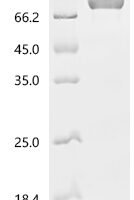
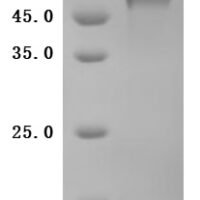
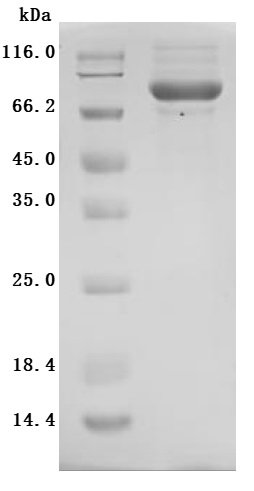
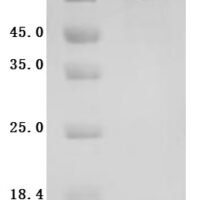
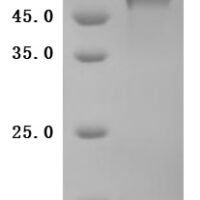
PurityGreater than 90% as determined by SDS-PAGE.
Expression SystemMammalian cell
Expression Region17-289aa
SpeciesMus musculus (Mouse)
Tag InfoC-terminal hFc1-tagged
Molecular weight58.9KDa
ActivityPlease contact us to obtain bioactivity data.
BufferIf the delivery form is liquid, the default storage buffer is Tris/PBS-based buffer, 5%-50% glycerol. If the delivery form is lyophilized powder, the buffer before lyophilization is Tris/PBS-based buffer, 6% Trehalose.
StorageStore at -20°C/-80°C upon receipt, aliquoting is necessary for mutiple use. Avoid repeated freeze-thaw cycles.
Research AreasSignal Transduction

Function

Mediates heterophilic cell-cell adhesion which regulates the activation, differentiation and tissue retention of various T-cell subsets. Interaction with CADM1 promotes natural killer (NK) cell cytotoxicity and IFNG/interferon-gamma secretion by CD8+ T-cells in vitro as well as NK cell-mediated rejection of tumors expressing CADM1 in vivo. Regulates CD8+ T-cell proliferation in response to T-cell receptor (TCR) activation.

Biological Context

Subcellular Location: Cell membrane (Single-pass type I membrane protein)
Tissue Specificity: In the immune system, expression is restricted to activated class-I MHC-restricted cells, including NKT, NK and CD8+ T-cells (at protein level). Transiently expressed in activated CD8+ T-cells and a subset of activated CD4+ T-cells (at protein level). Expressed in activated intestinal T-cells, specifically intraepithelial CD4+ CD8+ T-cells, intraepithelial CD4+ T-cells and, CD8+ T-cells in the intestine epithelium, lamina propria, Peyer's Patches and mesenteric lymph nodes. Also expressed in spleen, brain and testis

Product Specifications

Recombinant Mouse Cytotoxic and regulatory T-cell molecule (Crtam), partial (Active) is a recombinant protein from Mus musculus (Mouse), expressed in Mammalian cell, covering amino acids 17-289aa, with C-terminal hFc1-tagged tag, molecular weight 58.9KDa, purity Greater than 90% as determined by SDS-PAGE.. Suitable for ELISA and Western Blot applications.
Recommended applications depend on the target, product format, and product-specific validation data. Refer to the product datasheet or Certificate of Analysis (CoA), or contact BioCrest Sci for application guidance.

Biological Activity: Please contact us to obtain bioactivity data.

Storage: Store at -20°C/-80°C upon receipt, aliquoting is necessary for mutiple use. Avoid repeated freeze-thaw cycles.

Shipping & Lead Time: Availability, shipping conditions, and estimated lead time are confirmed in the formal quotation or order confirmation based on the product format, destination, and order requirements.

Protein Biology

Function

Mediates heterophilic cell-cell adhesion which regulates the activation, differentiation and tissue retention of various T-cell subsets (PubMed:15811952, PubMed:18329370, PubMed:19752223, PubMed:24687959). Interaction with CADM1 promotes natural killer (NK) cell cytotoxicity and IFNG/interferon-gamma secretion by CD8+ T-cells in vitro as well as NK cell-mediated rejection of tumors expressing CADM1 in vivo (PubMed:15811952). Regulates CD8+ T-cell proliferation in response to T-cell receptor (TCR) activation (PubMed:18329370). Appears to be dispensable for CD8+ T-cell-mediated cytotoxicity (PubMed:19752223). Interaction with SCRIB promotes the late phase of cellular polarization of a subset of CD4+ T-cells, which in turn regulates TCR-mediated proliferation and IFNG, IL17 and IL22 production (PubMed:18329370). By interacting with CADM1 on CD8+ dendritic cells, regulates the retention of activated CD8+ T-cells within the draining lymph node (PubMed:19752223). Required for the intestinal retention of intraepithelial CD4+ CD8+ T-cells and, to a lesser extent, intraepithelial and lamina propria CD8+ T-cells and CD4+ T-cells (PubMed:24687959). Interaction with CADM1 promotes the adhesion to gut-associated CD103+ dendritic cells, which may facilitate the expression of gut-homing and adhesion molecules on T-cells and the conversion of CD4+ T-cells into CD4+ CD8+ T-cells (PubMed:24687959)

Subcellular Location

Cell membrane (Single-pass type I membrane protein)

Tissue Specificity

In the immune system, expression is restricted to activated class-I MHC-restricted cells, including NKT, NK and CD8+ T-cells (at protein level) (PubMed:10811014, PubMed:15811952, PubMed:18329370, PubMed:19752223). Transiently expressed in activated CD8+ T-cells and a subset of activated CD4+ T-cells (at protein level) (PubMed:18329370). Expressed in activated intestinal T-cells, specifically intraepithelial CD4+ CD8+ T-cells, intraepithelial CD4+ T-cells and, CD8+ T-cells in the intestine epithelium, lamina propria, Peyer's Patches and mesenteric lymph nodes (PubMed:24687959). Also expressed in spleen, brain and testis (PubMed:10811014)

Subunit

Monomer (By similarity). May form homodimer (via Ig-like V-type domain) (By similarity). Interacts (via Ig-like V-type domain) with CADM1 (via Ig-like V-type domain); the interaction competes with CRTAM homodimerization and CADM1 homodimerization (PubMed:15781451, PubMed:15811952). Interacts (via PDZ-binding motif) with SCRIB (via PDZ domain 3); the interaction promotes CRTAM and SCRIB polarization in a subset of CD4+ T-cells (PubMed:18329370)

Gene: Crtam  |  Organism: Mus musculus  |  Synonyms: Class-I MHC-restricted T-cell-associated molecule
Key Publications

Frequently Asked Questions

How do I order or inquire about this product?

Submit the Online Inquiry form with your required quantity and specifications, or email sales@biocrestsci.com. Available sizes, pricing, stock status, documentation, and estimated lead time are confirmed in the formal quotation.

What is the shipping and delivery time?

Availability, dispatch timing, shipping conditions, and delivery estimates depend on the product format, destination, and order requirements. These details are confirmed in the formal quotation or order confirmation.

How should this product be stored?

Follow the storage and handling instructions in the product-specific datasheet and Certificate of Analysis (CoA). Requirements may vary by product form and formulation; contact BioCrest Sci if product-specific guidance is needed.

What quality controls are performed on your products?

Quality-control data such as identity, purity, endotoxin level, or biological activity are provided only when specified on this product page, the datasheet, or Certificate of Analysis (CoA). Biological activity is not implied unless explicitly stated.

Shopping Cart
Scroll to Top