Recombinant Mouse NACHT, LRR and PYD domains-containing protein 3 (Nlrp3), partial

Recombinant Mouse NACHT, LRR and PYD domains-containing protein 3 (Nlrp3), partial — Independently of inflammasome activation, regulates the differentiation of T helper 2 (Th2) cells and has a role in Th2 cell-dependent asthma and tumor growth. Purity >90%.

SKU: BCRECP-003883 Category:

Product Specifications

Product SkuBCRECP-003883
Product DescriptionRecombinant Mouse NACHT, LRR and PYD domains-containing protein 3 (Nlrp3) Protein is expressed from E.coli with N-terminal 6xHis-SUMO-tagged. It contains 1-153aa. [Accession | Q8R4B8].
Uniprot No.Q8R4B8
Gene NamesNlrp3
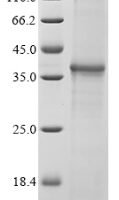
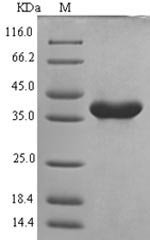
PurityGreater than 90% as determined by SDS-PAGE.
Expression SystemE.coli
Expression Region1-153aa
SpeciesMus musculus (Mouse)
Tag InfoN-terminal 6xHis-SUMO-tagged
Molecular weight34.2kDa
ActivityPlease contact us to obtain bioactivity data.
BufferIf the delivery form is liquid, the default storage buffer is Tris/PBS-based buffer, 5%-50% glycerol. If the delivery form is lyophilized powder, the buffer before lyophilization is Tris/PBS-based buffer, 6% Trehalose.
StorageStore at -20°C/-80°C upon receipt, aliquoting is necessary for mutiple use. Avoid repeated freeze-thaw cycles.
Research AreasOthers

Function

Independently of inflammasome activation, regulates the differentiation of T helper 2 (Th2) cells and has a role in Th2 cell-dependent asthma and tumor growth. During Th2 differentiation, required for optimal IRF4 binding to IL4 promoter and for IRF4-dependent IL4 transcription. Binds to the consensus DNA sequence 5'-GRRGGNRGAG-3'.

Biological Context

Subcellular Location: Cytoplasm, cytosol; Inflammasome; Cytoplasm, cytoskeleton, microtubule organizing center; Golgi apparatus membrane; Endoplasmic reticulum; Mitochondrion; Secreted; Nucleus
Tissue Specificity: Expressed with high levels in peripheral blood leukocytes, including Th2 lymphocytes and macrophages. Expressed at low levels in resting osteoblasts (at protein level)

Product Specifications

Recombinant Mouse NACHT, LRR and PYD domains-containing protein 3 (Nlrp3), partial is a recombinant protein from Mus musculus (Mouse), expressed in E.coli, covering amino acids 1-153aa, with N-terminal 6xHis-SUMO-tagged tag, molecular weight 34.2kDa, purity Greater than 90% as determined by SDS-PAGE.. Suitable for ELISA and Western Blot applications.
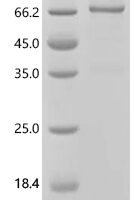
SDS-PAGE: Single band at expected molecular weight confirming purity.

ELISA: Suitable as coating antigen or detection standard.

Western Blot: Compatible with standard Western Blot protocols.

Protein Interaction: Validated for SPR (Surface Plasmon Resonance) and BLI (Bio-Layer Interferometry) studies.

Shipping: Shipped at ambient temperature. Lyophilized protein is stable during transit.

Storage: Store lyophilized protein at -20°C to -80°C. Reconstituted protein should be aliquoted and stored at -80°C. Avoid repeated freeze-thaw cycles.

Shelf Life: 12 months from date of receipt when stored as recommended.

Shipping Time: Orders placed before 2 PM EST ship same day. International orders typically deliver within 5-10 business days.

Protein Biology

Function

Independently of inflammasome activation, regulates the differentiation of T helper 2 (Th2) cells and has a role in Th2 cell-dependent asthma and tumor growth (PubMed:26098997). During Th2 differentiation, required for optimal IRF4 binding to IL4 promoter and for IRF4-dependent IL4 transcription (PubMed:26098997). Binds to the consensus DNA sequence 5'-GRRGGNRGAG-3' (PubMed:26098997). May also participate in the transcription of IL5, IL13, GATA3, CCR3, CCR4 and MAF (PubMed:26098997)

Subcellular Location

Cytoplasm, cytosol; Inflammasome; Cytoplasm, cytoskeleton, microtubule organizing center; Golgi apparatus membrane; Endoplasmic reticulum; Mitochondrion; Secreted; Nucleus

Tissue Specificity

Expressed with high levels in peripheral blood leukocytes, including Th2 lymphocytes and macrophages (PubMed:15302403, PubMed:16546100, PubMed:26098997, PubMed:28847925). Expressed at low levels in resting osteoblasts (at protein level) (PubMed:17907925)

Subunit

Sensor component of NLRP3 inflammasomes; inflammasomes are supramolecular complexes that assemble in the cytosol in response to pathogens and other damage-associated signals and play critical roles in innate immunity and inflammation (PubMed:34861190). The core of NLRP3 inflammasomes consists of a signal sensor component (NLRP3), an adapter (PYCARD/ASC), which recruits an effector pro-inflammatory caspase (CASP1 and, possibly, CASP4 and CASP5) (PubMed:24630723). Homodecamer; inactive NLRP3 forms homodecameric double-ring cages that hide pyrin domains within NACHT-LRR rings to avoid premature activation (PubMed:34861190, PubMed:35254907). Interacts (via pyrin domain) with PYCARD/ASC (via pyrin domain); interaction is direct (PubMed:17907925, PubMed:30487600). Interacts (via LRR repeat domain) with NEK7 (via N-terminus); the interaction is required for the formation of the complex NLRP3:PYCARD, oligomerization of PYCARD/ASC and activation of CASP1 (PubMed:26553871, PubMed:26642356, PubMed:26814970, PubMed:34615873, PubMed:37001519). Interacts (via LRR repeat domain) with NR4A1/Nur77 (via N-terminus); the interaction is direct, requires activation of NR4A1 by its ligands NBRE-containing dsDNA and lipopolysaccharide, and stimulates the association of NLRP3 with NEK7 for non-canonical NLRP3 inflammasome activation (PubMed:37001519). Interacts with CARD8; leading to inhibit formation of the NLRP3 inflammasome (By similarity). Interacts with MEFV; this interaction targets NLRP3 to degradation by autophagy, hence preventing excessive IL1B- and IL18-mediated inflammation (By similarity). Interacts with EIF2AK2/PKR; this interaction requires EIF2AK2 activity, is accompanied by EIF2AK2 autophosphorylation and promotes inflammasome assembly in response to specific stimuli (PubMed:22801494). Interacts with GBP5 (via DAPIN domain); this interaction promotes inflammasome assembly in response to microbial and soluble, but not crystalline, agents (By similarity). Interacts with PML (isoform PML-1) (via the leucine-rich repeat (LRR) domain); PML-mediated increase in NLRP3 inflammasome activation does not depend upon this interaction (By similarity). Interacts (via NACHT domain) with DHX33 (via DEAH box); NLRP3 activation in presence of cytosolic dsRNA is mediated by DHX33 (By similarity). Interacts (via NACHT and LRR domains) with ARRB2; this interaction is direct and inducible by polyunsaturated fatty acids (PUFAs) (By similarity). Interacts (via NACHT domain) with DDX3X under both LPS-primed and inflammasome-activating conditions (PubMed:31511697). Interacts with IRF4 (via the LRR domain); this interaction is direct and is required for optimal IRF4 binding to IL4 promoter and efficient IL4 transactivation during differentiation of Th2 helper T cells (PubMed:26098997). Interacts with MAVS; promoting localization to mitochondria and activation of the NLRP3 inflammasome (PubMed:23582325). Interacts with MARK4; promoting localization of NLRP3 to the microtubule organizing center (MTOC) (PubMed:28656979). Interacts with TRIM50; this interaction also promotes NLRP3 oligomerization and subsequent inflammasome activation (PubMed:36178239). Interacts with IRGM; preventing NLRP3 inflammasome assembly and promoting NLRP3 degradation (By similarity). Interacts (via KFERQ-like motifs) with HSPA8/HSC70; promoting NLRP3 degradation by the chaperone-mediated autophagy pathway (By similarity). Interacts (via NACHT and LLR domains) with ABHD8; this interaction is enhanced in the presence of NLRP3 inflammasome inducers, such as ATP, nigericin, silica, or alum. Interaction with ABHD8 leads the recruitment of ZDHHC12, hence facilitating NLRP3 palmitoylation and degradation by the chaperone-mediated autophagy pathway (CMA), therefore attenuating NLRP3 inflammasome activation (By similarity). Interacts with ZNFX1; the interaction inhibits NLRP3 inflammasome activation by sequestering NLRP3 in the cytoplasm (By similarity). Interacts with FAM120A; this interaction inhibits inflammasome activation (By similarity)

Gene: Nlrp3  |  Organism: Mus musculus  |  Synonyms: Cold autoinflammatory syndrome 1 protein homolog; Cryopyrin; Mast cell maturation-associated-inducible protein 1; PYRIN-containing APAF1-like protein 1
Key Publications

Frequently Asked Questions

How do I order or inquire about this product?

Fill out the Online Inquiry form with your required quantity and specifications. You can also email sales@biocrestsci.com. Our team typically responds within 4 business hours with a quote and availability confirmation.

What is the shipping and delivery time?

Orders placed before 2 PM EST ship the same day. Domestic (US) delivery typically takes 2-3 business days. International orders deliver within 5-10 business days. All products are shipped at ambient temperature with appropriate packaging to ensure stability.

How should I store this recombinant protein?

Lyophilized proteins should be stored at -20°C to -80°C upon receipt. After reconstitution, aliquot and store at -80°C. Avoid repeated freeze-thaw cycles. Shelf life is 12 months from date of receipt when stored as recommended.

What quality controls are performed on your products?

Each product undergoes SDS-PAGE purity analysis (typically >85-95%), endotoxin testing, and bioactivity validation. Products are validated for ELISA, Western Blot, and SPR/BLI applications as specified on this product page. A Certificate of Analysis (CoA) is available upon request.

Shopping Cart
Scroll to Top