,

Recombinant Mouse T-cell surface glycoprotein CD8 alpha chain (Cd8a), partial (Active)

Recombinant Mouse T-cell surface glycoprotein CD8 alpha chain (Cd8a), partial (Active) — Integral membrane glycoprotein that plays an essential role in the immune response and serves multiple functions in responses against both external and internal offenses. Purity >95%.

SKU: BCACP-000634 Categories: ,
Product SKUBCACP-000634
Product DescriptionRecombinant Mouse T-cell surface glycoprotein CD8 alpha chain (Cd8a) protein is expressed from Mammalian cell with C-terminal 10xHis-tagged. It contains 28-196aa. [Accession | P01731].
Uniprot No.P01731
Gene NamesCd8a
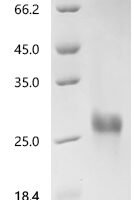
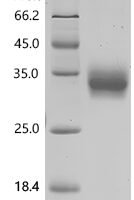
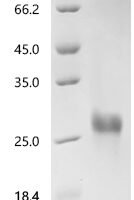
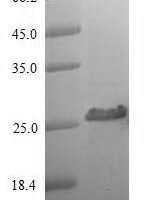
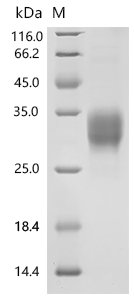
PurityGreater than 95% as determined by SDS-PAGE.
Expression SystemMammalian cell
Expression Region28-196aa
SpeciesMus musculus (Mouse)
Tag InfoC-terminal 10xHis-tagged
Molecular weight20.3 kDa
ActivityMeasured by its ability to cleave the fluorogenic peptide substrate, MCA-Arg-Pro-Lys-Pro-Val-Glu-NVAL-Trp-Arg-Lys(DNP)NH2. The specific activity is >50 pmol/min/µg.
BufferLyophilized from a 0.2 μm filtered 20 mM Tris-HCl, 0.5 M NaCl, 6% Trehalose, pH 8.0
StorageStore at -20°C/-80°C upon receipt, aliquoting is necessary for mutiple use. Avoid repeated freeze-thaw cycles.
Alternative NamesT-cell surface glycoprotein CD8 alpha chain; T-cell surface glycoprotein Lyt-2; CD antigen CD8a

Function

Integral membrane glycoprotein that plays an essential role in the immune response and serves multiple functions in responses against both external and internal offenses. In T-cells, functions primarily as a coreceptor for MHC class I molecule:peptide complex. The antigens presented by class I peptides are derived from cytosolic proteins while class II derived from extracellular proteins.

Biological Context

Subcellular Location: Cell membrane (Single-pass type I membrane protein)

Product Specifications

Recombinant Mouse T-cell surface glycoprotein CD8 alpha chain (Cd8a), partial (Active) is a recombinant protein from Mus musculus (Mouse), expressed in Mammalian cell, covering amino acids 28-196aa, with C-terminal 10xHis-tagged tag, molecular weight 20.3 kDa, purity Greater than 95% as determined by SDS-PAGE.. Suitable for ELISA and Western Blot applications.

Recommended applications depend on the target, product format, and product-specific validation data. Refer to the product datasheet or Certificate of Analysis (CoA), or contact BioCrest Sci for application guidance.

Biological Activity: Measured by its ability to cleave the fluorogenic peptide substrate, MCA-Arg-Pro-Lys-Pro-Val-Glu-NVAL-Trp-Arg-Lys(DNP)NH2. The specific activity is >50 pmol/min/µg.

Storage: Store at -20°C/-80°C upon receipt, aliquoting is necessary for mutiple use. Avoid repeated freeze-thaw cycles.

Shipping & Lead Time: Availability, shipping conditions, and estimated lead time are confirmed in the formal quotation or order confirmation based on the product format, destination, and order requirements.

Protein Biology

Function

Integral membrane glycoprotein that plays an essential role in the immune response and serves multiple functions in responses against both external and internal offenses. In T-cells, functions primarily as a coreceptor for MHC class I molecule:peptide complex. The antigens presented by class I peptides are derived from cytosolic proteins while class II derived from extracellular proteins. Interacts simultaneously with the T-cell receptor (TCR) and the MHC class I proteins presented by antigen presenting cells (APCs). In turn, recruits the Src kinase LCK to the vicinity of the TCR-CD3 complex. LCK then initiates different intracellular signaling pathways by phosphorylating various substrates ultimately leading to lymphokine production, motility, adhesion and activation of cytotoxic T-lymphocytes (CTLs). This mechanism enables CTLs to recognize and eliminate infected cells and tumor cells. In NK-cells, the presence of CD8A homodimers at the cell surface provides a survival mechanism allowing conjugation and lysis of multiple target cells. CD8A homodimer molecules also promote the survival and differentiation of activated lymphocytes into memory CD8 T-cells

Subcellular Location

Cell membrane (Single-pass type I membrane protein)

Subunit

Forms disulfide-linked heterodimers with CD8B at the cell surface. Also forms homodimers in several cell types including NK-cells or peripheral blood T-lymphocytes. Interacts with the MHC class I HLA-A/B2M dimer. Interacts with LCK in a zinc-dependent manner

Gene: Cd8a  |  Organism: Mus musculus  |  Synonyms: T-cell surface glycoprotein Lyt-2
Key Publications

Frequently Asked Questions

How do I order or inquire about this product?

Submit the Online Inquiry form with your required quantity and specifications, or email sales@biocrestsci.com. Available sizes, pricing, stock status, documentation, and estimated lead time are confirmed in the formal quotation.

What is the shipping and delivery time?

Availability, dispatch timing, shipping conditions, and delivery estimates depend on the product format, destination, and order requirements. These details are confirmed in the formal quotation or order confirmation.

How should this product be stored?

Follow the storage and handling instructions in the product-specific datasheet and Certificate of Analysis (CoA). Requirements may vary by product form and formulation; contact BioCrest Sci if product-specific guidance is needed.

What quality controls are performed on your products?

Quality-control data such as identity, purity, endotoxin level, or biological activity are provided only when specified on this product page, the datasheet, or Certificate of Analysis (CoA). Biological activity is not implied unless explicitly stated.

Shopping Cart
Scroll to Top