Function
Pore-forming subunit of the mechanotransducer (MET) non-selective cation channel complex located at the tips of stereocilia of cochlear hair cells and that mediates sensory transduction in the auditory system. The MET complex is composed of two dimeric pore-forming ion-conducting transmembrane TMC (TMC1 or TMC2) subunits, several auxiliary proteins including LHFPL5, TMIE, CIB2/3 and TOMT, the tip-link PCDH15, and possibly the PIEZO subunits. MET channel is activated by tension in the tip-link extending from the side wall of one stereocilium to the tip of the adjacent shorter stereocilium, where the channel is located.
Biological Context
Subcellular Location: Cell membrane (Multi-pass membrane protein)
Tissue Specificity: Detected in cochlear inner and outer hair cells and in neurosensory epithelia of the vestibular end organs. Also expressed in cortex, cerebellum, eye, colon, ovary and testis
Disease Association: [Defects in Tmc1 are the cause of the dominant deaf mutant Beethoven (BTH). Heterozygotes show progressive hair-cell degeneration from day 20 onwards, leading to severe depletion of inner hair cells and scattered loss of outer hair cells, and progressive loss of the Preyer reflex from around day 30. Homozygotes show almost complete degeneration of inner hair cells, and little or no Preyer reflex at any age] | [Defects in Tmc1 are the cause of recessive deaf mutant dn. The dn mutant shows profound deafness with degeneration of the organ of Corti, stria vascularis, and occasionally the saccular macula, starting at about 10 days after birth ]
Product Specifications
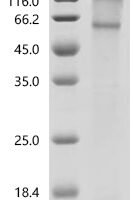
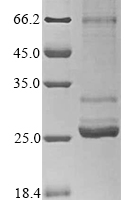
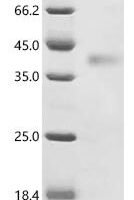
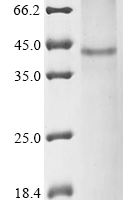
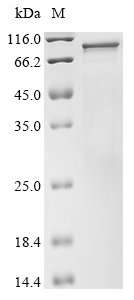
Recombinant Mouse Transmembrane channel-like protein 1 (Tmc1) Protein is a recombinant protein from Mus musculus (Mouse), expressed in in vitro E.coli expression system, covering amino acids 1-757aa, with N-terminal 10xHis-tagged tag, molecular weight 90.1kDa, purity Greater than 85% as determined by SDS-PAGE.. Suitable for ELISA and Western Blot applications.