,

Recombinant Mouse Ubiquitin carboxyl-terminal hydrolase CYLD (Cyld), partial

Recombinant Mouse Ubiquitin carboxyl-terminal hydrolase CYLD (Cyld), partial — Deubiquitinase that specifically cleaves ‘Lys-63’- and linear ‘Met-1’-linked polyubiquitin chains and is involved in NF-kappa-B activation and TNF-induced necroptosis. Purity >90%.

SKU: BCRECP-002490 Categories: ,

Product Specifications

Product SkuBCRECP-002490
Product DescriptionRecombinant Mouse Ubiquitin carboxyl-terminal hydrolase CYLD (Cyld) Protein is expressed from E.coli with N-terminal 10xHis-tagged and C-terminal Myc-tagged. It contains 579-952aa. [Accession | Q80TQ2].
Uniprot No.Q80TQ2
Gene NamesCyld
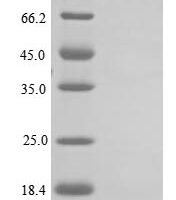
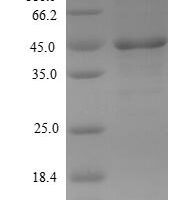
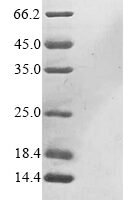
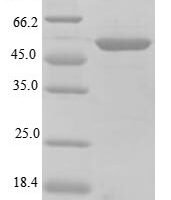
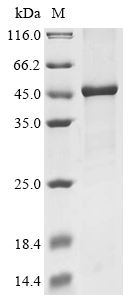
PurityGreater than 90% as determined by SDS-PAGE.
Expression SystemE.coli
Expression Region579-952aa
SpeciesMus musculus (Mouse)
Tag InfoN-terminal 10xHis-tagged and C-terminal Myc-tagged
Molecular weight50.6kDa
ActivityPlease contact us to obtain bioactivity data.
BufferIf the delivery form is liquid, the default storage buffer is Tris/PBS-based buffer, 5%-50% glycerol. If the delivery form is lyophilized powder, the buffer before lyophilization is Tris/PBS-based buffer, 6% Trehalose.
StorageStore at -20°C/-80°C upon receipt, aliquoting is necessary for mutiple use. Avoid repeated freeze-thaw cycles.
Research AreasCancer

Function

Deubiquitinase that specifically cleaves 'Lys-63'- and linear 'Met-1'-linked polyubiquitin chains and is involved in NF-kappa-B activation and TNF-induced necroptosis. Negatively regulates NF-kappa-B activation by deubiquitinating upstream signaling factors. Contributes to the regulation of cell survival, proliferation and differentiation via its effects on NF-kappa-B activation.

Biological Context

Subcellular Location: Cytoplasm; Cytoplasm, perinuclear region; Cytoplasm, cytoskeleton; Cell membrane (Peripheral membrane protein); Cytoplasm, cytoskeleton, microtubule organizing center, centrosome; Cytoplasm, cytoskeleton, spindle; Cytoplasm, cytoskeleton, cilium basal body

Product Specifications

Recombinant Mouse Ubiquitin carboxyl-terminal hydrolase CYLD (Cyld), partial is a recombinant protein from Mus musculus (Mouse), expressed in E.coli, covering amino acids 579-952aa, with N-terminal 10xHis-tagged and C-terminal Myc-tagged tag, molecular weight 50.6kDa, purity Greater than 90% as determined by SDS-PAGE.. Suitable for ELISA and Western Blot applications.

SDS-PAGE: Single band at expected molecular weight confirming purity.

ELISA: Suitable as coating antigen or detection standard.

Western Blot: Compatible with standard Western Blot protocols.

Protein Interaction: Validated for SPR (Surface Plasmon Resonance) and BLI (Bio-Layer Interferometry) studies.

Shipping: Shipped at ambient temperature. Lyophilized protein is stable during transit.

Storage: Store lyophilized protein at -20°C to -80°C. Reconstituted protein should be aliquoted and stored at -80°C. Avoid repeated freeze-thaw cycles.

Shelf Life: 12 months from date of receipt when stored as recommended.

Shipping Time: Orders placed before 2 PM EST ship same day. International orders typically deliver within 5-10 business days.

Protein Biology

Function

Deubiquitinase that specifically cleaves 'Lys-63'- and linear 'Met-1'-linked polyubiquitin chains and is involved in NF-kappa-B activation and TNF-induced necroptosis (PubMed:17548520, PubMed:28701375, PubMed:29291351, PubMed:32185393, PubMed:32424362). Negatively regulates NF-kappa-B activation by deubiquitinating upstream signaling factors (PubMed:16713561). Contributes to the regulation of cell survival, proliferation and differentiation via its effects on NF-kappa-B activation (PubMed:16713561). Negative regulator of Wnt signaling. Inhibits HDAC6 and thereby promotes acetylation of alpha-tubulin and stabilization of microtubules (PubMed:19893491). Plays a role in the regulation of microtubule dynamics, and thereby contributes to the regulation of cell proliferation, cell polarization, cell migration, and angiogenesis (PubMed:16713561, PubMed:19893491, PubMed:20194890). Required for normal cell cycle progress and normal cytokinesis (PubMed:19893491). Inhibits nuclear translocation of NF-kappa-B (By similarity). Plays a role in the regulation of inflammation and the innate immune response, via its effects on NF-kappa-B activation (By similarity). Dispensable for the maturation of intrathymic natural killer cells, but required for the continued survival of immature natural killer cells (PubMed:16501569, PubMed:18643924). Negatively regulates TNFRSF11A signaling and osteoclastogenesis (PubMed:18382763). Involved in the regulation of ciliogenesis, allowing ciliary basal bodies to migrate and dock to the plasma membrane; this process does not depend on NF-kappa-B activation (PubMed:25134987). Ability to remove linear ('Met-1'-linked) polyubiquitin chains regulates innate immunity and TNF-induced necroptosis: recruited to the LUBAC complex via interaction with SPATA2 and restricts linear polyubiquitin formation on target proteins (PubMed:28701375). Regulates innate immunity by restricting linear polyubiquitin formation on RIPK2 in response to NOD2 stimulation (By similarity). Involved in TNF-induced necroptosis by removing linear ('Met-1'-linked) polyubiquitin chains from RIPK1, thereby regulating the kinase activity of RIPK1 (PubMed:28701375). Negatively regulates intestinal inflammation by removing 'Lys-63' linked polyubiquitin chain of NLRP6, thereby reducing the interaction between NLRP6 and PYCARD/ASC and formation of the NLRP6 inflammasome (PubMed:32424362). Does not catalyze deubiquitination of heterotypic 'Lys-63'-/'Lys-48'-linked branched ubiquitin chains (By similarity). Removes 'Lys-63' linked polyubiquitin chain of MAP3K7, which inhibits phosphorylation and blocks downstream activation of the JNK-p38 kinase cascades (PubMed:17548520, PubMed:29291351). Also removes 'Lys-63'-linked polyubiquitin chains of MAP3K1 and MA3P3K3, which inhibit their interaction with MAP2K1 and MAP2K2 (By similarity)

Subcellular Location

Cytoplasm; Cytoplasm, perinuclear region; Cytoplasm, cytoskeleton; Cell membrane (Peripheral membrane protein); Cytoplasm, cytoskeleton, microtubule organizing center, centrosome; Cytoplasm, cytoskeleton, spindle; Cytoplasm, cytoskeleton, cilium basal body

Subunit

Interacts (via CAP-Gly domain) with IKBKG/NEMO (via proline-rich C-terminal region) (By similarity). Interacts with TRAF2 and TRIP (By similarity). Interacts with PLK1, DVL1, DVL3, MAVS, TBK1, IKKE and RIGI (By similarity). Interacts (via CAP-Gly domain) with microtubules (PubMed:19893491). Interacts with HDAC6 and BCL3 (PubMed:16713561, PubMed:19893491). Interacts with MAP3K7 (PubMed:17548520). Identified in a complex with TRAF6 and SQSTM1 (PubMed:18382763). Interacts with OPTN and SQSTM1 (By similarity). Interacts with CEP350 (By similarity). Interacts with RNF31; the interaction is indirect and is mediated via SPATA2 (By similarity). Interacts with SPATA2 (via the PUB domain); the interaction is direct and recruits CYLD to the LUBAC complex, thereby regulating TNF-induced necroptosis (By similarity)

Gene: Cyld  |  Organism: Mus musculus  |  Synonyms: Deubiquitinating enzyme CYLD; Ubiquitin thioesterase CYLD; Ubiquitin-specific-processing protease CYLD
Key Publications

Frequently Asked Questions

How do I order or inquire about this product?

Fill out the Online Inquiry form with your required quantity and specifications. You can also email sales@biocrestsci.com. Our team typically responds within 4 business hours with a quote and availability confirmation.

What is the shipping and delivery time?

Orders placed before 2 PM EST ship the same day. Domestic (US) delivery typically takes 2-3 business days. International orders deliver within 5-10 business days. All products are shipped at ambient temperature with appropriate packaging to ensure stability.

How should I store this recombinant protein?

Lyophilized proteins should be stored at -20°C to -80°C upon receipt. After reconstitution, aliquot and store at -80°C. Avoid repeated freeze-thaw cycles. Shelf life is 12 months from date of receipt when stored as recommended.

What quality controls are performed on your products?

Each product undergoes SDS-PAGE purity analysis (typically >85-95%), endotoxin testing, and bioactivity validation. Products are validated for ELISA, Western Blot, and SPR/BLI applications as specified on this product page. A Certificate of Analysis (CoA) is available upon request.

Shopping Cart
Scroll to Top