,

Recombinant Mouse Vascular endothelial growth factor receptor 2 (Kdr), partial (Active)

Recombinant Mouse Vascular endothelial growth factor receptor 2 (Kdr), partial (Active) — Tyrosine-protein kinase that acts as a cell-surface receptor for VEGFA, VEGFC and VEGFD. Purity >95%.

SKU: BCACP-000644 Categories: ,
Product SKUBCACP-000644
Product DescriptionRecombinant Mouse Vascular endothelial growth factor receptor 2 (Kdr) protein is expressed from Mammalian cell with C-terminal hFc1-tagged. It contains 20-762aa. [Accession | P35918].
Uniprot No.P35918
Gene NamesKdr
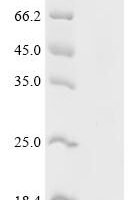
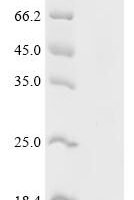
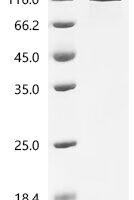
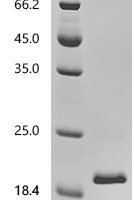
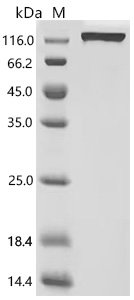
PurityGreater than 95% as determined by SDS-PAGE.Greater than 95% as determined by SEC-HPLC.
Expression SystemMammalian cell
Expression Region20-762aa
SpeciesMus musculus (Mouse)
Tag InfoC-terminal hFc1-tagged
Molecular weight111.9 kDa
ActivityMeasured by its binding ability in a functional ELISA. Immobilized Mouse Il1rl2 at 2 μg/mL can bind Anti-Il1rl2 recombinant antibody . The EC50 is 0.6983-1.037 ng/mL.;IL1RL2 Recombinant Monoclonal Antibody captured on Protein A Chip can bind Recombinant Mouse Il1rl2 protein with an affinity constant of 0.236 nM as detected by MetaSPR Assay (WeSPRTM 200).
BufferLyophilized from a 0.2 μm filtered 20 mM Tris-HCl, 0.5 M NaCl, 6% Trehalose, pH 8.0
StorageStore at -20°C/-80°C upon receipt, aliquoting is necessary for mutiple use. Avoid repeated freeze-thaw cycles.
Alternative NamesVascular endothelial growth factor receptor 2; VEGFR-2; EC 2.7.10.1; Fetal liver kinase 1; FLK-1; Kinase NYK; Protein-tyrosine kinase receptor flk-1; CD antigen CD309

Function

Tyrosine-protein kinase that acts as a cell-surface receptor for VEGFA, VEGFC and VEGFD. Plays an essential role in the regulation of angiogenesis, vascular development, vascular permeability, and embryonic hematopoiesis. Promotes proliferation, survival, migration and differentiation of endothelial cells.

Biological Context

Subcellular Location: Secreted
Tissue Specificity: Expressed in endothelial cells (at protein level). Detected in embryonic endothelial cells, as well as hematopoietic stem and progenitor cells. Detected in vascular endothelium. Expressed at high levels in adult heart, lung, kidney, brain and skeletal muscle, but is also expressed at lower levels in most other adult tissues

Product Specifications

Recombinant Mouse Vascular endothelial growth factor receptor 2 (Kdr), partial (Active) is a recombinant protein from Mus musculus (Mouse), expressed in Mammalian cell, covering amino acids 20-762aa, with C-terminal hFc1-tagged tag, molecular weight 111.9 kDa, purity Greater than 95% as determined by SDS-PAGE.Greater than 95% as determined by SEC-HPLC.. Suitable for ELISA and Western Blot applications.

Recommended applications depend on the target, product format, and product-specific validation data. Refer to the product datasheet or Certificate of Analysis (CoA), or contact BioCrest Sci for application guidance.

Biological Activity: Measured by its binding ability in a functional ELISA. Immobilized Mouse Il1rl2 at 2 μg/mL can bind Anti-Il1rl2 recombinant antibody . The EC50 is 0.6983-1.037 ng/mL.;IL1RL2 Recombinant Monoclonal Antibody captured on Protein A Chip can bind Recombinant Mouse Il1rl2 protein with an affinity constant of 0.236 nM as detected by MetaSPR Assay (WeSPRTM 200).

Storage: Store at -20°C/-80°C upon receipt, aliquoting is necessary for mutiple use. Avoid repeated freeze-thaw cycles.

Shipping & Lead Time: Availability, shipping conditions, and estimated lead time are confirmed in the formal quotation or order confirmation based on the product format, destination, and order requirements.

Protein Biology

Function

Tyrosine-protein kinase that acts as a cell-surface receptor for VEGFA, VEGFC and VEGFD. Plays an essential role in the regulation of angiogenesis, vascular development, vascular permeability, and embryonic hematopoiesis. Promotes proliferation, survival, migration and differentiation of endothelial cells. Promotes reorganization of the actin cytoskeleton. Isoforms lacking a transmembrane domain, such as isoform 2, may function as decoy receptors for VEGFA, VEGFC and/or VEGFD. Isoform 2 plays an important role as a negative regulator of VEGFA- and VEGFC-mediated lymphangiogenesis by limiting the amount of free VEGFA and/or VEGFC and by preventing their binding to FLT4. Modulates FLT1 and FLT4 signaling by forming heterodimers. Binding of vascular growth factors to isoform 1 leads to the activation of several signaling cascades. Activation of PLCG1 leads to the production of the cellular signaling molecules diacylglycerol and inositol 1,4,5-trisphosphate and the activation of protein kinase C. Mediates activation of MAPK1/ERK2, MAPK3/ERK1 and the MAP kinase signaling pathway, as well as of the AKT1 signaling pathway. Mediates phosphorylation of PIK3R1, the regulatory subunit of phosphatidylinositol 3-kinase, reorganization of the actin cytoskeleton and activation of PTK2/FAK1. Required for VEGFA-mediated induction of NOS2 and NOS3, leading to the production of the signaling molecule nitric oxide (NO) by endothelial cells. Phosphorylates PLCG1. Promotes phosphorylation of FYN, NCK1, NOS3, PIK3R1, PTK2/FAK1 and SRC

Subcellular Location

Secreted

Tissue Specificity

Expressed in endothelial cells (at protein level). Detected in embryonic endothelial cells, as well as hematopoietic stem and progenitor cells. Detected in vascular endothelium. Expressed at high levels in adult heart, lung, kidney, brain and skeletal muscle, but is also expressed at lower levels in most other adult tissues

Subunit

Homodimer in the presence of bound dimeric VEGFA, VEGFC or VEGFD ligands; monomeric in the absence of bound ligands. Can also form heterodimers with FLT1/VEGFR1 and KDR/VEGFR2. Interacts (tyrosine phosphorylated) with LFYN, NCK1, PLCG1. Interacts (tyrosine-phosphorylated active form preferentially) with DAB2IP (via C2 domain and active form preferentially); the interaction occurs at the late phase of VEGFA response and inhibits KDR/VEGFR2 activity. Interacts with SHBSH2D2A/TSAD, GRB2, MYOF, CBL and PDCD6 (PubMed:12796773, PubMed:12881528, PubMed:15026417, PubMed:15673613, PubMed:17702744, PubMed:19668192, PubMed:7681362, PubMed:8356051). Interacts (via C-terminus domain) with ERN1 (via kinase domain); the interaction is facilitated in a XBP1 isoform 1- and vascular endothelial growth factor (VEGF)-dependent manner in endothelial cells (By similarity). Interacts (via juxtamembrane region) with chaperone PDCL3 (via thioredoxin fold region); the interaction leads to increased KDR/VEGFR2 abundance through inhibition of its ubiquitination and degradation (By similarity). Interacts (tyrosine phosphorylated) with CCDC88A/GIV (via SH2-like region); binding requires autophosphorylation of the KDR/VEGFR2 C-terminal region (By similarity). Interacts with isoform 2 of BSG (By similarity). Interacts with SLC31A1; this interaction is induced upon VEGFA stimulation leading to SLC31A1 and KDR subsequent co-internalization to early endosomes, thereby activating KDR downstream signaling in endothelial cells (By similarity)

Gene: Kdr  |  Organism: Mus musculus  |  Synonyms: Fetal liver kinase 1; Kinase NYK; Protein-tyrosine kinase receptor flk-1
Key Publications

Frequently Asked Questions

How do I order or inquire about this product?

Submit the Online Inquiry form with your required quantity and specifications, or email sales@biocrestsci.com. Available sizes, pricing, stock status, documentation, and estimated lead time are confirmed in the formal quotation.

What is the shipping and delivery time?

Availability, dispatch timing, shipping conditions, and delivery estimates depend on the product format, destination, and order requirements. These details are confirmed in the formal quotation or order confirmation.

How should this product be stored?

Follow the storage and handling instructions in the product-specific datasheet and Certificate of Analysis (CoA). Requirements may vary by product form and formulation; contact BioCrest Sci if product-specific guidance is needed.

What quality controls are performed on your products?

Quality-control data such as identity, purity, endotoxin level, or biological activity are provided only when specified on this product page, the datasheet, or Certificate of Analysis (CoA). Biological activity is not implied unless explicitly stated.

Shopping Cart
Scroll to Top