Recombinant Mouse Desmoglein-3 (Dsg3), partial (Active)

Recombinant Mouse Desmoglein-3 (Dsg3), partial (Active) — A component of desmosome cell-cell junctions which are required for positive regulation of cellular adhesion. Purity >85%.

SKU: BCACP-000143 Category:
Product SKUBCACP-000143
Product DescriptionRecombinant Mouse Desmoglein-3 (Dsg3) protein is expressed from Mammalian cell with C-terminal 10xHis-tagged. It contains 50-617aa. [Accession | O35902].
Uniprot No.O35902
Gene NamesDsg3
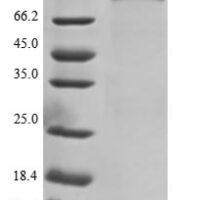
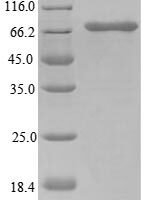
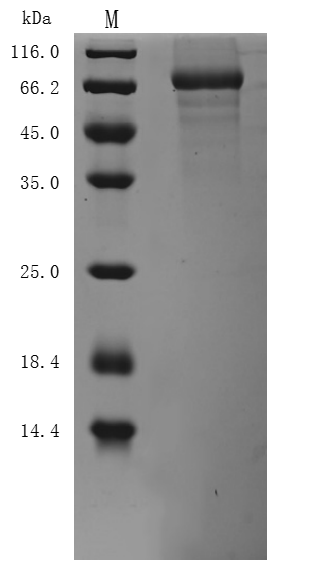
PurityGreater than 85% as determined by SDS-PAGE.
Expression SystemMammalian cell
Expression Region50-617aa
SpeciesMus musculus (Mouse)
Tag InfoC-terminal 10xHis-tagged
Molecular weight66.0 kDa
ActivityMeasured by its binding ability in a functional ELISA. Immobilized human SEMA4D at 5 μg/mL can bind human PLXNB1, the EC50 is 0.8179-1.357 μg/mL.
BufferLyophilized from a 0.2 μm filtered 20 mM Tris-HCl, 0.5 M NaCl, 6% Trehalose, pH 8.0
StorageStore at -20°C/-80°C upon receipt, aliquoting is necessary for mutiple use. Avoid repeated freeze-thaw cycles.
Alternative Names(Desmoglein-3)(130 kDa pemphigus vulgaris antigen homolog)

Function

A component of desmosome cell-cell junctions which are required for positive regulation of cellular adhesion. Required for adherens and desmosome junction assembly in response to mechanical force in keratinocytes. Required for desmosome-mediated cell-cell adhesion of cells surrounding the telogen hair club and the basal layer of the outer root sheath epithelium, consequently is essential for the anchoring of telogen hairs in the hair follicle.

Biological Context

Subcellular Location: Cell membrane (Single-pass type I membrane protein); Cell junction, desmosome; Cytoplasm; Cell junction, tight junction; Cell junction
Tissue Specificity: Expressed in the basal layer of the outer root sheath of the telogen hair club, specifically at the cell membrane between the apex of the cells and the surrounding hair club (at protein level). Expression is less abundant between the lateral margins of the outer root sheath basal cells (at protein level). Expressed in epidermis (at protein level). Expressed in the epithelium of the tongue

Product Specifications

Recombinant Mouse Desmoglein-3 (Dsg3), partial (Active) is a recombinant protein from Mus musculus (Mouse), expressed in Mammalian cell, covering amino acids 50-617aa, with C-terminal 10xHis-tagged tag, molecular weight 66.0 kDa, purity Greater than 85% as determined by SDS-PAGE.. Suitable for ELISA and Western Blot applications.
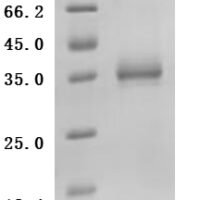
SDS-PAGE: Single band at expected molecular weight confirming purity.

ELISA: Suitable as coating antigen or detection standard.

Western Blot: Compatible with standard Western Blot protocols.

Protein Interaction: Validated for SPR (Surface Plasmon Resonance) and BLI (Bio-Layer Interferometry) studies.

Shipping: Shipped at ambient temperature. Lyophilized protein is stable during transit.

Storage: Store lyophilized protein at -20°C to -80°C. Reconstituted protein should be aliquoted and stored at -80°C. Avoid repeated freeze-thaw cycles.

Shelf Life: 12 months from date of receipt when stored as recommended.

Shipping Time: Orders placed before 2 PM EST ship same day. International orders typically deliver within 5-10 business days.

Protein Biology

Function

A component of desmosome cell-cell junctions which are required for positive regulation of cellular adhesion (PubMed:9166409). Required for adherens and desmosome junction assembly in response to mechanical force in keratinocytes (By similarity). Required for desmosome-mediated cell-cell adhesion of cells surrounding the telogen hair club and the basal layer of the outer root sheath epithelium, consequently is essential for the anchoring of telogen hairs in the hair follicle (PubMed:9166409, PubMed:9701552). Required for the maintenance of the epithelial barrier via promoting desmosome-mediated intercellular attachment of suprabasal epithelium to basal cells (PubMed:9166409). May play a role in the protein stability of the desmosome plaque components DSP, JUP, PKP1, PKP2 and PKP3 (By similarity). Required for YAP1 localization at the plasma membrane in keratinocytes in response to mechanical strain, via the formation of an interaction complex composed of DSG3, PKP1 and YWHAG (By similarity). May also be involved in the positive regulation of YAP1 target gene transcription and as a result cell proliferation (By similarity). Positively regulates cellular contractility and cell junction formation via organization of cortical F-actin bundles and anchoring of actin to tight junctions, in conjunction with RAC1 (By similarity). The cytoplasmic pool of DSG3 is required for the localization of CDH1 and CTNNB1 at developing adherens junctions, potentially via modulation of SRC activity (By similarity). Inhibits keratinocyte migration via suppression of p38MAPK signaling, may therefore play a role in moderating wound healing (PubMed:26763450)

Subcellular Location

Cell membrane (Single-pass type I membrane protein); Cell junction, desmosome; Cytoplasm; Cell junction, tight junction; Cell junction

Tissue Specificity

Expressed in the basal layer of the outer root sheath of the telogen hair club, specifically at the cell membrane between the apex of the cells and the surrounding hair club (at protein level) (PubMed:9701552). Expression is less abundant between the lateral margins of the outer root sheath basal cells (at protein level) (PubMed:9701552). Expressed in epidermis (at protein level) (PubMed:12787123, PubMed:30660666). Expressed in the epithelium of the tongue (PubMed:9166409)

Subunit

Homodimer (PubMed:30949721). Part of a complex that contains DSG3, PKP1, YAP1 and YWHAG; the complex is required for localization of DSG3 and YAP1 to the cell membrane in keratinocytes (By similarity). Interacts with PKP2. Interacts with CTNND1; the interaction facilitates DSG3 localization and retention at cell-cell junctions (PubMed:18343367). Interacts with CDH1; the interaction is required for CDH1 localization to developing adherens junctions (By similarity). Interacts with RAC1; the interaction is required for DSG3 translocation to cell-cell junctions, organization of cortical F-actin bundles and actin anchoring at cell-cell junctions (By similarity). Interacts with DSC3; the interaction may limit the interaction of DSC3 with p38MAPK family members and therefore repress p38MAPK signaling activation (PubMed:26763450)

Gene: Dsg3  |  Organism: Mus musculus  |  Synonyms: 130 kDa pemphigus vulgaris antigen homolog
Key Publications

Frequently Asked Questions

How do I order or inquire about this product?

Fill out the Online Inquiry form with your required quantity and specifications. You can also email sales@biocrestsci.com. Our team typically responds within 4 business hours with a quote and availability confirmation.

What is the shipping and delivery time?

Orders placed before 2 PM EST ship the same day. Domestic (US) delivery typically takes 2-3 business days. International orders deliver within 5-10 business days. All products are shipped at ambient temperature with appropriate packaging to ensure stability.

How should I store this recombinant protein?

Lyophilized proteins should be stored at -20°C to -80°C upon receipt. After reconstitution, aliquot and store at -80°C. Avoid repeated freeze-thaw cycles. Shelf life is 12 months from date of receipt when stored as recommended.

What quality controls are performed on your products?

Each product undergoes SDS-PAGE purity analysis (typically >85-95%), endotoxin testing, and bioactivity validation. Products are validated for ELISA, Western Blot, and SPR/BLI applications as specified on this product page. A Certificate of Analysis (CoA) is available upon request.

Shopping Cart
Scroll to Top