Recombinant Human Potassium voltage-gated channel subfamily KQT member 1 (KCNQ1) Protein

Recombinant Human Potassium voltage-gated channel subfamily KQT member 1 (KCNQ1) Protein — recombinant protein from Homo sapiens (Human), expressed in in vitro E.coli expression system. Purity >90%.

SKU: BCRECP-00234TM Category:

Product Specifications

Uniprot No.P51787
Gene NamesKCNQ1
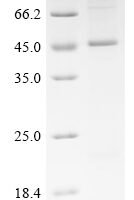
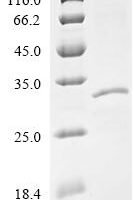
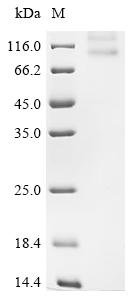
PurityGreater than 90% as determined by SDS-PAGE.
Expression Systemin vitro E.coli expression system
Expression Region1-676aa
SpeciesHomo sapiens (Human)
Tag InfoN-terminal 10xHis-tagged
Molecular weight80.7kDa
ActivityNot Test
BufferIf the delivery form is liquid, the default storage buffer is Tris/PBS-based buffer, 5%-50% glycerol.If the delivery form is lyophilized powder, the buffer before lyophilization is Tris/PBS-based buffer, 6% Trehalose.
StorageStore at -20°C/-80°C upon receipt, aliquoting is necessary for mutiple use. Avoid repeated freeze-thaw cycles.

Function

Non-functional alone but modulatory when coexpressed with the full-length isoform 1.

Biological Context

Subcellular Location: Cell membrane (Multi-pass membrane protein); Cytoplasmic vesicle membrane; Early endosome; Membrane raft; Endoplasmic reticulum; Basolateral cell membrane; Apical cell membrane (Multi-pass membrane protein)
Tissue Specificity: Abundantly expressed in heart, pancreas, prostate, kidney, small intestine and peripheral blood leukocytes. Less abundant in placenta, lung, spleen, colon, thymus, testis and ovaries
Disease Association: Long QT syndrome 1 (LQT1) : A heart disorder characterized by a prolonged QT interval on the ECG and polymorphic ventricular arrhythmias. They cause syncope and sudden death in response to exercise or emotional stress, and can present with a sentinel event of sudden cardiac death in infancy. [The disease is caused by variants affecting the gene represented in this entry] | Jervell and Lange-Nielsen syndrome 1 (JLNS1) : An autosomal recessive disorder characterized by congenital deafness, prolongation of the QT interval, syncopal attacks due to ventricular arrhythmias, and a high risk of sudden death. [The disease is caused by variants affecting the gene represented in this entry] | Atrial fibrillation, familial, 3 (ATFB3) : An autosomal dominant form of atrial fibrillation, a common sustained cardiac rhythm disturbance. Atrial fibrillation is characterized by disorganized atrial electrical activity and ineffective atrial contraction promoting blood stasis in the atria and reduces ventricular filling. It can result in palpitations, syncope, thromboembolic stroke, and congestive heart failure. [The disease is caused by variants affecting the gene represented in this entry] | Short QT syndrome 2 (SQT2) : An autosomal dominant form of short QT syndrome, a heart disorder characterized by idiopathic persistently and uniformly short QT interval on ECG in the absence of structural heart disease in affected individuals. It can cause syncope and sudden death. [The disease is caused by variants affecting the gene represented in this entry] | Type 2 diabetes mellitus (T2D) : A multifactorial disorder of glucose homeostasis caused by a lack of sensitivity to insulin. Affected individuals usually have an obese body habitus and manifestations of a metabolic syndrome characterized by diabetes, insulin resistance, hypertension and hypertriglyceridemia. The disease results in long-term complications that affect the eyes, kidneys, nerves, and blood vessels. [Disease susceptibility is associated with variants affecting the gene represented in this entry]

Product Specifications

Recombinant Human Potassium voltage-gated channel subfamily KQT member 1 (KCNQ1) Protein is a recombinant protein from Homo sapiens (Human), expressed in in vitro E.coli expression system, covering amino acids 1-676aa, with N-terminal 10xHis-tagged tag, molecular weight 80.7kDa, purity Greater than 90% as determined by SDS-PAGE.. Suitable for ELISA and Western Blot applications.
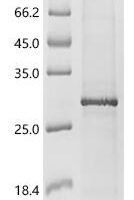
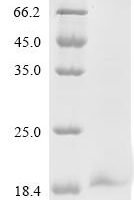
SDS-PAGE: Single band at expected molecular weight confirming purity.

ELISA: Suitable as coating antigen or detection standard.

Western Blot: Compatible with standard Western Blot protocols.

Protein Interaction: Validated for SPR (Surface Plasmon Resonance) and BLI (Bio-Layer Interferometry) studies.

Shipping: Shipped at ambient temperature. Lyophilized protein is stable during transit.

Storage: Store lyophilized protein at -20°C to -80°C. Reconstituted protein should be aliquoted and stored at -80°C. Avoid repeated freeze-thaw cycles.

Shelf Life: 12 months from date of receipt when stored as recommended.

Shipping Time: Orders placed before 2 PM EST ship same day. International orders typically deliver within 5-10 business days.

Protein Biology

Function

Non-functional alone but modulatory when coexpressed with the full-length isoform 1

Subcellular Location

Cell membrane (Multi-pass membrane protein); Cytoplasmic vesicle membrane; Early endosome; Membrane raft; Endoplasmic reticulum; Basolateral cell membrane; Apical cell membrane (Multi-pass membrane protein)

Disease Association

Long QT syndrome 1 (LQT1) : A heart disorder characterized by a prolonged QT interval on the ECG and polymorphic ventricular arrhythmias. They cause syncope and sudden death in response to exercise or emotional stress, and can present with a sentinel event of sudden cardiac death in infancy. [The disease is caused by variants affecting the gene represented in this entry] | Jervell and Lange-Nielsen syndrome 1 (JLNS1) : An autosomal recessive disorder characterized by congenital deafness, prolongation of the QT interval, syncopal attacks due to ventricular arrhythmias, and a high risk of sudden death. [The disease is caused by variants affecting the gene represented in this entry] | Atrial fibrillation, familial, 3 (ATFB3) : An autosomal dominant form of atrial fibrillation, a common sustained cardiac rhythm disturbance. Atrial fibrillation is characterized by disorganized atrial electrical activity and ineffective atrial contraction promoting blood stasis in the atria and reduces ventricular filling. It can result in palpitations, syncope, thromboembolic stroke, and congestive heart failure. [The disease is caused by variants affecting the gene represented in this entry] | Short QT syndrome 2 (SQT2) : An autosomal dominant form of short QT syndrome, a heart disorder characterized by idiopathic persistently and uniformly short QT interval on ECG in the absence of structural heart disease in affected individuals. It can cause syncope and sudden death. [The disease is caused by variants affecting the gene represented in this entry] | Type 2 diabetes mellitus (T2D) : A multifactorial disorder of glucose homeostasis caused by a lack of sensitivity to insulin. Affected individuals usually have an obese body habitus and manifestations of a metabolic syndrome characterized by diabetes, insulin resistance, hypertension and hypertriglyceridemia. The disease results in long-term complications that affect the eyes, kidneys, nerves, and blood vessels. [Disease susceptibility is associated with variants affecting the gene represented in this entry]

Tissue Specificity

Abundantly expressed in heart, pancreas, prostate, kidney, small intestine and peripheral blood leukocytes. Less abundant in placenta, lung, spleen, colon, thymus, testis and ovaries

Subunit

Tetramer (PubMed:18165683, PubMed:19693805, PubMed:25441029, PubMed:31883792). Heterotetramer with KCNE1; targets to the membrane raft (PubMed:19693805, PubMed:20533308, PubMed:25037568). Interacts (via C-terminus) with calmodulin; forms a heterooctameric structure (with 4:4 KCNQ1:CALM stoichiometry); the interaction is calcium-independent, constitutive, participates in the proper assembly of a functional channel and also acts a calcium sensor (PubMed:16556865, PubMed:18165683, PubMed:25441029, PubMed:31883792). KCNQ1 channels interact more strongly with Ca(2+)-CALM than with apoCALM (PubMed:16556865). Interacts with AKAP9; targets protein kinase A (PKA) catalytic and regulatory subunits and protein phosphatase 1 (PP1) to the KCNQ1-KCNE1 complex, allowing PKA-mediated phosphorylation and increase of delayed rectifier potassium channel activity (PubMed:11799244, PubMed:25037568). Interacts with KCNE2; forms a heterooligomer complex that targets to the membrane raft and leading to currents with an apparently instantaneous activation, a rapid deactivation process and a linear current-voltage relationship and decreases the amplitude of the outward current (PubMed:11101505, PubMed:20533308). Interacts with AP2M1; mediates estrogen-induced internalization via clathrin-coated vesicles (PubMed:23529131). Interacts with NEDD4L; promotes internalization and decreases I(Ks) currents (PubMed:22024150, PubMed:23529131). Interacts with USP2; counteracts the NEDD4L-specific down-regulation of I(Ks) and restore plasma membrane localization (PubMed:22024150). Heterotetramer with KCNQ5; has a voltage-gated potassium channel activity (PubMed:24855057). Interacts with KCNE3; four KCNE3 molecules are bound to one KCNQ1 tetramer (4:4 KCNQ1:KCNE3 stoichiometry); alters membrane raft localization; affects KCNQ1 structure and gating properties (PubMed:20533308, PubMed:31883792). Interacts with KCNE4; impairs KCNQ1 localization in lipid rafts and inhibits voltage-gated potassium channel activity (PubMed:19687231, PubMed:20533308). Interacts with KCNE5; impairs KCNQ1 localization in lipid rafts and only conducts current upon strong and continued depolarization (PubMed:12324418, PubMed:20533308). Interacts with SLC5A3; forms coregulatory channel-transporter complexes that modulate Na(+)-coupled myo-inositol influx through the transporter (By similarity)

Gene: KCNQ1  |  Organism: Homo sapiens  |  Synonyms: IKs producing slow voltage-gated potassium channel subunit alpha KvLQT1; KQT-like 1; Voltage-gated potassium channel subunit Kv7.1
Key Publications

Frequently Asked Questions

How do I order or inquire about this product?

Fill out the Online Inquiry form with your required quantity and specifications. You can also email sales@biocrestsci.com. Our team typically responds within 4 business hours with a quote and availability confirmation.

What is the shipping and delivery time?

Orders placed before 2 PM EST ship the same day. Domestic (US) delivery typically takes 2-3 business days. International orders deliver within 5-10 business days. All products are shipped at ambient temperature with appropriate packaging to ensure stability.

How should I store this recombinant protein?

Lyophilized proteins should be stored at -20°C to -80°C upon receipt. After reconstitution, aliquot and store at -80°C. Avoid repeated freeze-thaw cycles. Shelf life is 12 months from date of receipt when stored as recommended.

What quality controls are performed on your products?

Each product undergoes SDS-PAGE purity analysis (typically >85-95%), endotoxin testing, and bioactivity validation. Products are validated for ELISA, Western Blot, and SPR/BLI applications as specified on this product page. A Certificate of Analysis (CoA) is available upon request.

Shopping Cart
Scroll to Top