Recombinant Human Alpha-crystallin B chain (CRYAB)

Recombinant Human Alpha-crystallin B chain (CRYAB) — May contribute to the transparency and refractive index of the lens. Purity >90%.

SKU: BCRECP-000433 Category:

Product Specifications

Product SkuBCRECP-000433
Product DescriptionRecombinant Human Alpha-crystallin B chain (CRYAB) Protein is expressed from E.coli with N-terminal 6xHis-SUMO-tagged. It contains 1-175aa. [Accession | P02511].
Uniprot No.P02511
Gene NamesCRYAB
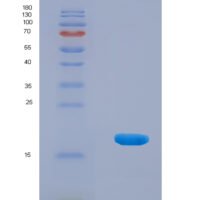
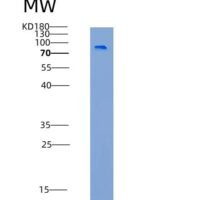
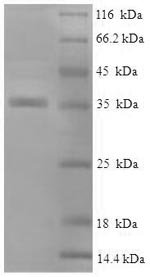
PurityGreater than 90% as determined by SDS-PAGE.
Expression SystemE.coli
Expression Region1-175aa
SpeciesHomo sapiens (Human)
Tag InfoN-terminal 6xHis-SUMO-tagged
Molecular weight36.2kDa
ActivityPlease contact us to obtain bioactivity data.
BufferIf the delivery form is liquid, the default storage buffer is Tris/PBS-based buffer, 5%-50% glycerol. If the delivery form is lyophilized powder, the buffer before lyophilization is Tris/PBS-based buffer, 6% Trehalose.
StorageStore at -20°C/-80°C upon receipt, aliquoting is necessary for mutiple use. Avoid repeated freeze-thaw cycles.
Research AreasCancer

Function

May contribute to the transparency and refractive index of the lens. Has chaperone-like activity, preventing aggregation of various proteins under a wide range of stress conditions. In lens epithelial cells, stabilizes the ATP6V1A protein, preventing its degradation by the proteasome.

Biological Context

Subcellular Location: Cytoplasm; Nucleus; Secreted; Lysosome
Tissue Specificity: Lens as well as other tissues. Expressed in myocardial tissue
Disease Association: Myopathy, myofibrillar, 2A, adult-onset (MFM2A) : A form of myofibrillar myopathy, a group of chronic neuromuscular disorders characterized at ultrastructural level by disintegration of the sarcomeric Z disk and myofibrils, and replacement of the normal myofibrillar markings by small dense granules, or larger hyaline masses, or amorphous material. MFM2A is an autosomal dominant form characterized by weakness of the proximal and distal limb muscles, weakness of the neck, velopharynx and trunk muscles, respiratory insufficiency, hypertrophic cardiomyopathy, and cataract. [The disease is caused by variants affecting the gene represented in this entry] | Cataract 16, multiple types (CTRCT16) : An opacification of the crystalline lens of the eye that frequently results in visual impairment or blindness. Opacities vary in morphology, are often confined to a portion of the lens, and may be static or progressive. In general, the more posteriorly located and dense an opacity, the greater the impact on visual function. CTRCT16 includes posterior polar cataract, among others. Posterior polar cataract is a subcapsular opacity, usually disk-shaped, located at the back of the lens. [The disease is caused by variants affecting the gene represented in this entry] | [CRYAB mutations may be involved in restrictive cardiomyopathy (RCM), a rare non-ischemic myocardial disease. RCM is characterized by restrictive ventricular-filling physiology in the presence of normal or reduced diastolic and/or systolic volumes (of 1 or both ventricles), biatrial enlargement, and normal ventricular wall thickness] | Myopathy, myofibrillar, 2B, infantile-onset (MFM2B) : A form of myofibrillar myopathy, a group of chronic neuromuscular disorders characterized at ultrastructural level by disintegration of the sarcomeric Z disk and myofibrils, and replacement of the normal myofibrillar markings by small dense granules, or larger hyaline masses, or amorphous material. MFM2B is an autosomal recessive form characterized by onset in the first weeks of life after a normal neonatal period. Affected infants show rapidly progressive muscular rigidity of the trunk and limbs associated with increasing respiratory difficulty resulting in death before age 3 years. [The disease is caused by variants affecting the gene represented in this entry] | Cardiomyopathy, dilated, 1II (CMD1II) : A disorder characterized by ventricular dilation and impaired systolic function, resulting in congestive heart failure and arrhythmia. Patients are at risk of premature death. [The disease is caused by variants affecting the gene represented in this entry]

Product Specifications

Recombinant Human Alpha-crystallin B chain (CRYAB) is a recombinant protein from Homo sapiens (Human), expressed in E.coli, covering amino acids 1-175aa, with N-terminal 6xHis-SUMO-tagged tag, molecular weight 36.2kDa, purity Greater than 90% as determined by SDS-PAGE.. Suitable for ELISA and Western Blot applications.
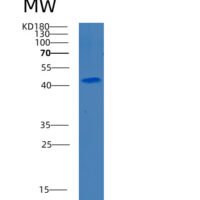
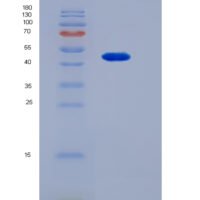
SDS-PAGE: Single band at expected molecular weight confirming purity.

ELISA: Suitable as coating antigen or detection standard.

Western Blot: Compatible with standard Western Blot protocols.

Protein Interaction: Validated for SPR (Surface Plasmon Resonance) and BLI (Bio-Layer Interferometry) studies.

Shipping: Shipped at ambient temperature. Lyophilized protein is stable during transit.

Storage: Store lyophilized protein at -20°C to -80°C. Reconstituted protein should be aliquoted and stored at -80°C. Avoid repeated freeze-thaw cycles.

Shelf Life: 12 months from date of receipt when stored as recommended.

Shipping Time: Orders placed before 2 PM EST ship same day. International orders typically deliver within 5-10 business days.

Protein Biology

Function

May contribute to the transparency and refractive index of the lens. Has chaperone-like activity, preventing aggregation of various proteins under a wide range of stress conditions. In lens epithelial cells, stabilizes the ATP6V1A protein, preventing its degradation by the proteasome (By similarity)

Subcellular Location

Cytoplasm; Nucleus; Secreted; Lysosome

Disease Association

Myopathy, myofibrillar, 2A, adult-onset (MFM2A) : A form of myofibrillar myopathy, a group of chronic neuromuscular disorders characterized at ultrastructural level by disintegration of the sarcomeric Z disk and myofibrils, and replacement of the normal myofibrillar markings by small dense granules, or larger hyaline masses, or amorphous material. MFM2A is an autosomal dominant form characterized by weakness of the proximal and distal limb muscles, weakness of the neck, velopharynx and trunk muscles, respiratory insufficiency, hypertrophic cardiomyopathy, and cataract. [The disease is caused by variants affecting the gene represented in this entry] | Cataract 16, multiple types (CTRCT16) : An opacification of the crystalline lens of the eye that frequently results in visual impairment or blindness. Opacities vary in morphology, are often confined to a portion of the lens, and may be static or progressive. In general, the more posteriorly located and dense an opacity, the greater the impact on visual function. CTRCT16 includes posterior polar cataract, among others. Posterior polar cataract is a subcapsular opacity, usually disk-shaped, located at the back of the lens. [The disease is caused by variants affecting the gene represented in this entry] | [CRYAB mutations may be involved in restrictive cardiomyopathy (RCM), a rare non-ischemic myocardial disease. RCM is characterized by restrictive ventricular-filling physiology in the presence of normal or reduced diastolic and/or systolic volumes (of 1 or both ventricles), biatrial enlargement, and normal ventricular wall thickness] | Myopathy, myofibrillar, 2B, infantile-onset (MFM2B) : A form of myofibrillar myopathy, a group of chronic neuromuscular disorders characterized at ultrastructural level by disintegration of the sarcomeric Z disk and myofibrils, and replacement of the normal myofibrillar markings by small dense granules, or larger hyaline masses, or amorphous material. MFM2B is an autosomal recessive form characterized by onset in the first weeks of life after a normal neonatal period. Affected infants show rapidly progressive muscular rigidity of the trunk and limbs associated with increasing respiratory difficulty resulting in death before age 3 years. [The disease is caused by variants affecting the gene represented in this entry] | Cardiomyopathy, dilated, 1II (CMD1II) : A disorder characterized by ventricular dilation and impaired systolic function, resulting in congestive heart failure and arrhythmia. Patients are at risk of premature death. [The disease is caused by variants affecting the gene represented in this entry]

Tissue Specificity

Lens as well as other tissues (PubMed:2387586, PubMed:838078). Expressed in myocardial tissue (PubMed:28493373)

Subunit

Heteromer composed of three CRYAA and one CRYAB subunits (PubMed:20836128). Aggregates with homologous proteins, including the small heat shock protein HSPB1, to form large heteromeric complexes (PubMed:10751411). Inter-subunit bridging via zinc ions enhances stability, which is crucial as there is no protein turn over in the lens (PubMed:22890888). Interacts with HSPBAP1 and TTN/titin (PubMed:14676215). Interacts with TMEM109; in the cellular response to DNA damage (PubMed:23542032). Interacts with DES; binds rapidly during early stages of DES filament assembly and a reduced binding seen in the later stages (PubMed:28470624). Interacts with TMED10; the interaction mediates the translocation from the cytoplasm into the ERGIC (endoplasmic reticulum-Golgi intermediate compartment) and thereby secretion (PubMed:32272059). Interacts with ATP6V1A and with MTOR, forming a ternary complex (PubMed:31786107)

Gene: CRYAB  |  Organism: Homo sapiens  |  Synonyms: Alpha(B)-crystallin; Heat shock protein beta-5; Heat shock protein family B member 5; Renal carcinoma antigen NY-REN-27; Rosenthal fiber component

Frequently Asked Questions

How do I order or inquire about this product?

Fill out the Online Inquiry form with your required quantity and specifications. You can also email sales@biocrestsci.com. Our team typically responds within 4 business hours with a quote and availability confirmation.

What is the shipping and delivery time?

Orders placed before 2 PM EST ship the same day. Domestic (US) delivery typically takes 2-3 business days. International orders deliver within 5-10 business days. All products are shipped at ambient temperature with appropriate packaging to ensure stability.

How should I store this recombinant protein?

Lyophilized proteins should be stored at -20°C to -80°C upon receipt. After reconstitution, aliquot and store at -80°C. Avoid repeated freeze-thaw cycles. Shelf life is 12 months from date of receipt when stored as recommended.

What quality controls are performed on your products?

Each product undergoes SDS-PAGE purity analysis (typically >85-95%), endotoxin testing, and bioactivity validation. Products are validated for ELISA, Western Blot, and SPR/BLI applications as specified on this product page. A Certificate of Analysis (CoA) is available upon request.

Shopping Cart
Scroll to Top