Function
Binding to cells via a high affinity receptor, laminin is thought to mediate the attachment, migration and organization of cells into tissues during embryonic development by interacting with other extracellular matrix components. Ladsin exerts cell-scattering activity toward a wide variety of cells, including epithelial, endothelial, and fibroblastic cells.
Biological Context
Subcellular Location: Secreted, extracellular space, extracellular matrix, basement membrane
Tissue Specificity: The large variant is expressed only in specific epithelial cells of embryonic and neonatal tissues. In 17-week old embryo the small variant is found in cerebral cortex, lung, and distal tubes of kidney, but not in epithelia except for distal tubuli
Disease Association: Epidermolysis bullosa, junctional 3A, intermediate (JEB3A) : A form of epidermolysis bullosa, a genodermatosis characterized by recurrent blistering, fragility of the skin and mucosal epithelia, and erosions caused by minor mechanical trauma. JEB3A is an autosomal recessive, intermediate form in which blistering lesions occur between the epidermis and the dermis at the lamina lucida level of the basement membrane zone. In intermediate forms of junctional epidermolysis bullosa, blistering does not lead to the formation of chronic granulation tissue and does not affect the lifespan of affected individuals. Nail dystrophy and dental enamel defects are present. Scarring or non-scarring alopecia and diffuse hair loss may occur. [The disease is caused by variants affecting the gene represented in this entry] | Epidermolysis bullosa, junctional 3B, severe (JEB3B) : A form of epidermolysis bullosa, a genodermatosis characterized by recurrent blistering, fragility of the skin and mucosal epithelia, and erosions caused by minor mechanical trauma. JEB3B is an autosomal recessive form in which blistering lesions occur between the epidermis and the dermis at the lamina lucida level of the basement membrane zone. It belongs to the severe spectrum of junctional epidermolysis bullosa (previously known as generalized severe or Herlitz type), characterized by onset of blistering over large regions of the body at birth or in early infancy. Blistering also affects the mucous membranes, such as the moist lining of the mouth and digestive tract, which can make it difficult to eat and digest food. The extensive blistering leads to scarring and the formation of red, bumpy patches called granulation tissue. Other complications can include fusion of the fingers and toes, abnormalities of the fingernails and toenails, joint deformities, dental enamel defects, and alopecia. Severe, junctional forms are associated with death in the first 6 to 24 months of life. [The disease is caused by variants affecting the gene represented in this entry]
Product Specifications
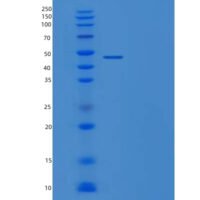
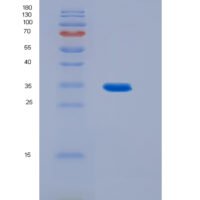
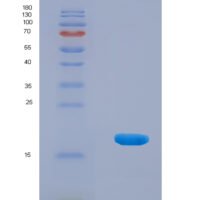
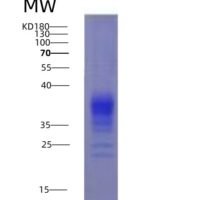
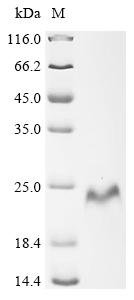
Recombinant Human Laminin subunit gamma-2 (LAMC2), partial is a recombinant protein from Homo sapiens (Human), expressed in Yeast, covering amino acids 417-588aa, with C-terminal 6xHis-tagged tag, molecular weight 19.6kDa, purity Greater than 95% as determined by SDS-PAGE.. Suitable for ELISA and Western Blot applications.