Recombinant Human Ras-related C3 botulinum toxin substrate 1 (RAC1)

Recombinant Human Ras-related C3 botulinum toxin substrate 1 (RAC1) — Isoform B has an accelerated GEF-independent GDP/GTP exchange and an impaired GTP hydrolysis, which is restored partially by GTPase-activating proteins. Purity >95%.

SKU: BCRECP-001510 Category:

Product Specifications

Product SkuBCRECP-001510
Product DescriptionRecombinant Human Ras-related C3 botulinum toxin substrate 1 (RAC1) Protein is expressed from E.coli with N-terminal 10xHis-tagged. It contains 1-208aa. [Accession | P63000].
Uniprot No.P63000
Gene NamesRAC1
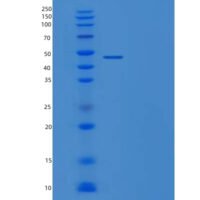
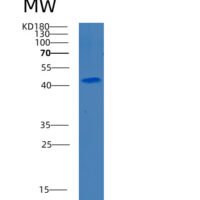
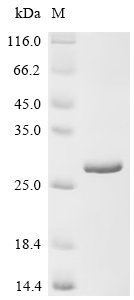
PurityGreater than 95% as determined by SDS-PAGE.
Expression SystemE.coli
Expression Region1-208aa
SpeciesHomo sapiens (Human)
Tag InfoN-terminal 10xHis-tagged
Molecular weight26.8kDa
ActivityPlease contact us to obtain bioactivity data.
BufferIf the delivery form is liquid, the default storage buffer is Tris/PBS-based buffer, 5%-50% glycerol. If the delivery form is lyophilized powder, the buffer before lyophilization is Tris/PBS-based buffer, 6% Trehalose.
StorageStore at -20°C/-80°C upon receipt, aliquoting is necessary for mutiple use. Avoid repeated freeze-thaw cycles.
Research AreasCancer

Function

Isoform B has an accelerated GEF-independent GDP/GTP exchange and an impaired GTP hydrolysis, which is restored partially by GTPase-activating proteins. It is able to bind to the GTPase-binding domain of PAK but not full-length PAK in a GTP-dependent manner, suggesting that the insertion does not completely abolish effector interaction.

Biological Context

Subcellular Location: Cell membrane (Lipid-anchor); Melanosome; Cytoplasm; Cell projection, lamellipodium; Cell projection, dendrite; Synapse; Nucleus; Cell projection, ruffle membrane
Tissue Specificity: Isoform B is predominantly identified in skin and epithelial tissues from the intestinal tract. Its expression is elevated in colorectal tumors at various stages of neoplastic progression, as compared to their respective adjacent tissues
Disease Association: Intellectual developmental disorder, autosomal dominant 48 (MRD48) : A disorder characterized by significantly below average general intellectual functioning associated with impairments in adaptive behavior and manifested during the developmental period. MRD48 patients manifest global developmental delay and moderate to severe intellectual disability. [The disease is caused by variants affecting the gene represented in this entry]

Product Specifications

Recombinant Human Ras-related C3 botulinum toxin substrate 1 (RAC1) is a recombinant protein from Homo sapiens (Human), expressed in E.coli, covering amino acids 1-208aa, with N-terminal 10xHis-tagged tag, molecular weight 26.8kDa, purity Greater than 95% as determined by SDS-PAGE.. Suitable for ELISA and Western Blot applications.
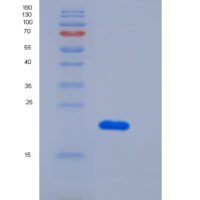
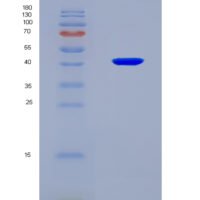
SDS-PAGE: Single band at expected molecular weight confirming purity.

ELISA: Suitable as coating antigen or detection standard.

Western Blot: Compatible with standard Western Blot protocols.

Protein Interaction: Validated for SPR (Surface Plasmon Resonance) and BLI (Bio-Layer Interferometry) studies.

Shipping: Shipped at ambient temperature. Lyophilized protein is stable during transit.

Storage: Store lyophilized protein at -20°C to -80°C. Reconstituted protein should be aliquoted and stored at -80°C. Avoid repeated freeze-thaw cycles.

Shelf Life: 12 months from date of receipt when stored as recommended.

Shipping Time: Orders placed before 2 PM EST ship same day. International orders typically deliver within 5-10 business days.

Protein Biology

Function

Isoform B has an accelerated GEF-independent GDP/GTP exchange and an impaired GTP hydrolysis, which is restored partially by GTPase-activating proteins (PubMed:14625275). It is able to bind to the GTPase-binding domain of PAK but not full-length PAK in a GTP-dependent manner, suggesting that the insertion does not completely abolish effector interaction (PubMed:14625275)

Subcellular Location

Cell membrane (Lipid-anchor); Melanosome; Cytoplasm; Cell projection, lamellipodium; Cell projection, dendrite; Synapse; Nucleus; Cell projection, ruffle membrane

Disease Association

Intellectual developmental disorder, autosomal dominant 48 (MRD48) : A disorder characterized by significantly below average general intellectual functioning associated with impairments in adaptive behavior and manifested during the developmental period. MRD48 patients manifest global developmental delay and moderate to severe intellectual disability. [The disease is caused by variants affecting the gene represented in this entry]

Tissue Specificity

Isoform B is predominantly identified in skin and epithelial tissues from the intestinal tract. Its expression is elevated in colorectal tumors at various stages of neoplastic progression, as compared to their respective adjacent tissues

Subunit

Interacts with NISCH. Interacts with PIP5K1A. Interacts with the GTP-bound form of RAB7A. Interacts with SRGAP2. Interacts with CYFIP1/SRA-1. Interacts with PLXNB3. Interacts with ARHGDIA; the interaction is induced by SEMA5A, mediated through PLXNB3 and inactivates and stabilizes RAC1. Interacts (GTP-bound form preferentially) with PKN2 (via the REM repeats); the interaction stimulates autophosphorylation and phosphorylation of PKN2. Interacts with the GEF proteins PREX1, RASGRF2, FARP1, FARP2, DOCK1, DOCK2 and DOCK7, which promote the exchange between GDP and GTP, and therefore activate it (PubMed:32651375). Interacts with PARD6A, PARD6B and PARD6G in a GTP-dependent manner. Part of a quaternary complex containing PARD3, some PARD6 protein (PARD6A, PARD6B or PARD6G) and some atypical PKC protein (PRKCI or PRKCZ), which plays a central role in epithelial cell polarization. Found in a trimeric complex composed of DOCK1 and ELMO1, which plays a central role in phagocytosis of apoptotic cells. Interacts with RALBP1 via its effector domain. Interacts with PLXNB1. Part of a complex with MAP2K3, MAP3K3, CCM2 and DEF6. Interacts with BAIAP2, BAIAP2L1 and DEF6. Interacts with Y.pseudotuberculosis YPKA and PLCB2. Interacts with NOXA1. Interacts with ARHGEF2. Interacts with TBC1D2. Interacts with UNKL. Interacts with USP6. Interacts with SPATA13. Interacts with ARHGEF16; mediates activation of RAC1 by EPHA2. Interacts with ITGB4. Interacts with S100A8 and calprotectin (S100A8/9). Interacts with PACSIN2. Interacts with ITGB1BP1. Interacts (when active) with PPP5C (via TPR repeats); activates PPP5C phosphatase activity and translocates PPP5C to the cell membrane. Interacts with RAPH1 (via Ras associating and PH domains) (PubMed:18499456). Interacts with MTSS2 (via IMD domain); this interaction may be important to potentiate PDGF-induced RAC1 activation (PubMed:20875796). Interacts with PAK2 (PubMed:20696164). Interacts (GTP-bound form) with SH3RF1 and SH3RF3 (PubMed:20696164). Found in a complex with SH3RF1, MAPK8IP1/JIP1, MAP3K11/MLK3, MAP2K7/MKK7 and MAPK8/JNK1. Interacts (both active GTP- or inactive GDP-bound forms) with SH3RF2 (By similarity). Interacts (GTP-bound form preferentially) with CYRIB (PubMed:30250061, PubMed:31285585). Interacts with DOCK4 (via DOCKER domain); functions as a guanine nucleotide exchange factor (GEF) for RAC1 (PubMed:16464467). Interacts with GARRE1 (PubMed:31871319). Interacts with RAP1GDS1 (PubMed:12551911, PubMed:20709748). Interacts with TNFAIP8L2 (PubMed:32460619). May interact with ARHGAP36 (PubMed:35986704). Interacts with CD151 and integrin beta1/ITGB1 (PubMed:22843693). Interacts with DSG3; the interaction is required for DSG3 translocation to cell-cell junctions, organization of cortical F-actin bundles and actin anchoring at cell-cell junctions (PubMed:22796473). Component of the phagocyte NADPH oxidase complex composed of an obligatory core heterodimer formed by the membrane proteins CYBA and CYBB and the cytosolic regulatory subunits NCF1/p47-phox, NCF2/p67-phox, NCF4/p40-phox and the small GTPase RAC1 or RAC2 (PubMed:38355798). Interacts with NCF2 (PubMed:11090627). Interacts with ELMO1; the interaction is direct and promotes binding of DOCK2 to RAC1 (PubMed:32651375). Interacts with SYNJ2; this interaction is GTP-dependent and mediates the translocation of SYNJ2 from the cytoplasm to the plasma membrane (PubMed:11084340)

Gene: RAC1  |  Organism: Homo sapiens  |  Synonyms: Cell migration-inducing gene 5 protein; Ras-like protein TC25; p21-Rac1
Key Publications

Frequently Asked Questions

How do I order or inquire about this product?

Fill out the Online Inquiry form with your required quantity and specifications. You can also email sales@biocrestsci.com. Our team typically responds within 4 business hours with a quote and availability confirmation.

What is the shipping and delivery time?

Orders placed before 2 PM EST ship the same day. Domestic (US) delivery typically takes 2-3 business days. International orders deliver within 5-10 business days. All products are shipped at ambient temperature with appropriate packaging to ensure stability.

How should I store this recombinant protein?

Lyophilized proteins should be stored at -20°C to -80°C upon receipt. After reconstitution, aliquot and store at -80°C. Avoid repeated freeze-thaw cycles. Shelf life is 12 months from date of receipt when stored as recommended.

What quality controls are performed on your products?

Each product undergoes SDS-PAGE purity analysis (typically >85-95%), endotoxin testing, and bioactivity validation. Products are validated for ELISA, Western Blot, and SPR/BLI applications as specified on this product page. A Certificate of Analysis (CoA) is available upon request.

Shopping Cart
Scroll to Top