Recombinant Human GTP-binding nuclear protein Ran (RAN)

Recombinant Human GTP-binding nuclear protein Ran (RAN) — GTPase involved in nucleocytoplasmic transport, participating both to the import and the export from the nucleus of proteins and RNAs. Purity >90%.

SKU: BCRECP-001517 Category:

Product Specifications

Product SkuBCRECP-001517
Product DescriptionRecombinant Human GTP-binding nuclear protein Ran (RAN) Protein is expressed from E.coli with N-terminal GST-tagged. It contains 1-216aa. [Accession | P62826].
Uniprot No.P62826
Gene NamesRAN
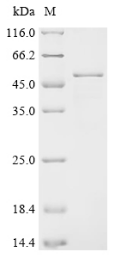
PurityGreater than 90% as determined by SDS-PAGE.
Expression SystemE.coli
Expression Region1-216aa
SpeciesHomo sapiens (Human)
Tag InfoN-terminal GST-tagged
Molecular weight51.3kDa
ActivityPlease contact us to obtain bioactivity data.
BufferIf the delivery form is liquid, the default storage buffer is Tris/PBS-based buffer, 5%-50% glycerol. If the delivery form is lyophilized powder, the buffer before lyophilization is Tris/PBS-based buffer, 6% Trehalose.
StorageStore at -20°C/-80°C upon receipt, aliquoting is necessary for mutiple use. Avoid repeated freeze-thaw cycles.
Research AreasCell Biology

Function

GTPase involved in nucleocytoplasmic transport, participating both to the import and the export from the nucleus of proteins and RNAs. Switches between a cytoplasmic GDP- and a nuclear GTP-bound state by nucleotide exchange and GTP hydrolysis. Nuclear import receptors such as importin beta bind their substrates only in the absence of GTP-bound RAN and release them upon direct interaction with GTP-bound RAN, while export receptors behave in the opposite way.

Biological Context

Subcellular Location: Nucleus; Nucleus envelope; Cytoplasm, cytosol; Cytoplasm; Melanosome
Tissue Specificity: Expressed in a variety of tissues

Product Specifications

Recombinant Human GTP-binding nuclear protein Ran (RAN) is a recombinant protein from Homo sapiens (Human), expressed in E.coli, covering amino acids 1-216aa, with N-terminal GST-tagged tag, molecular weight 51.3kDa, purity Greater than 90% as determined by SDS-PAGE.. Suitable for ELISA and Western Blot applications.
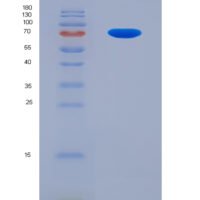
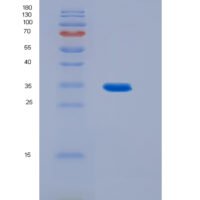
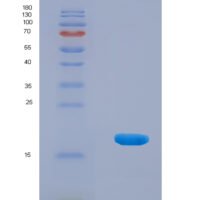
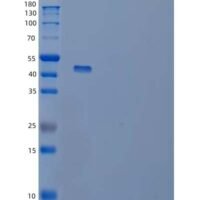
SDS-PAGE: Single band at expected molecular weight confirming purity.

ELISA: Suitable as coating antigen or detection standard.

Western Blot: Compatible with standard Western Blot protocols.

Protein Interaction: Validated for SPR (Surface Plasmon Resonance) and BLI (Bio-Layer Interferometry) studies.

Shipping: Shipped at ambient temperature. Lyophilized protein is stable during transit.

Storage: Store lyophilized protein at -20°C to -80°C. Reconstituted protein should be aliquoted and stored at -80°C. Avoid repeated freeze-thaw cycles.

Shelf Life: 12 months from date of receipt when stored as recommended.

Shipping Time: Orders placed before 2 PM EST ship same day. International orders typically deliver within 5-10 business days.

Protein Biology

Function

GTPase involved in nucleocytoplasmic transport, participating both to the import and the export from the nucleus of proteins and RNAs (PubMed:10400640, PubMed:17209048, PubMed:26272610, PubMed:27306458, PubMed:8276887, PubMed:8636225, PubMed:8692944, PubMed:8896452, PubMed:9351834, PubMed:9428644, PubMed:9822603). Switches between a cytoplasmic GDP- and a nuclear GTP-bound state by nucleotide exchange and GTP hydrolysis (PubMed:11336674, PubMed:26272610, PubMed:29040603, PubMed:7819259, PubMed:8636225, PubMed:8692944, PubMed:8896452, PubMed:9351834, PubMed:9428644, PubMed:9822603). Nuclear import receptors such as importin beta bind their substrates only in the absence of GTP-bound RAN and release them upon direct interaction with GTP-bound RAN, while export receptors behave in the opposite way. Thereby, RAN controls cargo loading and release by transport receptors in the proper compartment and ensures the directionality of the transport (PubMed:8896452, PubMed:9351834, PubMed:9428644). Interaction with RANBP1 induces a conformation change in the complex formed by XPO1 and RAN that triggers the release of the nuclear export signal of cargo proteins (PubMed:20485264). RAN (GTP-bound form) triggers microtubule assembly at mitotic chromosomes and is required for normal mitotic spindle assembly and chromosome segregation (PubMed:10408446, PubMed:29040603). Required for normal progress through mitosis (PubMed:12194828, PubMed:29040603, PubMed:8421051). The complex with BIRC5/survivin plays a role in mitotic spindle formation by serving as a physical scaffold to help deliver the RAN effector molecule TPX2 to microtubules (PubMed:18591255). Acts as a negative regulator of the kinase activity of VRK1 and VRK2 (PubMed:18617507). Enhances AR-mediated transactivation. Transactivation decreases as the poly-Gln length within AR increases (PubMed:10400640)

Subcellular Location

Nucleus; Nucleus envelope; Cytoplasm, cytosol; Cytoplasm; Melanosome

Tissue Specificity

Expressed in a variety of tissues

Subunit

(Microbial infection) Interacts with Mengo encephalomyocarditis virus Leader protein; the complex L-RAN recruits cellular kinases responsible for the L-induced nucleocytoplasmic trafficking inhibition

Gene: RAN  |  Organism: Homo sapiens  |  Synonyms: Androgen receptor-associated protein 24; GTPase Ran; Ras-like protein TC4; Ras-related nuclear protein
Key Publications

Frequently Asked Questions

How do I order or inquire about this product?

Fill out the Online Inquiry form with your required quantity and specifications. You can also email sales@biocrestsci.com. Our team typically responds within 4 business hours with a quote and availability confirmation.

What is the shipping and delivery time?

Orders placed before 2 PM EST ship the same day. Domestic (US) delivery typically takes 2-3 business days. International orders deliver within 5-10 business days. All products are shipped at ambient temperature with appropriate packaging to ensure stability.

How should I store this recombinant protein?

Lyophilized proteins should be stored at -20°C to -80°C upon receipt. After reconstitution, aliquot and store at -80°C. Avoid repeated freeze-thaw cycles. Shelf life is 12 months from date of receipt when stored as recommended.

What quality controls are performed on your products?

Each product undergoes SDS-PAGE purity analysis (typically >85-95%), endotoxin testing, and bioactivity validation. Products are validated for ELISA, Western Blot, and SPR/BLI applications as specified on this product page. A Certificate of Analysis (CoA) is available upon request.

Shopping Cart
Scroll to Top