Mouse anti-Human/Mouse/Rat sapiens (Human) FH Monoclonal Antibody

Mouse anti-Human/Mouse/Rat sapiens (Human) FH Monoclonal Antibody — Catalyzes the dehydration of L-malate to fumarate.

SKU: BCREC-000366MA Category:

Product Specifications

Uniprot No.P07954
Target NamesFH
Species ReactivityMouse
ImmunogenRecombinant Human FH protein
Immunogen SpeciesHomo sapiens (Human)
ConjugateNon-conjugated
IsotypeMouse IgG1
ClonalityMonoclonal
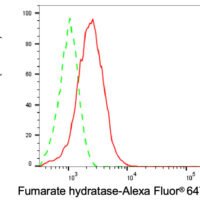
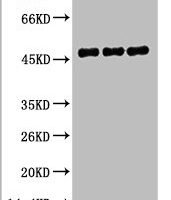
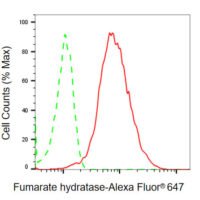
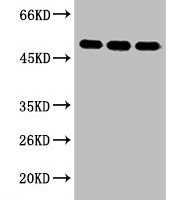
ApplicationsELISA, WB
BufferPBS, 50% glycerol, 0.05% Proclin 300, 0.05%BSA
StorageUpon receipt, store at -20°C or -80°C. Avoid repeated freeze.

Function

Catalyzes the dehydration of L-malate to fumarate. Fumarate metabolism in the cytosol plays a role during urea cycle and arginine metabolism; fumarate being a by-product of the urea cycle and amino-acid catabolism. Also plays a role in DNA repair by promoting non-homologous end-joining (NHEJ).

Biological Context

Subcellular Location: Cytoplasm, cytosol; Nucleus; Chromosome
Tissue Specificity: Expressed in red blood cells; underexpressed in red blood cells (cytoplasm) of patients with hereditary non-spherocytic hemolytic anemia of unknown etiology
Disease Association: Fumarase deficiency (FMRD) : A severe autosomal recessive metabolic disorder characterized by early-onset hypotonia, profound psychomotor retardation, and brain abnormalities, such as agenesis of the corpus callosum, gyral defects, and ventriculomegaly. Many patients show neonatal distress, metabolic acidosis, and/or encephalopathy. [The disease is caused by variants affecting the gene represented in this entry] | Hereditary leiomyomatosis and renal cell cancer (HLRCC) : A disorder characterized by predisposition to cutaneous and uterine leiomyomas, and papillary type 2 renal cancer which occurs in about 20% of patients. [The disease is caused by variants affecting the gene represented in this entry. Isoform Cytoplasmic: HLRCC is probably caused by an accumulation of fumarate. Accumulation of fumarate coupled with protonation promotes the formation of non-enzymatic post-translational modification cysteine S-succination (S-(2-succinyl)cysteine) on proteins, such as SMARCC1 ]
Pathway: Carbohydrate metabolism; tricarboxylic acid cycle; (S)-malate from fumarate: step 1/1

Product Specifications

Mouse anti-Human/Mouse/Rat sapiens (Human) FH Monoclonal Antibody is a recombinant protein. Suitable for ELISA and Western Blot applications.

Applications: ELISA, WB

Biological Activity: Not implied unless activity data are explicitly listed on this product page, the datasheet, or the CoA.

Storage: Upon receipt, store at -20°C or -80°C. Avoid repeated freeze.

Shipping & Lead Time: Availability, shipping conditions, and estimated lead time are confirmed in the formal quotation or order confirmation based on the product format, destination, and order requirements.

Protein Biology

Function

Catalyzes the dehydration of L-malate to fumarate (By similarity). Fumarate metabolism in the cytosol plays a role during urea cycle and arginine metabolism; fumarate being a by-product of the urea cycle and amino-acid catabolism (By similarity). Also plays a role in DNA repair by promoting non-homologous end-joining (NHEJ) (PubMed:20231875, PubMed:26237645). In response to DNA damage and phosphorylation by PRKDC, translocates to the nucleus and accumulates at DNA double-strand breaks (DSBs): acts by catalyzing formation of fumarate, an inhibitor of KDM2B histone demethylase activity, resulting in enhanced dimethylation of histone H3 'Lys-36' (H3K36me2) (PubMed:26237645)

Subcellular Location

Cytoplasm, cytosol; Nucleus; Chromosome

Disease Association

Fumarase deficiency (FMRD) : A severe autosomal recessive metabolic disorder characterized by early-onset hypotonia, profound psychomotor retardation, and brain abnormalities, such as agenesis of the corpus callosum, gyral defects, and ventriculomegaly. Many patients show neonatal distress, metabolic acidosis, and/or encephalopathy. [The disease is caused by variants affecting the gene represented in this entry] | Hereditary leiomyomatosis and renal cell cancer (HLRCC) : A disorder characterized by predisposition to cutaneous and uterine leiomyomas, and papillary type 2 renal cancer which occurs in about 20% of patients. [The disease is caused by variants affecting the gene represented in this entry. Isoform Cytoplasmic: HLRCC is probably caused by an accumulation of fumarate (PubMed:30718813). Accumulation of fumarate coupled with protonation promotes the formation of non-enzymatic post-translational modification cysteine S-succination (S-(2-succinyl)cysteine) on proteins, such as SMARCC1 (PubMed:30718813)]

Tissue Specificity

Expressed in red blood cells; underexpressed in red blood cells (cytoplasm) of patients with hereditary non-spherocytic hemolytic anemia of unknown etiology

Subunit

Homotetramer (PubMed:21445611, PubMed:30761759). Interacts with H2AZ1 (PubMed:26237645)

Pathway

Carbohydrate metabolism; tricarboxylic acid cycle; (S)-malate from fumarate: step 1/1

Gene: FH  |  Organism: Homo sapiens

Frequently Asked Questions

How do I order or inquire about this product?

Submit the Online Inquiry form with your required quantity and specifications, or email sales@biocrestsci.com. Available sizes, pricing, stock status, documentation, and estimated lead time are confirmed in the formal quotation.

What is the shipping and delivery time?

Availability, dispatch timing, shipping conditions, and delivery estimates depend on the product format, destination, and order requirements. These details are confirmed in the formal quotation or order confirmation.

How should this product be stored?

Follow the storage and handling instructions in the product-specific datasheet and Certificate of Analysis (CoA). Requirements may vary by product form and formulation; contact BioCrest Sci if product-specific guidance is needed.

What quality controls are performed on your products?

Quality-control data such as identity, purity, endotoxin level, or biological activity are provided only when specified on this product page, the datasheet, or Certificate of Analysis (CoA). Biological activity is not implied unless explicitly stated.

Shopping Cart
Scroll to Top