Function
May contribute to the transparency and refractive index of the lens. Has chaperone-like activity, preventing aggregation of various proteins under a wide range of stress conditions. In lens epithelial cells, stabilizes the ATP6V1A protein, preventing its degradation by the proteasome.
Biological Context
Subcellular Location: Cytoplasm; Nucleus; Secreted; Lysosome
Tissue Specificity: Lens as well as other tissues. Expressed in myocardial tissue
Disease Association: Myopathy, myofibrillar, 2A, adult-onset (MFM2A) : A form of myofibrillar myopathy, a group of chronic neuromuscular disorders characterized at ultrastructural level by disintegration of the sarcomeric Z disk and myofibrils, and replacement of the normal myofibrillar markings by small dense granules, or larger hyaline masses, or amorphous material. MFM2A is an autosomal dominant form characterized by weakness of the proximal and distal limb muscles, weakness of the neck, velopharynx and trunk muscles, respiratory insufficiency, hypertrophic cardiomyopathy, and cataract. [The disease is caused by variants affecting the gene represented in this entry] | Cataract 16, multiple types (CTRCT16) : An opacification of the crystalline lens of the eye that frequently results in visual impairment or blindness. Opacities vary in morphology, are often confined to a portion of the lens, and may be static or progressive. In general, the more posteriorly located and dense an opacity, the greater the impact on visual function. CTRCT16 includes posterior polar cataract, among others. Posterior polar cataract is a subcapsular opacity, usually disk-shaped, located at the back of the lens. [The disease is caused by variants affecting the gene represented in this entry] | [CRYAB mutations may be involved in restrictive cardiomyopathy (RCM), a rare non-ischemic myocardial disease. RCM is characterized by restrictive ventricular-filling physiology in the presence of normal or reduced diastolic and/or systolic volumes (of 1 or both ventricles), biatrial enlargement, and normal ventricular wall thickness] | Myopathy, myofibrillar, 2B, infantile-onset (MFM2B) : A form of myofibrillar myopathy, a group of chronic neuromuscular disorders characterized at ultrastructural level by disintegration of the sarcomeric Z disk and myofibrils, and replacement of the normal myofibrillar markings by small dense granules, or larger hyaline masses, or amorphous material. MFM2B is an autosomal recessive form characterized by onset in the first weeks of life after a normal neonatal period. Affected infants show rapidly progressive muscular rigidity of the trunk and limbs associated with increasing respiratory difficulty resulting in death before age 3 years. [The disease is caused by variants affecting the gene represented in this entry] | Cardiomyopathy, dilated, 1II (CMD1II) : A disorder characterized by ventricular dilation and impaired systolic function, resulting in congestive heart failure and arrhythmia. Patients are at risk of premature death. [The disease is caused by variants affecting the gene represented in this entry]
Product Specifications
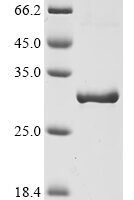
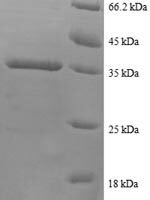
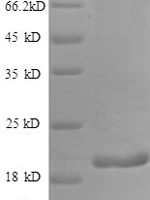
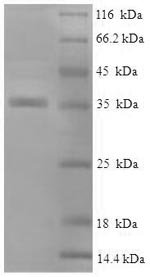
Recombinant Human Alpha-crystallin B chain (CRYAB) is a recombinant protein from Homo sapiens (Human), expressed in E.coli, covering amino acids 1-175aa, with N-terminal 6xHis-SUMO-tagged tag, molecular weight 36.2kDa, purity Greater than 90% as determined by SDS-PAGE.. Suitable for ELISA and Western Blot applications.