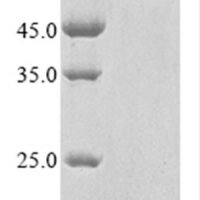
Recombinant Human CCN family member 2 (CCN2) (Active)

Recombinant Human CCN family member 2 (CCN2) (Active) — Major connective tissue mitoattractant secreted by vascular endothelial cells. Purity >95%.

SKU: BCACP-000646 Category:
Product SKUBCACP-000646
Product DescriptionRecombinant Human CCN family member 2 (CCN2) protein is expressed from Mammalian cell with C-terminal 10xHis-tagged. It contains 27-349aa. [Accession | P29279].
Uniprot No.P29279
Gene NamesCCN2
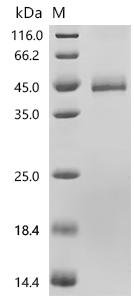
PurityGreater than 95% as determined by SDS-PAGE.
Expression SystemMammalian cell
Expression Region27-349aa
SpeciesHomo sapiens (Human)
Tag InfoC-terminal 10xHis-tagged
Molecular weight41.7 kDa
ActivityMeasured by its binding ability in a functional ELISA. Immobilized Human IL21R at 2 μg/mL can bind Mouse Il21. The EC50 is 10.79-13.20 ng/mL.;Measured by its binding ability in a functional ELISA. Immobilized Mouse Il21r at 2 μg/mL can bind Mouse Il21. The EC50 is 6.858-8.187 ng/mL.;Mouse Il21 captured on Protein A Chip can bind Recombinant Human IL21R with an affinity constant of 2.06 nM as detected by MetaSPR Assay (WeSPRTM 200).;Mouse Il21 captured on Protein A Chip can bind Recombinant Mouse Il21r with an affinity constant of 0.146 nM as detected by MetaSPR Assay (WeSPRTM 200).
BufferLyophilized from a 0.2 μm filtered 20 mM Tris-HCl, 0.5 M NaCl, 6% Trehalose, pH 8.0
StorageStore at -20°C/-80°C upon receipt, aliquoting is necessary for mutiple use. Avoid repeated freeze-thaw cycles.
Alternative NamesCCN family member 2; Cellular communication network factor 2; Connective tissue growth factor; Hypertrophic chondrocyte-specific protein 24; Insulin-like growth factor-binding protein 8; IBP-8; IGF-binding protein 8; IGFBP-8

Function

Major connective tissue mitoattractant secreted by vascular endothelial cells. Promotes proliferation and differentiation of chondrocytes. Is involved in the stimulation of osteoblast differentiation and has a critical role in osteogenesis.

Biological Context

Subcellular Location: Secreted, extracellular space, extracellular matrix; Secreted
Tissue Specificity: Expressed in bone marrow and thymic cells. Also expressed one of two Wilms tumors tested
Disease Association: Kyphomelic dysplasia (KMD) : An autosomal recessive skeletal dysplasia characterized by bowing of the limbs primarily affecting the femora, along with short stature, short and wide iliac wings, horizontal acetabular roof, platyspondyly, metaphyseal flaring and distinctive facial features that include prominent forehead, micrognathia, microstomia, cleft palate and low set ears. [The disease may be caused by variants affecting the gene represented in this entry] | Spondyloepimetaphyseal dysplasia, Li-Shao-Li type (SEMDLSL) : A form of spondyloepimetaphyseal dysplasia, a clinically and genetically heterogeneous group of skeletal disorders marked by vertebral, epiphyseal, and metaphyseal abnormalities. SEMDLSL is an autosomal dominant form characterized by childhood onset of defective skeletal development. Affected individuals exhibit disproportionate short stature, short lower limbs, limited joint flexion, premature osteoarthritis-like changes in weight-bearing joints, and low bone mass. [The disease may be caused by variants affecting the gene represented in this entry]

Product Specifications

Recombinant Human CCN family member 2 (CCN2) (Active) is a recombinant protein from Homo sapiens (Human), expressed in Mammalian cell, covering amino acids 27-349aa, with C-terminal 10xHis-tagged tag, molecular weight 41.7 kDa, purity Greater than 95% as determined by SDS-PAGE.. Suitable for ELISA and Western Blot applications.
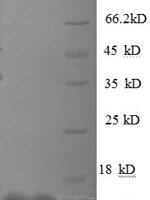
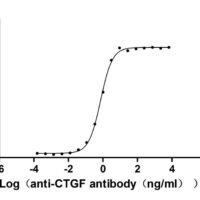
SDS-PAGE: Single band at expected molecular weight confirming purity.

ELISA: Suitable as coating antigen or detection standard.

Western Blot: Compatible with standard Western Blot protocols.

Protein Interaction: Validated for SPR (Surface Plasmon Resonance) and BLI (Bio-Layer Interferometry) studies.

Shipping: Shipped at ambient temperature. Lyophilized protein is stable during transit.

Storage: Store lyophilized protein at -20°C to -80°C. Reconstituted protein should be aliquoted and stored at -80°C. Avoid repeated freeze-thaw cycles.

Shelf Life: 12 months from date of receipt when stored as recommended.

Shipping Time: Orders placed before 2 PM EST ship same day. International orders typically deliver within 5-10 business days.

Protein Biology

Function

Major connective tissue mitoattractant secreted by vascular endothelial cells. Promotes proliferation and differentiation of chondrocytes. Is involved in the stimulation of osteoblast differentiation and has a critical role in osteogenesis (PubMed:39414788). Mediates heparin- and divalent cation-dependent cell adhesion in many cell types including fibroblasts, myofibroblasts, endothelial and epithelial cells. Enhances fibroblast growth factor-induced DNA synthesis

Subcellular Location

Secreted, extracellular space, extracellular matrix; Secreted

Disease Association

Kyphomelic dysplasia (KMD) : An autosomal recessive skeletal dysplasia characterized by bowing of the limbs primarily affecting the femora, along with short stature, short and wide iliac wings, horizontal acetabular roof, platyspondyly, metaphyseal flaring and distinctive facial features that include prominent forehead, micrognathia, microstomia, cleft palate and low set ears. [The disease may be caused by variants affecting the gene represented in this entry] | Spondyloepimetaphyseal dysplasia, Li-Shao-Li type (SEMDLSL) : A form of spondyloepimetaphyseal dysplasia, a clinically and genetically heterogeneous group of skeletal disorders marked by vertebral, epiphyseal, and metaphyseal abnormalities. SEMDLSL is an autosomal dominant form characterized by childhood onset of defective skeletal development. Affected individuals exhibit disproportionate short stature, short lower limbs, limited joint flexion, premature osteoarthritis-like changes in weight-bearing joints, and low bone mass. [The disease may be caused by variants affecting the gene represented in this entry]

Tissue Specificity

Expressed in bone marrow and thymic cells. Also expressed one of two Wilms tumors tested

Subunit

Monomer (PubMed:1654338). Interacts with TSKU (PubMed:30232710)

Gene: CCN2  |  Organism: Homo sapiens  |  Synonyms: Cellular communication network factor 2; Connective tissue growth factor; Hypertrophic chondrocyte-specific protein 24; Insulin-like growth factor-binding protein 8
Key Publications

Frequently Asked Questions

How do I order or inquire about this product?

Fill out the Online Inquiry form with your required quantity and specifications. You can also email sales@biocrestsci.com. Our team typically responds within 4 business hours with a quote and availability confirmation.

What is the shipping and delivery time?

Orders placed before 2 PM EST ship the same day. Domestic (US) delivery typically takes 2-3 business days. International orders deliver within 5-10 business days. All products are shipped at ambient temperature with appropriate packaging to ensure stability.

How should I store this recombinant protein?

Lyophilized proteins should be stored at -20°C to -80°C upon receipt. After reconstitution, aliquot and store at -80°C. Avoid repeated freeze-thaw cycles. Shelf life is 12 months from date of receipt when stored as recommended.

What quality controls are performed on your products?

Each product undergoes SDS-PAGE purity analysis (typically >85-95%), endotoxin testing, and bioactivity validation. Products are validated for ELISA, Western Blot, and SPR/BLI applications as specified on this product page. A Certificate of Analysis (CoA) is available upon request.

Shopping Cart
Scroll to Top