Recombinant Human Ferritin heavy chain (FTH1)

Recombinant Human Ferritin heavy chain (FTH1) — Stores iron in a soluble, non-toxic, readily available form. Purity >90%.

SKU: BCRECP-000698 Category:

Product Specifications

Product SkuBCRECP-000698
Product DescriptionRecombinant Human Ferritin heavy chain (FTH1) Protein is expressed from E.coli with N-terminal GST-tagged. It contains 2-183aa. [Accession | P02794].
Uniprot No.P02794
Gene NamesFTH1
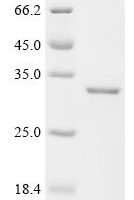
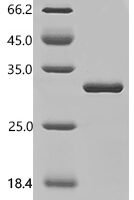
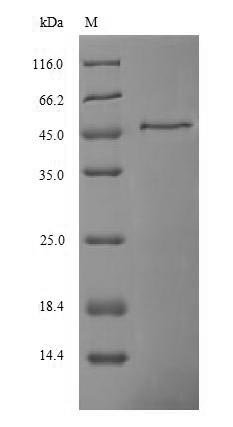
PurityGreater than 90% as determined by SDS-PAGE.
Expression SystemE.coli
Expression Region2-183aa
SpeciesHomo sapiens (Human)
Tag InfoN-terminal GST-tagged
Molecular weight48.1kDa
ActivityPlease contact us to obtain bioactivity data.
BufferIf the delivery form is liquid, the default storage buffer is Tris/PBS-based buffer, 5%-50% glycerol. If the delivery form is lyophilized powder, the buffer before lyophilization is Tris/PBS-based buffer, 6% Trehalose.
StorageStore at -20°C/-80°C upon receipt, aliquoting is necessary for mutiple use. Avoid repeated freeze-thaw cycles.
Research AreasMetabolism

Function

Stores iron in a soluble, non-toxic, readily available form. Important for iron homeostasis. Has ferroxidase activity.

Biological Context

Subcellular Location: Cytoplasm; Lysosome; Cytoplasmic vesicle, autophagosome
Tissue Specificity: Expressed in the liver
Disease Association: Hemochromatosis 5 (HFE5) : A disorder of iron metabolism characterized by iron overload. Excess iron is deposited in a variety of organs leading to their failure, and resulting in serious illnesses including cirrhosis, hepatomas, diabetes, cardiomyopathy, arthritis, and hypogonadotropic hypogonadism. Severe effects of the disease usually do not appear until after decades of progressive iron loading. [The disease is caused by variants affecting the gene represented in this entry. In a Japanese family affected by HFE5, a single point mutation has been detected in the iron-responsive element (IRE) in the 5'-UTR of FTH1 mRNA. This mutation leads to an increased binding affinity for iron regulatory protein and thereby to the efficient suppression of mRNA translation] | Neurodegeneration with brain iron accumulation 9 (NBIA9) : An autosomal dominant neurodegenerative disorder associated with iron accumulation, primarily in the basal ganglia. It is characterized by global developmental delay apparent from infancy, and progressive decline of motor and cognitive skills. Clinical features include delayed walking or inability to walk, spasticity with hyperreflexia, ataxia, dystonia, and poor or absent language. [The disease is caused by variants affecting the gene represented in this entry]

Product Specifications

Recombinant Human Ferritin heavy chain (FTH1) is a recombinant protein from Homo sapiens (Human), expressed in E.coli, covering amino acids 2-183aa, with N-terminal GST-tagged tag, molecular weight 48.1kDa, purity Greater than 90% as determined by SDS-PAGE.. Suitable for ELISA and Western Blot applications.
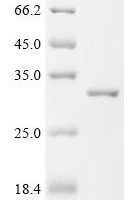
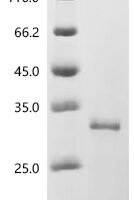
SDS-PAGE: Single band at expected molecular weight confirming purity.

ELISA: Suitable as coating antigen or detection standard.

Western Blot: Compatible with standard Western Blot protocols.

Protein Interaction: Validated for SPR (Surface Plasmon Resonance) and BLI (Bio-Layer Interferometry) studies.

Shipping: Shipped at ambient temperature. Lyophilized protein is stable during transit.

Storage: Store lyophilized protein at -20°C to -80°C. Reconstituted protein should be aliquoted and stored at -80°C. Avoid repeated freeze-thaw cycles.

Shelf Life: 12 months from date of receipt when stored as recommended.

Shipping Time: Orders placed before 2 PM EST ship same day. International orders typically deliver within 5-10 business days.

Protein Biology

Function

Stores iron in a soluble, non-toxic, readily available form. Important for iron homeostasis. Has ferroxidase activity (PubMed:9003196). Iron is taken up in the ferrous form and deposited as ferric hydroxides after oxidation (PubMed:9003196). Also plays a role in delivery of iron to cells (By similarity). Mediates iron uptake in capsule cells of the developing kidney (By similarity). Delivery to lysosomes is mediated by the cargo receptor NCOA4 for autophagic degradation and release of iron (PubMed:24695223, PubMed:26436293)

Subcellular Location

Cytoplasm; Lysosome; Cytoplasmic vesicle, autophagosome

Disease Association

Hemochromatosis 5 (HFE5) : A disorder of iron metabolism characterized by iron overload. Excess iron is deposited in a variety of organs leading to their failure, and resulting in serious illnesses including cirrhosis, hepatomas, diabetes, cardiomyopathy, arthritis, and hypogonadotropic hypogonadism. Severe effects of the disease usually do not appear until after decades of progressive iron loading. [The disease is caused by variants affecting the gene represented in this entry. In a Japanese family affected by HFE5, a single point mutation has been detected in the iron-responsive element (IRE) in the 5'-UTR of FTH1 mRNA. This mutation leads to an increased binding affinity for iron regulatory protein and thereby to the efficient suppression of mRNA translation] | Neurodegeneration with brain iron accumulation 9 (NBIA9) : An autosomal dominant neurodegenerative disorder associated with iron accumulation, primarily in the basal ganglia. It is characterized by global developmental delay apparent from infancy, and progressive decline of motor and cognitive skills. Clinical features include delayed walking or inability to walk, spasticity with hyperreflexia, ataxia, dystonia, and poor or absent language. [The disease is caused by variants affecting the gene represented in this entry]

Tissue Specificity

Expressed in the liver

Subunit

Oligomer of 24 subunits (PubMed:9159481). There are two types of subunits: L (light) chain and H (heavy) chain (PubMed:9159481). The major chain can be light or heavy, depending on the species and tissue type. In the human liver, the heavy chain is predominant (PubMed:9159481). The functional molecule forms a roughly spherical shell with a diameter of 12 nm and contains a central cavity into which the insoluble mineral iron core is deposited (PubMed:9159481). Interacts with NCOA4; NCOA4 promotes targeting of the iron-binding ferritin complex to autolysosomes following starvation or iron depletion (PubMed:24695223)

Gene: FTH1  |  Organism: Homo sapiens  |  Synonyms: Cell proliferation-inducing gene 15 protein
Key Publications

Frequently Asked Questions

How do I order or inquire about this product?

Fill out the Online Inquiry form with your required quantity and specifications. You can also email sales@biocrestsci.com. Our team typically responds within 4 business hours with a quote and availability confirmation.

What is the shipping and delivery time?

Orders placed before 2 PM EST ship the same day. Domestic (US) delivery typically takes 2-3 business days. International orders deliver within 5-10 business days. All products are shipped at ambient temperature with appropriate packaging to ensure stability.

How should I store this recombinant protein?

Lyophilized proteins should be stored at -20°C to -80°C upon receipt. After reconstitution, aliquot and store at -80°C. Avoid repeated freeze-thaw cycles. Shelf life is 12 months from date of receipt when stored as recommended.

What quality controls are performed on your products?

Each product undergoes SDS-PAGE purity analysis (typically >85-95%), endotoxin testing, and bioactivity validation. Products are validated for ELISA, Western Blot, and SPR/BLI applications as specified on this product page. A Certificate of Analysis (CoA) is available upon request.

Shopping Cart
Scroll to Top