,

Recombinant Human Fibroblast growth factor 17 (FGF17) (Active)

Recombinant Human Fibroblast growth factor 17 (FGF17) (Active) — Plays an important role in the regulation of embryonic development and as signaling molecule in the induction and patterning of the embryonic brain. Purity >95%.

SKU: BCACP-001208 Categories: ,
Product SKUBCACP-001208
Product DescriptionRecombinant Human Fibroblast growth factor 17 (FGF17) protein is expressed from E.coli with Tag-Free. It contains 23-216aa. [Accession | O60258].
Uniprot No.O60258
Gene NamesFGF17
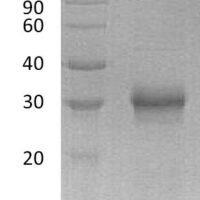
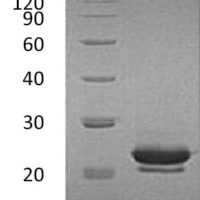
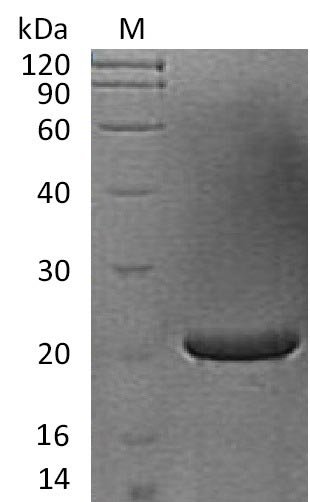
PurityGreater than 95% as determined by SDS-PAGE.
Expression SystemE.coli
Expression Region23-216aa
SpeciesHomo sapiens (Human)
Tag InfoTag-Free
Molecular weight22.6 kDa
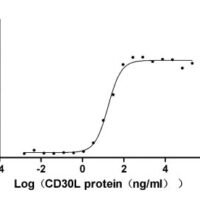
ActivityThe ED50 as determined by its ability to inhibit the IL-4-dependent proliferation of TF-1 cells is 30-180pg/ml.
BufferLyophilized from a 0.2 μm filtered 20 mM Tris-HCl, 0.5 M NaCl, 6% Trehalose, pH 8.0
StorageStore at -20°C/-80°C upon receipt, aliquoting is necessary for mutiple use. Avoid repeated freeze-thaw cycles.
Alternative NamesFGF 13; FGF 17; FGF-17; FGF13; Fgf17; FGF17_HUMAN; Fibroblast growth factor 17; HH20

Function

Plays an important role in the regulation of embryonic development and as signaling molecule in the induction and patterning of the embryonic brain. Required for normal brain development.

Biological Context

Subcellular Location: Secreted
Tissue Specificity: Preferentially expressed in the embryonic brain
Disease Association: Hypogonadotropic hypogonadism 20 with or without anosmia (HH20) : A disorder characterized by absent or incomplete sexual maturation by the age of 18 years, in conjunction with low levels of circulating gonadotropins and testosterone and no other abnormalities of the hypothalamic-pituitary axis. In some cases, it is associated with non-reproductive phenotypes, such as anosmia, cleft palate, and sensorineural hearing loss. Anosmia or hyposmia is related to the absence or hypoplasia of the olfactory bulbs and tracts. Hypogonadism is due to deficiency in gonadotropin-releasing hormone and probably results from a failure of embryonic migration of gonadotropin-releasing hormone-synthesizing neurons. In the presence of anosmia, idiopathic hypogonadotropic hypogonadism is referred to as Kallmann syndrome, whereas in the presence of a normal sense of smell, it has been termed normosmic idiopathic hypogonadotropic hypogonadism (nIHH). [The disease is caused by variants affecting distinct genetic loci, including the gene represented in this entry. Some patients carrying mutations in FGF17 also have a mutation in another HH-associated gene including FGFR1, HS6ST1 and FLRT3 ]

Product Specifications

Recombinant Human Fibroblast growth factor 17 (FGF17) (Active) is a recombinant protein from Homo sapiens (Human), expressed in E.coli, covering amino acids 23-216aa, with Tag-Free tag, molecular weight 22.6 kDa, purity Greater than 95% as determined by SDS-PAGE.. Suitable for ELISA and Western Blot applications.

SDS-PAGE: Single band at expected molecular weight confirming purity.

ELISA: Suitable as coating antigen or detection standard.

Western Blot: Compatible with standard Western Blot protocols.

Protein Interaction: Validated for SPR (Surface Plasmon Resonance) and BLI (Bio-Layer Interferometry) studies.

Shipping: Shipped at ambient temperature. Lyophilized protein is stable during transit.

Storage: Store lyophilized protein at -20°C to -80°C. Reconstituted protein should be aliquoted and stored at -80°C. Avoid repeated freeze-thaw cycles.

Shelf Life: 12 months from date of receipt when stored as recommended.

Shipping Time: Orders placed before 2 PM EST ship same day. International orders typically deliver within 5-10 business days.

Protein Biology

Function

Plays an important role in the regulation of embryonic development and as signaling molecule in the induction and patterning of the embryonic brain. Required for normal brain development

Subcellular Location

Secreted

Disease Association

Hypogonadotropic hypogonadism 20 with or without anosmia (HH20) : A disorder characterized by absent or incomplete sexual maturation by the age of 18 years, in conjunction with low levels of circulating gonadotropins and testosterone and no other abnormalities of the hypothalamic-pituitary axis. In some cases, it is associated with non-reproductive phenotypes, such as anosmia, cleft palate, and sensorineural hearing loss. Anosmia or hyposmia is related to the absence or hypoplasia of the olfactory bulbs and tracts. Hypogonadism is due to deficiency in gonadotropin-releasing hormone and probably results from a failure of embryonic migration of gonadotropin-releasing hormone-synthesizing neurons. In the presence of anosmia, idiopathic hypogonadotropic hypogonadism is referred to as Kallmann syndrome, whereas in the presence of a normal sense of smell, it has been termed normosmic idiopathic hypogonadotropic hypogonadism (nIHH). [The disease is caused by variants affecting distinct genetic loci, including the gene represented in this entry. Some patients carrying mutations in FGF17 also have a mutation in another HH-associated gene including FGFR1, HS6ST1 and FLRT3 (PubMed:23643382)]

Tissue Specificity

Preferentially expressed in the embryonic brain

Subunit

Interacts with FGFR3 and FGFR4

Gene: FGF17  |  Organism: Homo sapiens
Key Publications

Frequently Asked Questions

How do I order or inquire about this product?

Fill out the Online Inquiry form with your required quantity and specifications. You can also email sales@biocrestsci.com. Our team typically responds within 4 business hours with a quote and availability confirmation.

What is the shipping and delivery time?

Orders placed before 2 PM EST ship the same day. Domestic (US) delivery typically takes 2-3 business days. International orders deliver within 5-10 business days. All products are shipped at ambient temperature with appropriate packaging to ensure stability.

How should I store this recombinant protein?

Lyophilized proteins should be stored at -20°C to -80°C upon receipt. After reconstitution, aliquot and store at -80°C. Avoid repeated freeze-thaw cycles. Shelf life is 12 months from date of receipt when stored as recommended.

What quality controls are performed on your products?

Each product undergoes SDS-PAGE purity analysis (typically >85-95%), endotoxin testing, and bioactivity validation. Products are validated for ELISA, Western Blot, and SPR/BLI applications as specified on this product page. A Certificate of Analysis (CoA) is available upon request.

Shopping Cart
Scroll to Top