Recombinant Human Humanin (MT-RNR2)

Recombinant Human Humanin (MT-RNR2) — Plays a role as a neuroprotective factor. Purity >85%.

SKU: BCRECP-001192 Category:

Product Specifications

Product SkuBCRECP-001192
Product DescriptionRecombinant Human Humanin (MT-RNR2) Protein is expressed from E.coli with N-terminal GST-tagged. It contains 1-24aa. [Accession | Q8IVG9].
Uniprot No.Q8IVG9
Gene NamesMT-RNR2
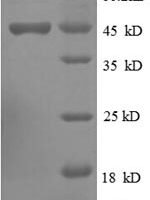
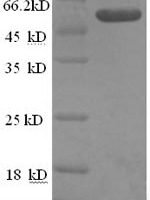
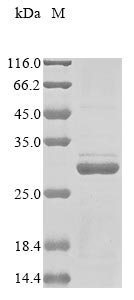
PurityGreater than 85% as determined by SDS-PAGE.
Expression SystemE.coli
Expression Region1-24aa
SpeciesHomo sapiens (Human)
Tag InfoN-terminal GST-tagged
Molecular weight29.4kDa
ActivityPlease contact us to obtain bioactivity data.
BufferIf the delivery form is liquid, the default storage buffer is Tris/PBS-based buffer, 5%-50% glycerol. If the delivery form is lyophilized powder, the buffer before lyophilization is Tris/PBS-based buffer, 6% Trehalose.
StorageStore at -20°C/-80°C upon receipt, aliquoting is necessary for mutiple use. Avoid repeated freeze-thaw cycles.
Research Areasothers

Function

Plays a role as a neuroprotective factor. Protects against neuronal cell death induced by multiple different familial Alzheimer disease genes and amyloid-beta proteins in Alzheimer disease. Mediates its neuroprotective effect by binding to the humanin receptor complex; binding of MT-RNR2 activates the intracellular JAK-STAT3 signaling pathways.

Biological Context

Subcellular Location: Secreted; Cytoplasm; Cell projection, cilium, flagellum; Nucleus; Mitochondrion
Tissue Specificity: Expressed in testis, seminal plasma and sperm (at protein level). Higher seminal plasma levels are associated with normospermia than with oligospermia, asthenospermia or oligoasthenospermia (at protein level). Higher sperm levels are associated with normospermia than with asthenospermia (at protein level). Expressed in retinal epithelial cells (at protein level). Expressed in the heart, skeletal muscle, kidney and liver. Lesser but significant expression is observed in the brain and the gastrointestinal tract. Expressed in the AD brain, where it is found in some of the large intact neurons of the occipital lobes and small and round reactive glial cells in the hippocampus

Product Specifications

Recombinant Human Humanin (MT-RNR2) is a recombinant protein from Homo sapiens (Human), expressed in E.coli, covering amino acids 1-24aa, with N-terminal GST-tagged tag, molecular weight 29.4kDa, purity Greater than 85% as determined by SDS-PAGE.. Suitable for ELISA and Western Blot applications.
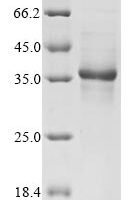
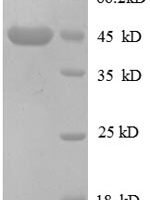
SDS-PAGE: Single band at expected molecular weight confirming purity.

ELISA: Suitable as coating antigen or detection standard.

Western Blot: Compatible with standard Western Blot protocols.

Protein Interaction: Validated for SPR (Surface Plasmon Resonance) and BLI (Bio-Layer Interferometry) studies.

Shipping: Shipped at ambient temperature. Lyophilized protein is stable during transit.

Storage: Store lyophilized protein at -20°C to -80°C. Reconstituted protein should be aliquoted and stored at -80°C. Avoid repeated freeze-thaw cycles.

Shelf Life: 12 months from date of receipt when stored as recommended.

Shipping Time: Orders placed before 2 PM EST ship same day. International orders typically deliver within 5-10 business days.

Protein Biology

Function

Plays a role as a neuroprotective factor (PubMed:11371646, PubMed:11717357, PubMed:12154011, PubMed:12787071, PubMed:12860203, PubMed:19386761). Protects against neuronal cell death induced by multiple different familial Alzheimer disease genes and amyloid-beta proteins in Alzheimer disease (PubMed:11371646, PubMed:11717357, PubMed:12154011, PubMed:12787071, PubMed:12860203, PubMed:19386761). Mediates its neuroprotective effect by binding to the humanin receptor complex; binding of MT-RNR2 activates the intracellular JAK-STAT3 signaling pathways (PubMed:16005025, PubMed:19386761, PubMed:27384491). Also acts as a ligand for G protein-coupled receptors FPR2/FPRL1 and FPR3/FPRL2 (PubMed:15465011). Inhibits amyloid-beta protein 40 fibril formation (PubMed:27349871). Also inhibits amyloid-beta protein 42 fibril formation (PubMed:28282805). Suppresses apoptosis by binding to BAX and preventing the translocation of BAX from the cytosol to mitochondria (PubMed:12732850, PubMed:26990160). Also suppresses apoptosis by binding to BID and inhibiting the interaction of BID with BAX and BAK which prevents oligomerization of BAX and BAK and suppresses release of apoptogenic proteins from mitochondria (PubMed:15661737). Forms fibers with BAX and also with BID, inducing BAX and BID conformational changes and sequestering them into the fibers which prevents their activation (PubMed:31690630, PubMed:33106313). Can also suppress apoptosis by interacting with BIM isoform BimEL, inhibiting BimEL-induced activation of BAX, blocking oligomerization of BAX and BAK, and preventing release of apoptogenic proteins from mitochondria (PubMed:15661735). Plays a role in up-regulation of anti-apoptotic protein BIRC6/APOLLON, leading to inhibition of neuronal cell death (PubMed:25138702). Binds to IGFBP3 and specifically blocks IGFBP3-induced cell death (PubMed:14561895, PubMed:26216267). Competes with importin KPNB1 for binding to IGFBP3 which is likely to block IGFBP3 nuclear import (PubMed:26216267). Induces chemotaxis of mononuclear phagocytes via FPR2/FPRL1 (PubMed:15153530). Reduces aggregation and fibrillary formation by suppressing the effect of APP on mononuclear phagocytes and acts by competitively inhibiting the access of FPR2 to APP (PubMed:15153530). Protects retinal pigment epithelium (RPE) cells against oxidative stress-induced and endoplasmic reticulum (ER) stress-induced apoptosis (PubMed:26990160, PubMed:27783653). Promotes mitochondrial biogenesis in RPE cells following oxidative stress and promotes STAT3 phosphorylation which leads to inhibition of CASP3 release (PubMed:26990160). Also reduces CASP4 levels in RPE cells, suppresses ER stress-induced mitochondrial superoxide production and plays a role in up-regulation of mitochondrial glutathione (PubMed:27783653). Reduces testicular hormone deprivation-induced apoptosis of germ cells at the nonandrogen-sensitive stages of the seminiferous epithelium cycle (PubMed:19952275). Protects endothelial cells against free fatty acid-induced inflammation by suppressing oxidative stress, reducing expression of TXNIP and inhibiting activation of the NLRP3 inflammasome which inhibits expression of pro-inflammatory cytokines IL1B and IL18 (PubMed:32923762). Protects against high glucose-induced endothelial cell dysfunction by mediating activation of ERK5 which leads to increased expression of transcription factor KLF2 and prevents monocyte adhesion to endothelial cells (PubMed:30029058). Inhibits the inflammatory response in astrocytes (PubMed:23277413). Increases the expression of PPARGC1A/PGC1A in pancreatic beta cells which promotes mitochondrial biogenesis (PubMed:29432738). Increases insulin sensitivity (PubMed:19623253)

Subcellular Location

Secreted; Cytoplasm; Cell projection, cilium, flagellum; Nucleus; Mitochondrion

Tissue Specificity

Expressed in testis, seminal plasma and sperm (at protein level) (PubMed:20542501, PubMed:30920769). Higher seminal plasma levels are associated with normospermia than with oligospermia, asthenospermia or oligoasthenospermia (at protein level) (PubMed:30920769). Higher sperm levels are associated with normospermia than with asthenospermia (at protein level) (PubMed:30920769). Expressed in retinal epithelial cells (at protein level) (PubMed:26990160). Expressed in the heart, skeletal muscle, kidney and liver. Lesser but significant expression is observed in the brain and the gastrointestinal tract. Expressed in the AD brain, where it is found in some of the large intact neurons of the occipital lobes and small and round reactive glial cells in the hippocampus

Subunit

Homodimer (PubMed:12787071, PubMed:12860203). Interacts with amyloid-beta protein 42 (Abeta42); the interaction prevents Abeta42 fibril formation (PubMed:28282805). Interacts with BAX; forms fibers with BAX which results in BAX conformational changes and sequestering of BAX into the fibers, preventing BAX activation (PubMed:12732850, PubMed:31690630). Interacts with both full-length BID and cleaved BID p15; forms fibers with BID which results in BID conformational changes and sequestering of BID into the fibers, preventing BID activation (PubMed:15661737, PubMed:33106313). Interacts with BIM isoform BimEL but not with BIM isoforms BimL or BimS; the interaction prevents BIM-induced apoptosis (PubMed:15661735). Interacts with IGFBP3; competes with importin KPNB1 for binding to IGFBP3, blocking IGFBP3 nuclear import (PubMed:14561895, PubMed:19623253, PubMed:26216267). Interacts with TRIM11 (PubMed:12670303). Interacts with MPP8 (PubMed:23532874)

Gene: MT-RNR2  |  Organism: Homo sapiens  |  Synonyms: Humanin mitochondrial
Key Publications

Frequently Asked Questions

How do I order or inquire about this product?

Fill out the Online Inquiry form with your required quantity and specifications. You can also email sales@biocrestsci.com. Our team typically responds within 4 business hours with a quote and availability confirmation.

What is the shipping and delivery time?

Orders placed before 2 PM EST ship the same day. Domestic (US) delivery typically takes 2-3 business days. International orders deliver within 5-10 business days. All products are shipped at ambient temperature with appropriate packaging to ensure stability.

How should I store this recombinant protein?

Lyophilized proteins should be stored at -20°C to -80°C upon receipt. After reconstitution, aliquot and store at -80°C. Avoid repeated freeze-thaw cycles. Shelf life is 12 months from date of receipt when stored as recommended.

What quality controls are performed on your products?

Each product undergoes SDS-PAGE purity analysis (typically >85-95%), endotoxin testing, and bioactivity validation. Products are validated for ELISA, Western Blot, and SPR/BLI applications as specified on this product page. A Certificate of Analysis (CoA) is available upon request.

Shopping Cart
Scroll to Top