,

Recombinant Human Platelet-derived growth factor subunit B (PDGFB) (Active)

Recombinant Human Platelet-derived growth factor subunit B (PDGFB) (Active) — Growth factor that plays an essential role in the regulation of embryonic development, cell proliferation, cell migration, survival and chemotaxis. Purity >95%.

SKU: BCACP-001153 Categories: ,
Product SKUBCACP-001153
Product DescriptionRecombinant Human Platelet-derived growth factor subunit B (PDGFB) protein is expressed from Yeast with Tag free. It contains 82-190aa. [Accession | P01127].
Uniprot No.P01127
Gene NamesPDGF-BB
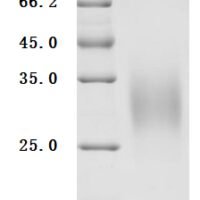
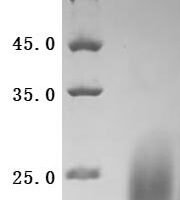
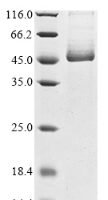
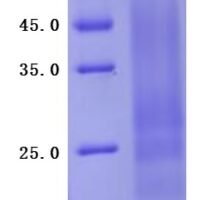
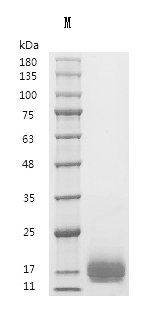
PurityGreater than 95% as determined by SDS-PAGE.
Expression SystemYeast
Expression Region82-190aa
SpeciesHomo sapiens (Human)
Tag InfoTag free
Molecular weight12.2 kDa
ActivityMeasured in a cell inhibition assay using TF-1 cells at IL4 presence. The ED50 for this effect is ≤0.1ng/mL.
BufferLyophilized from a 0.2 μm filtered 20 mM Tris-HCl, 0.5 M NaCl, 6% Trehalose, pH 8.0
StorageStore at -20°C/-80°C upon receipt, aliquoting is necessary for mutiple use. Avoid repeated freeze-thaw cycles.
Alternative NamesPDGFBB; PDGF-BB

Function

Growth factor that plays an essential role in the regulation of embryonic development, cell proliferation, cell migration, survival and chemotaxis. Potent mitogen for cells of mesenchymal origin. Required for normal proliferation and recruitment of pericytes and vascular smooth muscle cells in the central nervous system, skin, lung, heart and placenta.

Biological Context

Subcellular Location: Secreted
Tissue Specificity: Expressed at high levels in the heart, brain (sustantia nigra), placenta and fetal kidney. Expressed at moderate levels in the brain (hippocampus), skeletal muscle, kidney and lung
Disease Association: Basal ganglia calcification, idiopathic, 5 (IBGC5) : A form of basal ganglia calcification, an autosomal dominant condition characterized by symmetric calcification in the basal ganglia and other brain regions. Affected individuals can either be asymptomatic or show a wide spectrum of neuropsychiatric symptoms, including parkinsonism, dystonia, tremor, ataxia, dementia, psychosis, seizures, and chronic headache. Serum levels of calcium, phosphate, alkaline phosphatase and parathyroid hormone are normal. The neuropathological hallmark of the disease is vascular and pericapillary calcification, mainly of calcium phosphate, in the affected brain areas. [The disease is caused by variants affecting the gene represented in this entry] | [A chromosomal aberration involving PDGFB is found in dermatofibrosarcoma protuberans. Translocation t(17;22)(q22;q13) with PDGFB]

Product Specifications

Recombinant Human Platelet-derived growth factor subunit B (PDGFB) (Active) is a recombinant protein from Homo sapiens (Human), expressed in Yeast, covering amino acids 82-190aa, with Tag free tag, molecular weight 12.2 kDa, purity Greater than 95% as determined by SDS-PAGE.. Suitable for ELISA and Western Blot applications.

Recommended applications depend on the target, product format, and product-specific validation data. Refer to the product datasheet or Certificate of Analysis (CoA), or contact BioCrest Sci for application guidance.

Biological Activity: Measured in a cell inhibition assay using TF-1 cells at IL4 presence. The ED50 for this effect is ≤0.1ng/mL.

Storage: Store at -20°C/-80°C upon receipt, aliquoting is necessary for mutiple use. Avoid repeated freeze-thaw cycles.

Shipping & Lead Time: Availability, shipping conditions, and estimated lead time are confirmed in the formal quotation or order confirmation based on the product format, destination, and order requirements.

Protein Biology

Function

Growth factor that plays an essential role in the regulation of embryonic development, cell proliferation, cell migration, survival and chemotaxis. Potent mitogen for cells of mesenchymal origin (PubMed:26599395). Required for normal proliferation and recruitment of pericytes and vascular smooth muscle cells in the central nervous system, skin, lung, heart and placenta. Required for normal blood vessel development, and for normal development of kidney glomeruli. Plays an important role in wound healing. Signaling is modulated by the formation of heterodimers with PDGFA (By similarity)

Subcellular Location

Secreted

Disease Association

Basal ganglia calcification, idiopathic, 5 (IBGC5) : A form of basal ganglia calcification, an autosomal dominant condition characterized by symmetric calcification in the basal ganglia and other brain regions. Affected individuals can either be asymptomatic or show a wide spectrum of neuropsychiatric symptoms, including parkinsonism, dystonia, tremor, ataxia, dementia, psychosis, seizures, and chronic headache. Serum levels of calcium, phosphate, alkaline phosphatase and parathyroid hormone are normal. The neuropathological hallmark of the disease is vascular and pericapillary calcification, mainly of calcium phosphate, in the affected brain areas. [The disease is caused by variants affecting the gene represented in this entry] | [A chromosomal aberration involving PDGFB is found in dermatofibrosarcoma protuberans. Translocation t(17;22)(q22;q13) with PDGFB]

Tissue Specificity

Expressed at high levels in the heart, brain (sustantia nigra), placenta and fetal kidney. Expressed at moderate levels in the brain (hippocampus), skeletal muscle, kidney and lung

Subunit

Antiparallel homodimer; disulfide-linked. Antiparallel heterodimer with PDGFA; disulfide-linked. The PDGFB homodimer interacts with PDGFRA and PDGFRB homodimers, and with heterodimers formed by PDGFRA and PDGFRB. The heterodimer composed of PDGFA and PDGFB interacts with PDGFRB homodimers, and with heterodimers formed by PDGFRA and PDGFRB. Interacts with XLKD1 (By similarity). Interacts with LRP1 (PubMed:15053742). Interacts with SORL1 (via the N-terminal ectodomain) (PubMed:15053742, PubMed:16393139). Interacts with CD82; this interaction inhibits PDGFB-mediated signaling pathway (PubMed:34530889)

Gene: PDGFB  |  Organism: Homo sapiens  |  Synonyms: PDGF-2; Platelet-derived growth factor B chain; Platelet-derived growth factor beta polypeptide; Proto-oncogene c-Sis
Key Publications

Frequently Asked Questions

How do I order or inquire about this product?

Submit the Online Inquiry form with your required quantity and specifications, or email sales@biocrestsci.com. Available sizes, pricing, stock status, documentation, and estimated lead time are confirmed in the formal quotation.

What is the shipping and delivery time?

Availability, dispatch timing, shipping conditions, and delivery estimates depend on the product format, destination, and order requirements. These details are confirmed in the formal quotation or order confirmation.

How should this product be stored?

Follow the storage and handling instructions in the product-specific datasheet and Certificate of Analysis (CoA). Requirements may vary by product form and formulation; contact BioCrest Sci if product-specific guidance is needed.

What quality controls are performed on your products?

Quality-control data such as identity, purity, endotoxin level, or biological activity are provided only when specified on this product page, the datasheet, or Certificate of Analysis (CoA). Biological activity is not implied unless explicitly stated.

Shopping Cart
Scroll to Top