Recombinant Human Sonic hedgehog protein (SHH), partial (Active)

Recombinant Human Sonic hedgehog protein (SHH), partial (Active) — The dually lipidated sonic hedgehog protein N-product (ShhN) is a morphogen that activates the smoothened signaling pathway, and which is essential for a variety of patterning events during develop… Purity >98%.

SKU: BCACP-000865 Category:
Product SKUBCACP-000865
Product DescriptionRecombinant Human Sonic hedgehog protein (SHH) protein is expressed from E.Coli with Tag-Free. It contains 22-197aa. [Accession | Q15465].
Uniprot No.Q15465
Gene NamesSHH
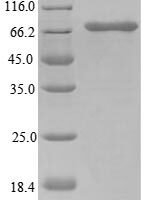
Purity>98% as determined by SDS-PAGE.
Expression SystemE.Coli
Expression Region22-197aa
SpeciesHomo sapiens (Human)
Tag InfoTag-Free
Molecular weight19.8 kDa
ActivityFully biologically active when compared to standard. The ED50 as determined by its ability to induce alkaline phosphatase production by C3H10T1/2(CCL-226) cells is 3.0-10 μg/ml.
BufferLyophilized from a 0.2 μm filtered 20 mM Tris-HCl, 0.5 M NaCl, 6% Trehalose, pH 8.0
StorageStore at -20°C/-80°C upon receipt, aliquoting is necessary for mutiple use. Avoid repeated freeze-thaw cycles.
Alternative NamesHHG 1; HHG-1; HHG1; HLP 3; HLP3; Holoprosencephaly 3; HPE 3; HPE3; MCOPCB5; shh; SHH_HUMAN; SMMC I; SMMCI; Sonic Hedgehog (Drosophila) homolog; sonic hedgehog homolog (Drosophila); Sonic hedgehog homolog; Sonic hedgehog protein; Sonic hedgehog protein C-product; TPT; TPTPS

Function

The dually lipidated sonic hedgehog protein N-product (ShhN) is a morphogen that activates the smoothened signaling pathway, and which is essential for a variety of patterning events during development. Acts by binding to the patched receptor (PTCH1 or PTCH2), relieving smoothened (SMO) inhibition by patched, activating the smoothened signaling pathway and transcription of target genes. In the absence of SHH, patched represses the constitutive signaling activity of SMO.

Biological Context

Subcellular Location: Secreted; Cell membrane (Lipid-anchor)
Disease Association: Microphthalmia/Coloboma 5 (MCOPCB5) : A disorder of eye formation, ranging from small size of a single eye to complete bilateral absence of ocular tissues. Ocular abnormalities like opacities of the cornea and lens, scaring of the retina and choroid, and other abnormalities may also be present. Ocular colobomas are a set of malformations resulting from abnormal morphogenesis of the optic cup and stalk, and the fusion of the fetal fissure (optic fissure). [The disease is caused by variants affecting the gene represented in this entry] | Holoprosencephaly 3 (HPE3) : A form of holoprosencephaly, a structural anomaly of the brain in which the developing forebrain fails to correctly separate into right and left hemispheres. It is a genetically and clinically heterogeneous disorder with a wide spectrum of severity, ranging from alobar holoprosencephaly with severe facial abnormalities, such as cyclopia and proboscis, to mild forms that include lobar or microform holoprosencephaly, without cerebral malformations and with mild craniofacial defects. The majority of HPE3 cases are apparently sporadic, although clear examples of autosomal dominant inheritance have been described. [The disease is caused by variants affecting the gene represented in this entry] | Solitary median maxillary central incisor (SMMCI) : Rare dental anomaly characterized by the congenital absence of one maxillary central incisor. [The disease is caused by variants affecting the gene represented in this entry] | Triphalangeal thumb with polysyndactyly (TPTPS) : Autosomal dominant syndrome. It is characterized by a wide spectrum of pre- and post-axial abnormalities due to altered SHH expression pattern during limb development. [The gene represented in this entry is involved in disease pathogenesis. SHH expression is altered due to disease-causing variants located in intron 5 of LMBR1 disrupt a long-range, cis-regulatory element of SHH] | Preaxial polydactyly 2 (PPD2) : Polydactyly consists of duplication of the distal phalanx. The thumb in PPD2 is usually opposable and possesses a normal metacarpal. [The gene represented in this entry is involved in disease pathogenesis. Mutations located in intron 5 of LMBR1 disrupt a long-range, cis-regulatory element of SHH and result in abnormal, ectopic SHH expression with pathological consequences ] | Hypoplasia or aplasia of tibia with polydactyly (THYP) : An autosomal dominant disease characterized by hypoplastic or absent tibia, and polydactyly. [The gene represented in this entry is involved in disease pathogenesis. Mutations located in intron 5 of LMBR1 disrupt a long-range, cis-regulatory element of SHH and result in abnormal, ectopic SHH expression with pathological consequences] | Laurin-Sandrow syndrome (LSS) : A rare autosomal dominant disorder characterized by polysyndactyly of hands and/or feet, mirror image duplication of the feet, nasal defects, and loss of identity between fibula and tibia. Some patients do not have nasal abnormalities (segmental Laurin-Sandrow syndrome). [The gene represented in this entry is involved in disease pathogenesis. Abnormal SHH limb expression with pathological consequences is caused by duplications (16-75 kb) involving the ZPA regulatory sequence (ZRS), a SHH long-range cis-regulatory element, located in LMBR1 intron 5 ]

Product Specifications

Recombinant Human Sonic hedgehog protein (SHH), partial (Active) is a recombinant protein from Homo sapiens (Human), expressed in E.Coli, covering amino acids 22-197aa, with Tag-Free tag, molecular weight 19.8 kDa, purity >98% as determined by SDS-PAGE.. Suitable for ELISA and Western Blot applications.
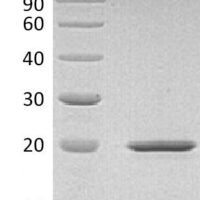
SDS-PAGE: Single band at expected molecular weight confirming purity.

ELISA: Suitable as coating antigen or detection standard.

Western Blot: Compatible with standard Western Blot protocols.

Protein Interaction: Validated for SPR (Surface Plasmon Resonance) and BLI (Bio-Layer Interferometry) studies.

Shipping: Shipped at ambient temperature. Lyophilized protein is stable during transit.

Storage: Store lyophilized protein at -20°C to -80°C. Reconstituted protein should be aliquoted and stored at -80°C. Avoid repeated freeze-thaw cycles.

Shelf Life: 12 months from date of receipt when stored as recommended.

Shipping Time: Orders placed before 2 PM EST ship same day. International orders typically deliver within 5-10 business days.

Protein Biology

Function

The dually lipidated sonic hedgehog protein N-product (ShhN) is a morphogen that activates the smoothened signaling pathway, and which is essential for a variety of patterning events during development (PubMed:10753901, PubMed:24522195, PubMed:24863049, PubMed:29995851, PubMed:30139912, PubMed:31127104, PubMed:31548691, PubMed:31555730). Acts by binding to the patched receptor (PTCH1 or PTCH2), relieving smoothened (SMO) inhibition by patched, activating the smoothened signaling pathway and transcription of target genes (PubMed:10753901, PubMed:29995851, PubMed:31548691, PubMed:31555730). In the absence of SHH, patched represses the constitutive signaling activity of SMO (PubMed:10753901). ShhN is widely expressed and plays a key role in the patterning of the central nervous system and limb development (By similarity). Induces ventral cell fate in the neural tube and somites (By similarity). Involved in the patterning of the anterior-posterior axis of the developing limb bud (By similarity). Essential for axon guidance (By similarity)

Subcellular Location

Secreted; Cell membrane (Lipid-anchor)

Disease Association

Microphthalmia/Coloboma 5 (MCOPCB5) : A disorder of eye formation, ranging from small size of a single eye to complete bilateral absence of ocular tissues. Ocular abnormalities like opacities of the cornea and lens, scaring of the retina and choroid, and other abnormalities may also be present. Ocular colobomas are a set of malformations resulting from abnormal morphogenesis of the optic cup and stalk, and the fusion of the fetal fissure (optic fissure). [The disease is caused by variants affecting the gene represented in this entry] | Holoprosencephaly 3 (HPE3) : A form of holoprosencephaly, a structural anomaly of the brain in which the developing forebrain fails to correctly separate into right and left hemispheres. It is a genetically and clinically heterogeneous disorder with a wide spectrum of severity, ranging from alobar holoprosencephaly with severe facial abnormalities, such as cyclopia and proboscis, to mild forms that include lobar or microform holoprosencephaly, without cerebral malformations and with mild craniofacial defects. The majority of HPE3 cases are apparently sporadic, although clear examples of autosomal dominant inheritance have been described. [The disease is caused by variants affecting the gene represented in this entry] | Solitary median maxillary central incisor (SMMCI) : Rare dental anomaly characterized by the congenital absence of one maxillary central incisor. [The disease is caused by variants affecting the gene represented in this entry] | Triphalangeal thumb with polysyndactyly (TPTPS) : Autosomal dominant syndrome. It is characterized by a wide spectrum of pre- and post-axial abnormalities due to altered SHH expression pattern during limb development. [The gene represented in this entry is involved in disease pathogenesis. SHH expression is altered due to disease-causing variants located in intron 5 of LMBR1 disrupt a long-range, cis-regulatory element of SHH] | Preaxial polydactyly 2 (PPD2) : Polydactyly consists of duplication of the distal phalanx. The thumb in PPD2 is usually opposable and possesses a normal metacarpal. [The gene represented in this entry is involved in disease pathogenesis. Mutations located in intron 5 of LMBR1 disrupt a long-range, cis-regulatory element of SHH and result in abnormal, ectopic SHH expression with pathological consequences (PubMed:12837695)] | Hypoplasia or aplasia of tibia with polydactyly (THYP) : An autosomal dominant disease characterized by hypoplastic or absent tibia, and polydactyly. [The gene represented in this entry is involved in disease pathogenesis. Mutations located in intron 5 of LMBR1 disrupt a long-range, cis-regulatory element of SHH and result in abnormal, ectopic SHH expression with pathological consequences] | Laurin-Sandrow syndrome (LSS) : A rare autosomal dominant disorder characterized by polysyndactyly of hands and/or feet, mirror image duplication of the feet, nasal defects, and loss of identity between fibula and tibia. Some patients do not have nasal abnormalities (segmental Laurin-Sandrow syndrome). [The gene represented in this entry is involved in disease pathogenesis. Abnormal SHH limb expression with pathological consequences is caused by duplications (16-75 kb) involving the ZPA regulatory sequence (ZRS), a SHH long-range cis-regulatory element, located in LMBR1 intron 5 (PubMed:24456159)]

Subunit

Multimer (PubMed:19561609, PubMed:24522195). Interacts with SCUBE2; SCUBE2 acts as a carrier to promote release of the dual-lipidated sonic hedgehog protein N-product (ShhN) from the cell surface (PubMed:22677548, PubMed:22902404, PubMed:24522195, PubMed:35231446). Interacts with DISP1 via its cholesterol anchor (PubMed:22902404). Interacts with BOC and CDON; BOC and CDON form a heterodimer that acts as a coreceptor for ShhN (By similarity). Interacts with GAS1; GAS1 acts as a coreceptor for ShhN (PubMed:35231446)

Gene: SHH  |  Organism: Homo sapiens  |  Synonyms: HHG-1; Shh unprocessed N-terminal signaling and C-terminal autoprocessing domains
Key Publications

Frequently Asked Questions

How do I order or inquire about this product?

Fill out the Online Inquiry form with your required quantity and specifications. You can also email sales@biocrestsci.com. Our team typically responds within 4 business hours with a quote and availability confirmation.

What is the shipping and delivery time?

Orders placed before 2 PM EST ship the same day. Domestic (US) delivery typically takes 2-3 business days. International orders deliver within 5-10 business days. All products are shipped at ambient temperature with appropriate packaging to ensure stability.

How should I store this recombinant protein?

Lyophilized proteins should be stored at -20°C to -80°C upon receipt. After reconstitution, aliquot and store at -80°C. Avoid repeated freeze-thaw cycles. Shelf life is 12 months from date of receipt when stored as recommended.

What quality controls are performed on your products?

Each product undergoes SDS-PAGE purity analysis (typically >85-95%), endotoxin testing, and bioactivity validation. Products are validated for ELISA, Western Blot, and SPR/BLI applications as specified on this product page. A Certificate of Analysis (CoA) is available upon request.

Shopping Cart
Scroll to Top