Recombinant Human Thrombopoietin/TPO Protein

Recombinant Human Thrombopoietin/TPO Protein — Lineage-specific cytokine affecting the proliferation and maturation of megakaryocytes from their committed progenitor cells. Purity >90%.

SKU: BCRETP-000040 Category:

Product Specifications

Product SkuBCRETP-000040
Product DescriptionRecombinant Human Thrombopoietin/TPO Protein is expressed from HEK293 with His tag at the C-Terminus. It contains 22-353aa. [Accession | P40225].
Uniprot No.P40225
SynonymsThrombopoietin;C-mpl ligand;Megakaryocyte colony-stimulating factor;Megakaryocyte growth and development factor;Myeloproliferative leukemia virus oncogene ligand;THPO
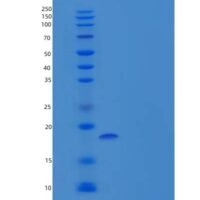
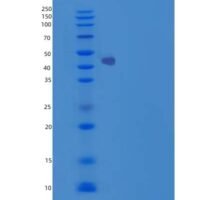
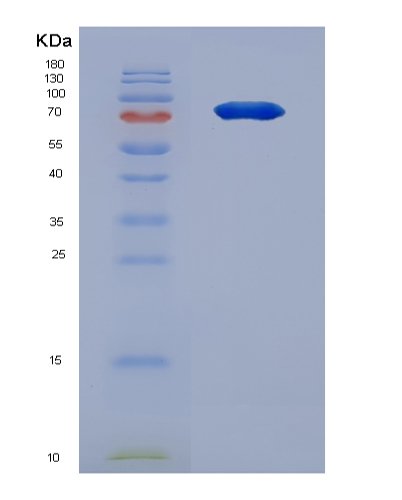
PurityGreater than 90% as determined by SDS-PAGE.
Expression SystemHEK293 Cells
Expression Region22-353aa
Tag InfoC-6His
Molecular weight90 kDa
EndotoxinLess than 1.0 EU/μg as determined by LAL method.

Function

Lineage-specific cytokine affecting the proliferation and maturation of megakaryocytes from their committed progenitor cells. It acts at a late stage of megakaryocyte development. It may be the major physiological regulator of circulating platelets.

Biological Context

Subcellular Location: Secreted
Disease Association: Thrombocythemia 1 (THCYT1) : A myeloproliferative disorder characterized by excessive platelet production, resulting in increased numbers of circulating platelets. It can be associated with spontaneous hemorrhages and thrombotic episodes. [The disease is caused by variants affecting the gene represented in this entry] | Amegakaryocytic thrombocytopenia, congenital, 2 (CAMT2) : A form of congenital amegakaryocytic thrombocytopenia, a hematologic disorder characterized by severe reduction of megakaryocytes and platelets at birth, and evolving into generalized bone marrow aplasia during childhood. CAMT2 is an autosomal recessive form. Most patients present with thrombocytopenia that progresses to pancytopenia. [The disease is caused by variants affecting the gene represented in this entry] | Thrombocytopenia 9 (THC9) : A form of thrombocytopenia, a hematologic disorder defined by a decrease in the number of platelets in circulating blood, resulting in the potential for increased bleeding and decreased ability for clotting. THC9 is an autosomal dominant form characterized by low platelet counts in the absence of significant bleeding tendency. Some individuals may have mild mucocutaneous bleeding, whereas others may be asymptomatic. [The disease is caused by variants affecting the gene represented in this entry]

Product Specifications

Recombinant Human Thrombopoietin/TPO Protein is a recombinant protein, expressed in HEK293 Cells, covering amino acids 22-353aa, with C-6His tag, molecular weight 90 kDa, purity Greater than 90% as determined by SDS-PAGE.. Suitable for ELISA and Western Blot applications.
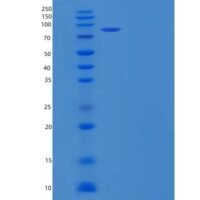
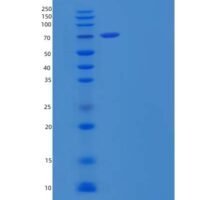
SDS-PAGE: Single band at expected molecular weight confirming purity.

ELISA: Suitable as coating antigen or detection standard.

Western Blot: Compatible with standard Western Blot protocols.

Protein Interaction: Validated for SPR (Surface Plasmon Resonance) and BLI (Bio-Layer Interferometry) studies.

Shipping: Shipped at ambient temperature. Lyophilized protein is stable during transit.

Storage: Store lyophilized protein at -20°C to -80°C. Reconstituted protein should be aliquoted and stored at -80°C. Avoid repeated freeze-thaw cycles.

Shelf Life: 12 months from date of receipt when stored as recommended.

Shipping Time: Orders placed before 2 PM EST ship same day. International orders typically deliver within 5-10 business days.

Protein Biology

Function

Lineage-specific cytokine affecting the proliferation and maturation of megakaryocytes from their committed progenitor cells. It acts at a late stage of megakaryocyte development. It may be the major physiological regulator of circulating platelets

Subcellular Location

Secreted

Disease Association

Thrombocythemia 1 (THCYT1) : A myeloproliferative disorder characterized by excessive platelet production, resulting in increased numbers of circulating platelets. It can be associated with spontaneous hemorrhages and thrombotic episodes. [The disease is caused by variants affecting the gene represented in this entry] | Amegakaryocytic thrombocytopenia, congenital, 2 (CAMT2) : A form of congenital amegakaryocytic thrombocytopenia, a hematologic disorder characterized by severe reduction of megakaryocytes and platelets at birth, and evolving into generalized bone marrow aplasia during childhood. CAMT2 is an autosomal recessive form. Most patients present with thrombocytopenia that progresses to pancytopenia. [The disease is caused by variants affecting the gene represented in this entry] | Thrombocytopenia 9 (THC9) : A form of thrombocytopenia, a hematologic disorder defined by a decrease in the number of platelets in circulating blood, resulting in the potential for increased bleeding and decreased ability for clotting. THC9 is an autosomal dominant form characterized by low platelet counts in the absence of significant bleeding tendency. Some individuals may have mild mucocutaneous bleeding, whereas others may be asymptomatic. [The disease is caused by variants affecting the gene represented in this entry]

Subunit

Interacts with MPL/TPOR (PubMed:37633268)

Gene: THPO  |  Organism: Homo sapiens  |  Synonyms: C-mpl ligand; Megakaryocyte colony-stimulating factor; Megakaryocyte growth and development factor; Myeloproliferative leukemia virus oncogene ligand
Key Publications

Frequently Asked Questions

How do I order or inquire about this product?

Fill out the Online Inquiry form with your required quantity and specifications. You can also email sales@biocrestsci.com. Our team typically responds within 4 business hours with a quote and availability confirmation.

What is the shipping and delivery time?

Orders placed before 2 PM EST ship the same day. Domestic (US) delivery typically takes 2-3 business days. International orders deliver within 5-10 business days. All products are shipped at ambient temperature with appropriate packaging to ensure stability.

How should I store this recombinant protein?

Lyophilized proteins should be stored at -20°C to -80°C upon receipt. After reconstitution, aliquot and store at -80°C. Avoid repeated freeze-thaw cycles. Shelf life is 12 months from date of receipt when stored as recommended.

What quality controls are performed on your products?

Each product undergoes SDS-PAGE purity analysis (typically >85-95%), endotoxin testing, and bioactivity validation. Products are validated for ELISA, Western Blot, and SPR/BLI applications as specified on this product page. A Certificate of Analysis (CoA) is available upon request.

Shopping Cart
Scroll to Top