Recombinant Rat Apoptosis regulator Bcl-2 (Bcl2) Protein

Recombinant Rat Apoptosis regulator Bcl-2 (Bcl2) Protein — Suppresses apoptosis in a variety of cell systems including factor-dependent lymphohematopoietic and neural cells. Purity >90%.

SKU: BCRECP-00082TM Category:

Product Specifications

Uniprot No.P49950
Gene NamesBcl2
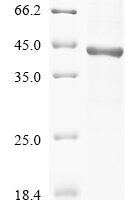
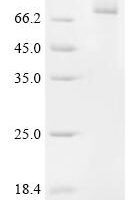
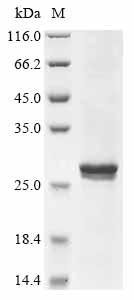
PurityGreater than 90% as determined by SDS-PAGE.
Expression Systemin vitro E.coli expression system
Expression Region1-236aa
SpeciesRattus norvegicus (Rat)
Tag InfoN-terminal 10xHis-tagged
Molecular weight28.1kDa
BufferIf the delivery form is liquid, the default storage buffer is Tris/PBS-based buffer, 5%-50% glycerol.If the delivery form is lyophilized powder, the buffer before lyophilization is Tris/PBS-based buffer, 6% Trehalose.
StorageStore at -20°C/-80°C upon receipt, aliquoting is necessary for mutiple use. Avoid repeated freeze-thaw cycles.

Function

Suppresses apoptosis in a variety of cell systems including factor-dependent lymphohematopoietic and neural cells. Regulates cell death by controlling the mitochondrial membrane permeability. Appears to function in a feedback loop system with caspases.

Biological Context

Subcellular Location: Mitochondrion outer membrane (Single-pass membrane protein); Nucleus membrane (Single-pass membrane protein); Endoplasmic reticulum membrane (Single-pass membrane protein); Cytoplasm
Tissue Specificity: Expressed in a variety of tissues, with highest levels in reproductive tissues. In the adult brain, expression is localized in mitral cells of the olfactory bulb, granule and pyramidal neurons of hippocampus, pontine nuclei, cerebellar granule neurons, and in ependymal cells. In prenatal brain, expression is higher and localized in the neuroepithelium and in the cortical plate

Product Specifications

Recombinant Rat Apoptosis regulator Bcl-2 (Bcl2) Protein is a recombinant protein from Rattus norvegicus (Rat), expressed in in vitro E.coli expression system, covering amino acids 1-236aa, with N-terminal 10xHis-tagged tag, molecular weight 28.1kDa, purity Greater than 90% as determined by SDS-PAGE.. Suitable for ELISA and Western Blot applications.
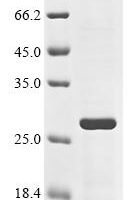
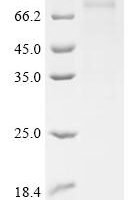
SDS-PAGE: Single band at expected molecular weight confirming purity.

ELISA: Suitable as coating antigen or detection standard.

Western Blot: Compatible with standard Western Blot protocols.

Protein Interaction: Validated for SPR (Surface Plasmon Resonance) and BLI (Bio-Layer Interferometry) studies.

Shipping: Shipped at ambient temperature. Lyophilized protein is stable during transit.

Storage: Store lyophilized protein at -20°C to -80°C. Reconstituted protein should be aliquoted and stored at -80°C. Avoid repeated freeze-thaw cycles.

Shelf Life: 12 months from date of receipt when stored as recommended.

Shipping Time: Orders placed before 2 PM EST ship same day. International orders typically deliver within 5-10 business days.

Protein Biology

Function

Suppresses apoptosis in a variety of cell systems including factor-dependent lymphohematopoietic and neural cells. Regulates cell death by controlling the mitochondrial membrane permeability. Appears to function in a feedback loop system with caspases. Inhibits caspase activity either by preventing the release of cytochrome c from the mitochondria and/or by binding to the apoptosis-activating factor (APAF-1). Also acts as an inhibitor of autophagy: interacts with BECN1 and AMBRA1 during non-starvation conditions and inhibits their autophagy function. May attenuate inflammation by impairing NLRP1-inflammasome activation, hence CASP1 activation and IL1B release

Subcellular Location

Mitochondrion outer membrane (Single-pass membrane protein); Nucleus membrane (Single-pass membrane protein); Endoplasmic reticulum membrane (Single-pass membrane protein); Cytoplasm

Tissue Specificity

Expressed in a variety of tissues, with highest levels in reproductive tissues. In the adult brain, expression is localized in mitral cells of the olfactory bulb, granule and pyramidal neurons of hippocampus, pontine nuclei, cerebellar granule neurons, and in ependymal cells. In prenatal brain, expression is higher and localized in the neuroepithelium and in the cortical plate

Subunit

Forms homodimers, and heterodimers with BAX, BAD, BAK and Bcl-X(L). Heterodimerization with BAX requires intact BH1 and BH2 motifs, and is necessary for anti-apoptotic activity (By similarity). Component of the complex, at least composed of LRPPRC, BECN1 and BCL2; the interactions prevent BECN1 from forming an autophagy-inducing complex with PIK3C3 (By similarity). Interacts with EI24 (By similarity). Also interacts with APAF1, BBC3, BCL2L1, BNIPL, MRPL41 and TP53BP2. Binding to FKBP8 seems to target BCL2 to the mitochondria and probably interferes with the binding of BCL2 to its targets. Interacts with BAG1 in an ATP-dependent manner. Interacts with RAF1 (the 'Ser-338' and 'Ser-339' phosphorylated form). Interacts (via the BH4 domain) with EGLN3; the interaction prevents the formation of the BAX-BCL2 complex and inhibits the anti-apoptotic activity of BCL2. Interacts with G0S2; this interaction also prevents the formation of the anti-apoptotic BAX-BCL2 complex. Interacts with RTL10/BOP. Interacts with the SCF(FBXO10) complex. Interacts (via the loop between motifs BH4 and BH3) with NLRP1 (via LRR repeats), but not with NLRP2, NLRP3, NLRP4, PYCARD, nor MEFV (By similarity). Interacts with GIMAP3/IAN4, GIMAP4/IAN1 and GIMAP5/IAN5 (By similarity). Interacts with BCAP31. Interacts with IRF3; the interaction is inhibited by Sendai virus infection. Interacts with BECN1; thereby inhibiting autophagy in non-starvation conditions. Interacts with AMBRA1; thereby inhibiting autophagy (By similarity)

Gene: Bcl2  |  Organism: Rattus norvegicus
Key Publications

Frequently Asked Questions

How do I order or inquire about this product?

Fill out the Online Inquiry form with your required quantity and specifications. You can also email sales@biocrestsci.com. Our team typically responds within 4 business hours with a quote and availability confirmation.

What is the shipping and delivery time?

Orders placed before 2 PM EST ship the same day. Domestic (US) delivery typically takes 2-3 business days. International orders deliver within 5-10 business days. All products are shipped at ambient temperature with appropriate packaging to ensure stability.

How should I store this recombinant protein?

Lyophilized proteins should be stored at -20°C to -80°C upon receipt. After reconstitution, aliquot and store at -80°C. Avoid repeated freeze-thaw cycles. Shelf life is 12 months from date of receipt when stored as recommended.

What quality controls are performed on your products?

Each product undergoes SDS-PAGE purity analysis (typically >85-95%), endotoxin testing, and bioactivity validation. Products are validated for ELISA, Western Blot, and SPR/BLI applications as specified on this product page. A Certificate of Analysis (CoA) is available upon request.

Shopping Cart
Scroll to Top