Recombinant Rat Toll-like receptor 4 (Tlr4), partial Protein

Recombinant Rat Toll-like receptor 4 (Tlr4), partial Protein — Transmembrane receptor that functions as a pattern recognition receptor recognizing pathogen- and damage-associated molecular patterns (PAMPs and DAMPs) to induce innate immune responses via downst… Purity >90%.

SKU: BCRECP-00639TM Category:

Product Specifications

Uniprot No.Q9QX05
Gene NamesTlr4
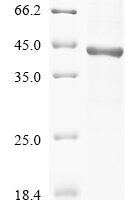
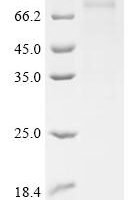
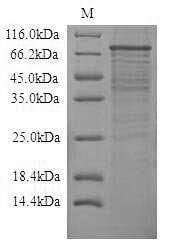
PurityGreater than 90% as determined by SDS-PAGE.
Expression Systemin vitro E.coli expression system
Expression Region26-638aa
SpeciesRattus norvegicus (Rat)
Tag InfoN-terminal 10xHis-SUMO-tagged and C-terminal Myc-tagged
Molecular weight90.2kDa
BufferIf the delivery form is liquid, the default storage buffer is Tris/PBS-based buffer, 5%-50% glycerol.If the delivery form is lyophilized powder, the buffer before lyophilization is Tris/PBS-based buffer, 6% Trehalose.
StorageStore at -20°C/-80°C upon receipt, aliquoting is necessary for mutiple use. Avoid repeated freeze-thaw cycles.

Function

Transmembrane receptor that functions as a pattern recognition receptor recognizing pathogen- and damage-associated molecular patterns (PAMPs and DAMPs) to induce innate immune responses via downstream signaling pathways. At the plasma membrane, cooperates with LY96 to mediate the innate immune response to bacterial lipopolysaccharide (LPS). Also involved in LPS-independent inflammatory responses triggered by free fatty acids, such as palmitate, and Ni(2+).

Biological Context

Subcellular Location: Cell membrane (Single-pass type I membrane protein); Early endosome; Cell projection, ruffle

Product Specifications

Recombinant Rat Toll-like receptor 4 (Tlr4), partial Protein is a recombinant protein from Rattus norvegicus (Rat), expressed in in vitro E.coli expression system, covering amino acids 26-638aa, with N-terminal 10xHis-SUMO-tagged and C-terminal Myc-tagged tag, molecular weight 90.2kDa, purity Greater than 90% as determined by SDS-PAGE.. Suitable for ELISA and Western Blot applications.
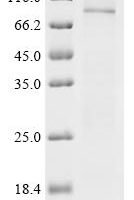
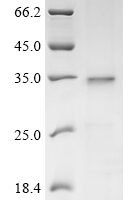
SDS-PAGE: Single band at expected molecular weight confirming purity.

ELISA: Suitable as coating antigen or detection standard.

Western Blot: Compatible with standard Western Blot protocols.

Protein Interaction: Validated for SPR (Surface Plasmon Resonance) and BLI (Bio-Layer Interferometry) studies.

Shipping: Shipped at ambient temperature. Lyophilized protein is stable during transit.

Storage: Store lyophilized protein at -20°C to -80°C. Reconstituted protein should be aliquoted and stored at -80°C. Avoid repeated freeze-thaw cycles.

Shelf Life: 12 months from date of receipt when stored as recommended.

Shipping Time: Orders placed before 2 PM EST ship same day. International orders typically deliver within 5-10 business days.

Protein Biology

Function

Transmembrane receptor that functions as a pattern recognition receptor recognizing pathogen- and damage-associated molecular patterns (PAMPs and DAMPs) to induce innate immune responses via downstream signaling pathways. At the plasma membrane, cooperates with LY96 to mediate the innate immune response to bacterial lipopolysaccharide (LPS). Also involved in LPS-independent inflammatory responses triggered by free fatty acids, such as palmitate, and Ni(2+). Mechanistically, acts via MYD88, TIRAP and TRAF6, leading to NF-kappa-B activation, cytokine secretion and the inflammatory response. Alternatively, CD14-mediated TLR4 internalization via endocytosis is associated with the initiation of a MYD88-independent signaling via the TICAM1-TBK1-IRF3 axis leading to type I interferon production. In addition to the secretion of proinflammatory cytokines, initiates the activation of NLRP3 inflammasome and formation of a positive feedback loop between autophagy and NF-kappa-B signaling cascade. In complex with TLR6, promotes inflammation in monocytes/macrophages by associating with TLR6 and the receptor CD86. Upon ligand binding, such as oxLDL or amyloid-beta 42, the TLR4:TLR6 complex is internalized and triggers inflammatory response, leading to NF-kappa-B-dependent production of CXCL1, CXCL2 and CCL9 cytokines, via MYD88 signaling pathway, and CCL5 cytokine, via TICAM1 signaling pathway. In myeloid dendritic cells, vesicular stomatitis virus glycoprotein G but not LPS promotes the activation of IRF7, leading to type I IFN production in a CD14-dependent manner

Subcellular Location

Cell membrane (Single-pass type I membrane protein); Early endosome; Cell projection, ruffle

Subunit

Belongs to the lipopolysaccharide (LPS) receptor, a multi-protein complex containing at least CD14, LY96 and TLR4. Binding to bacterial LPS leads to homodimerization. Interacts with LY96 via the extracellular domain. Interacts with MYD88 and TIRAP via their respective TIR domains. Interacts with TICAM2. Interacts with NOX4. Interacts with CNPY3 and HSP90B1; this interaction is required for proper folding in the endoplasmic reticulum. Interacts with MAP3K21; this interaction leads to negative regulation of TLR4 signaling. Interacts with CD36, following CD36 stimulation by oxLDL or amyloid-beta 42, and forms a heterodimer with TLR6. The trimeric complex is internalized and triggers inflammatory response. LYN kinase activity facilitates TLR4-TLR6 heterodimerization and signal initiation. Interacts with TICAM1 in response to LPS in a WDFY1-dependent manner. Interacts with WDFY1 in response to LPS. Interacts with SMPDL3B. Interacts with CEACAM1; upon lipopolysaccharide stimulation, forms a complex including TLR4 and the phosphorylated form of SYK and CEACAM1, which in turn, recruits PTPN6 that dephosphorylates SYK, reducing the production of reactive oxygen species (ROS) and lysosome disruption, which in turn, reduces the activity of the inflammasome. Interacts with RFTN1; the interaction occurs in response to lipopolysaccharide stimulation. Interacts with SCIMP; the interaction occurs in response to lipopolysaccharide stimulation and is enhanced by phosphorylation of SCIMP by LYN (By similarity). This interaction facilitates the phosphorylation of TLR4 by LYN which elicits a selective cytokine response in macrophages (By similarity). Interacts with TRAF3IP3 (By similarity). Interacts with TREM1; this interaction enhances TLR4-mediated inflammatory response (By similarity). Interacts with ZG16B/PAUF (By similarity). Interacts with CD82; this interaction inhibits TLR4-mediated signaling pathway (By similarity)

Gene: Tlr4  |  Organism: Rattus norvegicus

Frequently Asked Questions

How do I order or inquire about this product?

Fill out the Online Inquiry form with your required quantity and specifications. You can also email sales@biocrestsci.com. Our team typically responds within 4 business hours with a quote and availability confirmation.

What is the shipping and delivery time?

Orders placed before 2 PM EST ship the same day. Domestic (US) delivery typically takes 2-3 business days. International orders deliver within 5-10 business days. All products are shipped at ambient temperature with appropriate packaging to ensure stability.

How should I store this recombinant protein?

Lyophilized proteins should be stored at -20°C to -80°C upon receipt. After reconstitution, aliquot and store at -80°C. Avoid repeated freeze-thaw cycles. Shelf life is 12 months from date of receipt when stored as recommended.

What quality controls are performed on your products?

Each product undergoes SDS-PAGE purity analysis (typically >85-95%), endotoxin testing, and bioactivity validation. Products are validated for ELISA, Western Blot, and SPR/BLI applications as specified on this product page. A Certificate of Analysis (CoA) is available upon request.

Shopping Cart
Scroll to Top