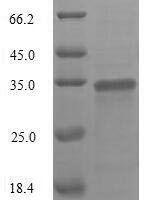
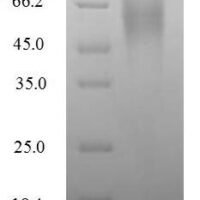
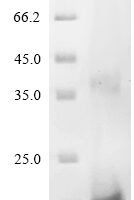
![Recombinant Rotavirus A Outer capsid glycoprotein VP7, Rotavirus A (strain RVA/Cow/Canada/C486/1977/G6P6[1]) (RV-A), E.coli, N-terminal 10xHis-tagged and C-terminal Myc-tagged, 36.0kDa, purity >85% as determined by SDS-PAGE.](https://www.biocrestsci.com/wp-content/uploads/protein/1/BCRECP-003708_SDS.jpg)
Function
Calcium-binding protein that interacts with rotavirus cell receptors once the initial attachment by VP4 has been achieved. Rotavirus attachment and entry into the host cell probably involves multiple sequential contacts between the outer capsid proteins VP4 and VP7, and the cell receptors. Following entry into the host cell, low intracellular or intravesicular Ca(2+) concentration probably causes the calcium-stabilized VP7 trimers to dissociate from the virion.
Biological Context
Subcellular Location: Virion; Host endoplasmic reticulum lumen
Product Specifications
Recombinant Rotavirus A Outer capsid glycoprotein VP7 is a recombinant protein from Rotavirus A (strain RVA/Cow/Canada/C486/1977/G6P6[1]) (RV-A), expressed in E.coli, covering amino acids 34-309aa, with N-terminal 10xHis-tagged and C-terminal Myc-tagged tag, molecular weight 36.0kDa, purity Greater than 85% as determined by SDS-PAGE.. Suitable for ELISA and Western Blot applications. Explore more Viral Antigen proteins →