Recombinant Synechococcus elongatus Circadian clock oscillator protein KaiA (kaiA)

Recombinant Synechococcus elongatus Circadian clock oscillator protein KaiA (kaiA) — KaiA binds oxidized quinones via its N-terminal PsR domain and is able to sense redox signals directly; quinone analog DBMIB (2,5-dibromo-3-methyl-6-isopropyl-p-benzoquinone) blocks KaiA stimulatio… Purity >95%.

SKU: BCRECP-003205 Category:

Product Specifications

Product SkuBCRECP-003205
Product DescriptionRecombinant Synechococcus elongatus Circadian clock oscillator protein KaiA (kaiA) Protein is expressed from E.coli with C-terminal 6xHis-tagged. It contains 1-284aa. [Accession | Q79PF6].
Uniprot No.Q79PF6
Gene NameskaiA
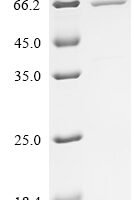
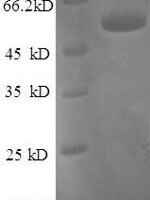
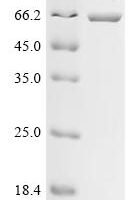
PurityGreater than 95% as determined by SDS-PAGE.
Expression SystemE.coli
Expression Region1-284aa
SpeciesSynechococcus elongatus (strain ATCC 33912 / PCC 7942 / FACHB-805) (Anacystis nidulans R2)
Tag InfoC-terminal 6xHis-tagged
Molecular weight39.6kDa
ActivityPlease contact us to obtain bioactivity data.
BufferIf the delivery form is liquid, the default storage buffer is Tris/PBS-based buffer, 5%-50% glycerol. If the delivery form is lyophilized powder, the buffer before lyophilization is Tris/PBS-based buffer, 6% Trehalose.
StorageStore at -20°C/-80°C upon receipt, aliquoting is necessary for mutiple use. Avoid repeated freeze-thaw cycles.
Research AreasOthers

Function

KaiA binds oxidized quinones via its N-terminal PsR domain and is able to sense redox signals directly; quinone analog DBMIB (2,5-dibromo-3-methyl-6-isopropyl-p-benzoquinone) blocks KaiA stimulation of KaiC phosphorylation. The homodimer binds up to 8 quinones in the crystal structure, 3 in the PsR domain and 1 via the C-terminal helical bundle. Binding of oxidized quinone to the KaiA C-terminal domain reduces the phosphorylation of KaiC slightly; quinones may interact in a complex manner with KaiA to mediate clock input.

Product Specifications

Recombinant Synechococcus elongatus Circadian clock oscillator protein KaiA (kaiA) is a recombinant protein from Synechococcus elongatus (strain ATCC 33912 / PCC 7942 / FACHB-805) (Anacystis nidulans R2), expressed in E.coli, covering amino acids 1-284aa, with C-terminal 6xHis-tagged tag, molecular weight 39.6kDa, purity Greater than 95% as determined by SDS-PAGE.. Suitable for ELISA and Western Blot applications.

Recommended applications depend on the target, product format, and product-specific validation data. Refer to the product datasheet or Certificate of Analysis (CoA), or contact BioCrest Sci for application guidance.

Biological Activity: Please contact us to obtain bioactivity data.

Storage: Store at -20°C/-80°C upon receipt, aliquoting is necessary for mutiple use. Avoid repeated freeze-thaw cycles.

Shipping & Lead Time: Availability, shipping conditions, and estimated lead time are confirmed in the formal quotation or order confirmation based on the product format, destination, and order requirements.

Protein Biology

Function

KaiA binds oxidized quinones via its N-terminal PsR domain and is able to sense redox signals directly; quinone analog DBMIB (2,5-dibromo-3-methyl-6-isopropyl-p-benzoquinone) blocks KaiA stimulation of KaiC phosphorylation (PubMed:20231482). The homodimer binds up to 8 quinones in the crystal structure, 3 in the PsR domain and 1 via the C-terminal helical bundle. Binding of oxidized quinone to the KaiA C-terminal domain reduces the phosphorylation of KaiC slightly; quinones may interact in a complex manner with KaiA to mediate clock input (PubMed:23020633)

Subunit

Homodimer (PubMed:15007067, PubMed:23020633, PubMed:26200123). The KaiABC complex composition changes during the circadian cycle to control KaiC phosphorylation. Complexes KaiC(6), KaiA(2-4):KaiC(6), KaiB(6):KaiC(6) and KaiC(6):KaiB(6):KaiA(12) are among the most important forms, many form cooperatively (PubMed:28302852, PubMed:34618577). The KaiA:KaiB complex is only found at 20-24 hours in the circadian cycle (subjective night) (PubMed:15347812). Binds to the C-terminal A-loop of KaiC via a coiled-coil structure (PubMed:26200123). KaiA and CikA compete for binding to KaiB(fs) (PubMed:26113641, PubMed:28302851). CikA copurifies with this protein in the clock complex (PubMed:17088557). Interacts with LdpA (PubMed:15775978)

Gene: kaiA  |  Organism: Synechococcus elongatus (strain ATCC 33912 / PCC 7942 / FACHB-805)
Key Publications

Frequently Asked Questions

How do I order or inquire about this product?

Submit the Online Inquiry form with your required quantity and specifications, or email sales@biocrestsci.com. Available sizes, pricing, stock status, documentation, and estimated lead time are confirmed in the formal quotation.

What is the shipping and delivery time?

Availability, dispatch timing, shipping conditions, and delivery estimates depend on the product format, destination, and order requirements. These details are confirmed in the formal quotation or order confirmation.

How should this product be stored?

Follow the storage and handling instructions in the product-specific datasheet and Certificate of Analysis (CoA). Requirements may vary by product form and formulation; contact BioCrest Sci if product-specific guidance is needed.

What quality controls are performed on your products?

Quality-control data such as identity, purity, endotoxin level, or biological activity are provided only when specified on this product page, the datasheet, or Certificate of Analysis (CoA). Biological activity is not implied unless explicitly stated.

Shopping Cart
Scroll to Top