Recombinant Human Bone morphogenetic protein 7 (BMP7),Partial (Active)

Recombinant Human Bone morphogenetic protein 7 (BMP7),Partial (Active) — Growth factor of the TGF-beta superfamily that plays important role in various biological processes, including embryogenesis, hematopoiesis, neurogenesis and skeletal morphogenesis. Purity >95%.

SKU: BCACP-001118 Category:
Product SKUBCACP-001118
Product DescriptionRecombinant Human Bone morphogenetic protein 7 (BMP7),Partial protein is expressed from Mammalian cell with Tag free. It contains M+316-431aa. [Accession | P18075].
Uniprot No.P18075
Gene NamesBMP-7
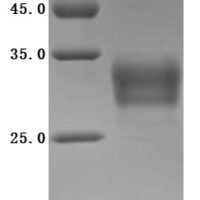
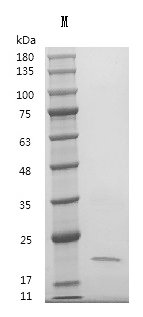
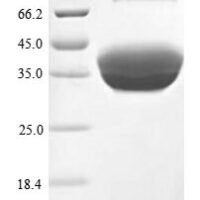
PurityGreater than 95% as determined by SDS-PAGE.
Expression SystemMammalian cell
Expression RegionM+316-431aa
SpeciesHomo sapiens (Human)
Tag InfoTag free
Molecular weight13.1 kDa
ActivityMeasured in a cell proliferation assay using NIH3T3 mouse embryonic fibroblast cells. The ED50 for this effect is 0.25-1 ng/mL
BufferLyophilized from a 0.2 μm filtered 20 mM Tris-HCl, 0.5 M NaCl, 6% Trehalose, pH 8.0
StorageStore at -20°C/-80°C upon receipt, aliquoting is necessary for mutiple use. Avoid repeated freeze-thaw cycles.
Alternative NamesBone morphogenetic protein 7; BMP-7; Osteogenic protein 1 (OP-1); Eptotermin alfa; BMP7; OP1

Function

Growth factor of the TGF-beta superfamily that plays important role in various biological processes, including embryogenesis, hematopoiesis, neurogenesis and skeletal morphogenesis. Initiates the canonical BMP signaling cascade by associating with type I receptor ACVR1 and type II receptor ACVR2A. Once all three components are bound together in a complex at the cell surface, ACVR2A phosphorylates and activates ACVR1.

Biological Context

Subcellular Location: Secreted
Tissue Specificity: Expressed in the kidney and bladder. Lower levels seen in the brain

Product Specifications

Recombinant Human Bone morphogenetic protein 7 (BMP7),Partial (Active) is a recombinant protein from Homo sapiens (Human), expressed in Mammalian cell, covering amino acids M+316-431aa, with Tag free tag, molecular weight 13.1 kDa, purity Greater than 95% as determined by SDS-PAGE.. Suitable for ELISA and Western Blot applications.

Recommended applications depend on the target, product format, and product-specific validation data. Refer to the product datasheet or Certificate of Analysis (CoA), or contact BioCrest Sci for application guidance.

Biological Activity: Measured in a cell proliferation assay using NIH3T3 mouse embryonic fibroblast cells. The ED50 for this effect is 0.25-1 ng/mL

Storage: Store at -20°C/-80°C upon receipt, aliquoting is necessary for mutiple use. Avoid repeated freeze-thaw cycles.

Shipping & Lead Time: Availability, shipping conditions, and estimated lead time are confirmed in the formal quotation or order confirmation based on the product format, destination, and order requirements.

Protein Biology

Function

Growth factor of the TGF-beta superfamily that plays important role in various biological processes, including embryogenesis, hematopoiesis, neurogenesis and skeletal morphogenesis (PubMed:31208997). Initiates the canonical BMP signaling cascade by associating with type I receptor ACVR1 and type II receptor ACVR2A (PubMed:12667445, PubMed:9748228). Once all three components are bound together in a complex at the cell surface, ACVR2A phosphorylates and activates ACVR1. In turn, ACVR1 propagates signal by phosphorylating SMAD1/5/8 that travel to the nucleus and act as activators and repressors of transcription of target genes (PubMed:12478285). For specific functions such as growth cone collapse in developing spinal neurons and chemotaxis of monocytes, also uses BMPR2 as type II receptor (PubMed:31208997). Can also signal through non-canonical pathways such as P38 MAP kinase signaling cascade that promotes brown adipocyte differentiation through activation of target genes, including members of the SOX family of transcription factors (PubMed:27923061). Promotes the expression of HAMP, this is repressed by its interaction with ERFE (PubMed:30097509)

Subcellular Location

Secreted

Tissue Specificity

Expressed in the kidney and bladder. Lower levels seen in the brain

Subunit

Homodimer; disulfide-linked (PubMed:8570652). Interacts with SOSTDC1 (PubMed:15020244). Interacts with TWSG1 (By similarity). Interacts with FBN1 (via N-terminal domain) and FBN2 (PubMed:18339631). Interacts with type I receptor ACVR1 (PubMed:9748228). Interacts with type II receptor ACVR2A (PubMed:12667445). Interacts with NOG; this interaction inhibits canonical BMP signaling (PubMed:12478285). Interacts with SCUBE3 (PubMed:33308444). Interacts with ERFE; the interaction inhibits BMP-induced transcription of HAMP (PubMed:30097509). Interacts with TGFBR3 (By similarity)

Gene: BMP7  |  Organism: Homo sapiens  |  Synonyms: Osteogenic protein 1
Key Publications

Frequently Asked Questions

How do I order or inquire about this product?

Submit the Online Inquiry form with your required quantity and specifications, or email sales@biocrestsci.com. Available sizes, pricing, stock status, documentation, and estimated lead time are confirmed in the formal quotation.

What is the shipping and delivery time?

Availability, dispatch timing, shipping conditions, and delivery estimates depend on the product format, destination, and order requirements. These details are confirmed in the formal quotation or order confirmation.

How should this product be stored?

Follow the storage and handling instructions in the product-specific datasheet and Certificate of Analysis (CoA). Requirements may vary by product form and formulation; contact BioCrest Sci if product-specific guidance is needed.

What quality controls are performed on your products?

Quality-control data such as identity, purity, endotoxin level, or biological activity are provided only when specified on this product page, the datasheet, or Certificate of Analysis (CoA). Biological activity is not implied unless explicitly stated.

Shopping Cart
Scroll to Top