Recombinant Human V-type proton ATPase subunit d 1 (ATP6V0D1)

Recombinant Human V-type proton ATPase subunit d 1 (ATP6V0D1) — Subunit of the V0 complex of vacuolar(H+)-ATPase (V-ATPase), a multisubunit enzyme composed of a peripheral complex (V1) that hydrolyzes ATP and a membrane integral complex (V0) that translocates p… Purity >90%.

SKU: BCRECP-000136 Category:

Product Specifications

Product SkuBCRECP-000136
Product DescriptionRecombinant Human V-type proton ATPase subunit d 1 (ATP6V0D1) Protein is expressed from E.coli with N-terminal GST-tagged. It contains 1-351aa. [Accession | P61421].
Uniprot No.P61421
Gene NamesATP6V0D1
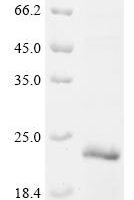
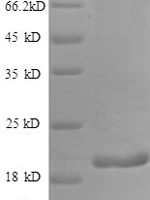
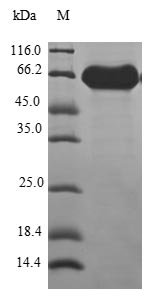
PurityGreater than 90% as determined by SDS-PAGE.
Expression SystemE.coli
Expression Region1-351aa
SpeciesHomo sapiens (Human)
Tag InfoN-terminal GST-tagged
Molecular weight67.3kDa
ActivityPlease contact us to obtain bioactivity data.
BufferIf the delivery form is liquid, the default storage buffer is Tris/PBS-based buffer, 5%-50% glycerol. If the delivery form is lyophilized powder, the buffer before lyophilization is Tris/PBS-based buffer, 6% Trehalose.
StorageStore at -20°C/-80°C upon receipt, aliquoting is necessary for mutiple use. Avoid repeated freeze-thaw cycles.
Research AreasSignal Transduction

Function

Subunit of the V0 complex of vacuolar(H+)-ATPase (V-ATPase), a multisubunit enzyme composed of a peripheral complex (V1) that hydrolyzes ATP and a membrane integral complex (V0) that translocates protons. V-ATPase is responsible for acidifying and maintaining the pH of intracellular compartments and in some cell types, is targeted to the plasma membrane, where it promotes acidification of the extracellular environment. The V-ATPase complex also acts as an activator for mTORC1 on lysosomal membrane by promoting the guanine nucleotide exchange factor (GEF) of the Ragulator complex, thereby enabling mTORC1 recruitment.

Biological Context

Subcellular Location: Membrane (Peripheral membrane protein); Lysosome membrane (Peripheral membrane protein); Cytoplasmic vesicle, clathrin-coated vesicle membrane (Peripheral membrane protein)
Tissue Specificity: Ubiquitous

Product Specifications

Recombinant Human V-type proton ATPase subunit d 1 (ATP6V0D1) is a recombinant protein from Homo sapiens (Human), expressed in E.coli, covering amino acids 1-351aa, with N-terminal GST-tagged tag, molecular weight 67.3kDa, purity Greater than 90% as determined by SDS-PAGE.. Suitable for ELISA and Western Blot applications.
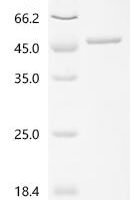
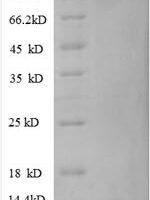
SDS-PAGE: Single band at expected molecular weight confirming purity.

ELISA: Suitable as coating antigen or detection standard.

Western Blot: Compatible with standard Western Blot protocols.

Protein Interaction: Validated for SPR (Surface Plasmon Resonance) and BLI (Bio-Layer Interferometry) studies.

Shipping: Shipped at ambient temperature. Lyophilized protein is stable during transit.

Storage: Store lyophilized protein at -20°C to -80°C. Reconstituted protein should be aliquoted and stored at -80°C. Avoid repeated freeze-thaw cycles.

Shelf Life: 12 months from date of receipt when stored as recommended.

Shipping Time: Orders placed before 2 PM EST ship same day. International orders typically deliver within 5-10 business days.

Protein Biology

Function

Subunit of the V0 complex of vacuolar(H+)-ATPase (V-ATPase), a multisubunit enzyme composed of a peripheral complex (V1) that hydrolyzes ATP and a membrane integral complex (V0) that translocates protons (PubMed:28296633, PubMed:30374053, PubMed:33065002). V-ATPase is responsible for acidifying and maintaining the pH of intracellular compartments and in some cell types, is targeted to the plasma membrane, where it promotes acidification of the extracellular environment (PubMed:30374053). The V-ATPase complex also acts as an activator for mTORC1 on lysosomal membrane by promoting the guanine nucleotide exchange factor (GEF) of the Ragulator complex, thereby enabling mTORC1 recruitment (PubMed:22053050). May play a role in coupling of proton transport and ATP hydrolysis (By similarity). In aerobic conditions, involved in intracellular iron homeostasis, thus triggering the activity of Fe(2+) prolyl hydroxylase (PHD) enzymes, and leading to HIF1A hydroxylation and subsequent proteasomal degradation (PubMed:28296633). May play a role in cilium biogenesis through regulation of the transport and the localization of proteins to the cilium (By similarity)

Subcellular Location

Membrane (Peripheral membrane protein); Lysosome membrane (Peripheral membrane protein); Cytoplasmic vesicle, clathrin-coated vesicle membrane (Peripheral membrane protein)

Tissue Specificity

Ubiquitous

Subunit

V-ATPase is a heteromultimeric enzyme made up of two complexes: the ATP-hydrolytic V1 complex and the proton translocation V0 complex (PubMed:33065002). The V1 complex consists of three catalytic AB heterodimers that form a heterohexamer, three peripheral stalks each consisting of EG heterodimers, one central rotor including subunits D and F, and the regulatory subunits C and H (PubMed:33065002). The proton translocation complex V0 consists of the proton transport subunit a, a ring of proteolipid subunits c9c'', rotary subunit d, subunits e and f, and the accessory subunits ATP6AP1/Ac45 and ATP6AP2/PRR (PubMed:33065002). Interacts with ATP6AP2; ATP6AP2 is a V-ATPase accessory protein and the interaction promotes v-ATPase complex assembly (PubMed:30374053). Interacts with TMEM9; TMEM9 is a v-ATPase assembly regulator and the interaction induces the interaction with ATP6AP2 (PubMed:30374053). Interacts with PIP4P1 (PubMed:29644770)

Gene: ATP6V0D1  |  Organism: Homo sapiens  |  Synonyms: 32 kDa accessory protein; V-ATPase 40 kDa accessory protein; V-ATPase AC39 subunit; Vacuolar proton pump subunit d 1
Key Publications

Frequently Asked Questions

How do I order or inquire about this product?

Fill out the Online Inquiry form with your required quantity and specifications. You can also email sales@biocrestsci.com. Our team typically responds within 4 business hours with a quote and availability confirmation.

What is the shipping and delivery time?

Orders placed before 2 PM EST ship the same day. Domestic (US) delivery typically takes 2-3 business days. International orders deliver within 5-10 business days. All products are shipped at ambient temperature with appropriate packaging to ensure stability.

How should I store this recombinant protein?

Lyophilized proteins should be stored at -20°C to -80°C upon receipt. After reconstitution, aliquot and store at -80°C. Avoid repeated freeze-thaw cycles. Shelf life is 12 months from date of receipt when stored as recommended.

What quality controls are performed on your products?

Each product undergoes SDS-PAGE purity analysis (typically >85-95%), endotoxin testing, and bioactivity validation. Products are validated for ELISA, Western Blot, and SPR/BLI applications as specified on this product page. A Certificate of Analysis (CoA) is available upon request.

Shopping Cart
Scroll to Top