,

Recombinant Mouse Tumor necrosis factor receptor superfamily member 14 (Tnfrsf14), partial (Active)

Recombinant Mouse Tumor necrosis factor receptor superfamily member 14 (Tnfrsf14), partial (Active) — Receptor for four distinct ligands: The TNF superfamily members TNFSF14/LIGHT and homotrimeric LTA/lymphotoxin-alpha and the immunoglobulin superfamily members BTLA and CD160, altogether defining…

SKU: BCACP-001286 Categories: ,
Product SKUBCACP-001286
Product DescriptionRecombinant Mouse Tumor necrosis factor receptor superfamily member 14 (Tnfrsf14) protein is expressed from Mammalian cell with C-terminal hFc-tagged. It contains 39-207aa. [Accession | Q80WM9].
Uniprot No.Q80WM9
Gene NamesTnfrsf14
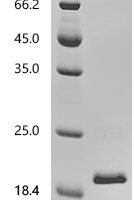
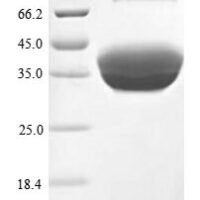
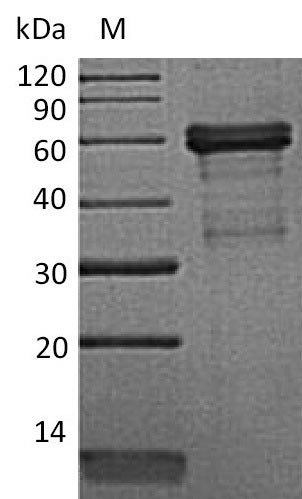
PurityGreater than 95% as determined by SDS-PAGE.
Expression SystemMammalian cell
Expression Region39-207aa
SpeciesMus musculus (Mouse)
Tag InfoC-terminal hFc-tagged
Molecular weight45.6 kDa
ActivityThe ED50 as determined by its ability to bind Human BTLA in functional ELISA is typically 1.17 ug/ml
BufferLyophilized from a 0.2 μm filtered 20 mM Tris-HCl, 0.5 M NaCl, 6% Trehalose, pH 8.0
StorageStore at -20°C/-80°C upon receipt, aliquoting is necessary for mutiple use. Avoid repeated freeze-thaw cycles.
Alternative NamesTnfrsf14; hvem; Tumor necrosis factor receptor superfamily member 14; Herpes virus entry mediator A; Herpesvirus entry mediator A; HveA; Tumor necrosis factor receptor-like 2; TR2; CD antigen CD270

Function

Receptor for four distinct ligands: The TNF superfamily members TNFSF14/LIGHT and homotrimeric LTA/lymphotoxin-alpha and the immunoglobulin superfamily members BTLA and CD160, altogether defining a complex stimulatory and inhibitory signaling network. Signals via the TRAF2-TRAF3 E3 ligase pathway to promote immune cell survival and differentiation. Participates in bidirectional cell-cell contact signaling between antigen presenting cells and lymphocytes.

Product Specifications

Recombinant Mouse Tumor necrosis factor receptor superfamily member 14 (Tnfrsf14), partial (Active) is a recombinant protein, expressed in Mammalian cell, covering amino acids 39-207aa, with C-terminal hFc-tagged tag, molecular weight 45.6 kDa, purity Greater than 95% as determined by SDS-PAGE.. Suitable for ELISA and Western Blot applications.

Recommended applications depend on the target, product format, and product-specific validation data. Refer to the product datasheet or Certificate of Analysis (CoA), or contact BioCrest Sci for application guidance.

Biological Activity: The ED50 as determined by its ability to bind Human BTLA in functional ELISA is typically 1.17 ug/ml

Storage: Store at -20°C/-80°C upon receipt, aliquoting is necessary for mutiple use. Avoid repeated freeze-thaw cycles.

Shipping & Lead Time: Availability, shipping conditions, and estimated lead time are confirmed in the formal quotation or order confirmation based on the product format, destination, and order requirements.

Protein Biology

Function

Receptor for four distinct ligands: The TNF superfamily members TNFSF14/LIGHT and homotrimeric LTA/lymphotoxin-alpha and the immunoglobulin superfamily members BTLA and CD160, altogether defining a complex stimulatory and inhibitory signaling network (By similarity). Signals via the TRAF2-TRAF3 E3 ligase pathway to promote immune cell survival and differentiation (PubMed:19915044). Participates in bidirectional cell-cell contact signaling between antigen presenting cells and lymphocytes. In response to ligation of TNFSF14/LIGHT, delivers costimulatory signals to T cells, promoting cell proliferation and effector functions (By similarity). Interacts with CD160 on NK cells, enhancing IFNG production and anti-tumor immune response (PubMed:25711213). In the context of bacterial infection, acts as a signaling receptor on epithelial cells for CD160 from intraepithelial lymphocytes, triggering the production of antimicrobial proteins and pro-inflammatory cytokines (PubMed:22801499). Upon binding to CD160 on activated CD4+ T cells, down-regulates CD28 costimulatory signaling, restricting memory and alloantigen-specific immune response (By similarity). May interact in cis (on the same cell) or in trans (on other cells) with BTLA (PubMed:15568026, PubMed:19915044). In cis interactions, appears to play an immune regulatory role inhibiting in trans interactions in naive T cells to maintain a resting state. In trans interactions, can predominate during adaptive immune response to provide survival signals to effector T cells (PubMed:15568026, PubMed:19915044)

Gene: Tnfrsf14  |  Organism: Mus musculus

Frequently Asked Questions

How do I order or inquire about this product?

Submit the Online Inquiry form with your required quantity and specifications, or email sales@biocrestsci.com. Available sizes, pricing, stock status, documentation, and estimated lead time are confirmed in the formal quotation.

What is the shipping and delivery time?

Availability, dispatch timing, shipping conditions, and delivery estimates depend on the product format, destination, and order requirements. These details are confirmed in the formal quotation or order confirmation.

How should this product be stored?

Follow the storage and handling instructions in the product-specific datasheet and Certificate of Analysis (CoA). Requirements may vary by product form and formulation; contact BioCrest Sci if product-specific guidance is needed.

What quality controls are performed on your products?

Quality-control data such as identity, purity, endotoxin level, or biological activity are provided only when specified on this product page, the datasheet, or Certificate of Analysis (CoA). Biological activity is not implied unless explicitly stated.

Shopping Cart
Scroll to Top